Early Citrus Harvest in Northern Jordan Valley Sparks Debate Over Profit and Quality
Published By Arab Hub Post Staff
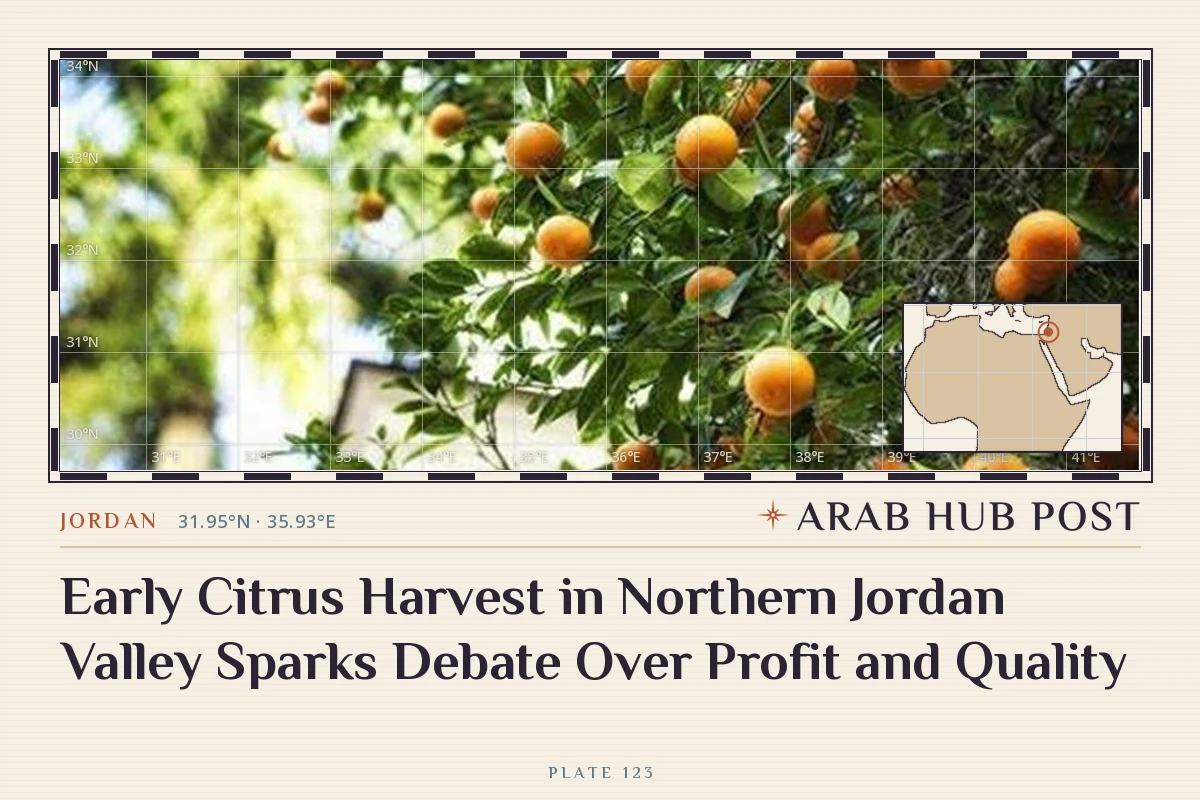
In Jordan, farmers in the Northern Jordan Valley have begun picking part of their citrus crop ahead of the usual timetable, even though officials repeatedly warn against sending unripe fruit to market.
This early picking sits between growers’ wish for quick cash to cover rising expenses and the agriculture department’s demand that fruit reach full maturity and quality before sale, leaving the season in the valley poised between economic pressure and technical caution.
Early harvest pressures
Some growers argue that waiting for full ripeness yields better fruit and steadier prices, while others contend that harvesting early offers a chance to secure solid returns amid volatile market conditions and urgent cash‑flow needs.
Farmer Ali Abu Zeina says that harvest timing is influenced by economic factors; growers consider not just the fruit on the tree but also the outlays incurred since the season started, the potential market earnings, and whether a later pick would actually bring a higher return.
“Farmers do not look only at the fruit on the tree; they also calculate how much they have spent since the beginning of the season, what they can earn in the market, and whether waiting longer will actually generate a higher return.”
He notes that these calculations grow more complicated as production costs rise, forcing a choice between letting the fruit mature fully while bearing extra costs and risks, or starting the harvest when the market appears able to absorb the crop at a profitable price.
Some farmers maintain that picking at this stage can deliver the profits they seek, especially when demand for particular varieties is strong or when direct sales fetch better prices than those expected later in the peak of the season.
Balancing profit and quality
Farmer Khaled Al-Bashtawi cautions that this approach puts the onus on producers to safeguard product standards, warning that quick gains from an early sale may not be real if they undermine quality or consumer trust.
He stresses that growers must stay aware of market shifts and the prices their fruit commands at different points in the season, noting that citrus is perishable and prolonged delay also carries a cost.
He explains that early‑season demand can allow part of the crop to be sold for income rather than waiting for prices to drop as supply rises, but he adds that harvesting early does not automatically mean every variety or every fruit is ready for market; it is essential to separate fruit that has met maturity indicators from that which still needs time.
“This is where agricultural guidance becomes important, as it can help farmers determine the appropriate harvesting time for each variety rather than applying a single schedule to all trees and fruit,” Al-Bashtawi says.
He adds that citrus is not just a seasonal crop but an economic lifeline and a primary source of livelihood for thousands of families in the area.
Official advice and regional context
Farmer Mohammad Khader describes citrus producers as juggling competing demands: they must produce high‑quality fruit while covering costs and earning a return from a growing season that has already lasted months.
He argues that debates about early picking should consider the growers’ overall situation rather than focusing solely on fruit maturity.
Growers incur expenses for irrigation, upkeep and labour while contending with weather swings, pest threats and price uncertainty, naturally seeking the optimal moment to convert harvest into income.
Khader insists that product quality cannot be compromised; sending substandard fruit to market could hurt producers over the long term and tarnish the reputation of local produce.
Quality is non‑negotiable.
While agricultural authorities warn against rushing fruit to market before it reaches the proper stage of maturity, officials stress that maintaining fruit standards is not a minor detail but a fundamental requirement for supporting national produce.
These warnings come as citrus remains one of the leading crops in the Northern Jordan Valley, with large tracts devoted to its cultivation. Published figures show that the agricultural land in the Northern Jordan Valley District totals about 118,000 dunums, of which roughly 66,000 dunums are planted with citrus, underscoring the sector’s importance to the regional economy and to farmers’ livelihoods.
Northern Jordan Valley Agriculture Director Engineer Mohammad Al‑Naim urges farmers to follow technical recommendations and sound agricultural practices that preserve production quality and sustainability.
He says the directorate continues to provide agricultural guidance and raise awareness about crop management and irrigation, especially during the heat waves and heat stress affecting the region.
He explains that marketing difficulties, falling citrus prices or declining quality affect not only farmers but also workers, traders, transport operators, markets and every other link in the agricultural supply chain.
“We are counting on farmers’ awareness of the need to preserve production quality, which is particularly important in a market where local and imported products compete,” he says.
The General Union of Jordanian Farmers has also called on growers to adopt proper harvesting habits and to ensure that fruit is mature and free of blemishes so as to obtain fair prices and avoid marketing bottlenecks.
The union stresses that agricultural profit is not measured merely by how fast a crop is sold, but by the ability to produce high‑quality fruit, sell it at a fair price and keep consumer confidence in local produce.
It further highlights the need to strengthen field‑based agricultural guidance so that growers can base harvesting decisions on genuine maturity indicators, aiming to secure fair returns today while protecting the reputation and long‑term sustainability of local citrus.
The report was published by Al‑Ghad, with reporting by Ola Abdel Latif.