
Egyptian Scholar Explores How Institutions Shape Success During New York Visit
Published By Regional Desk
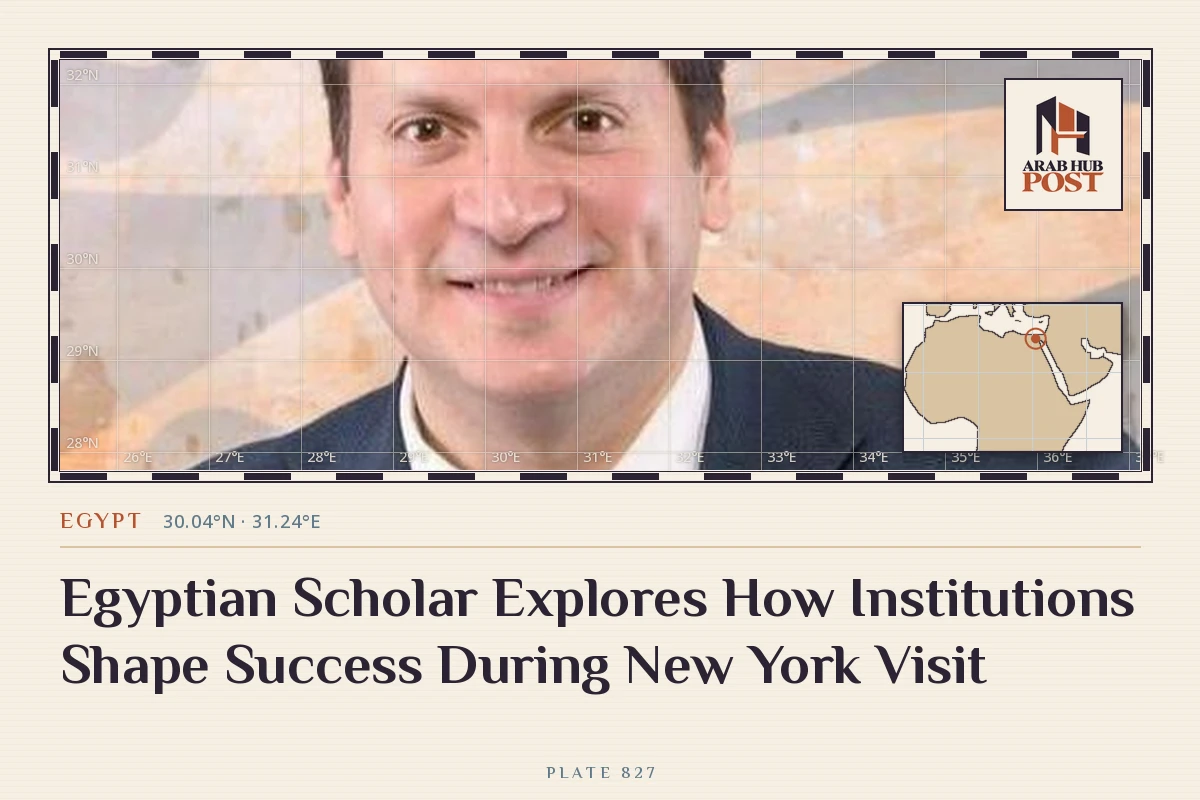
Personal trajectory and perspective
Dr Ramy Galal explains that every journey leaves a different mark on him, with some trips ending in photographs and fleeting memories while others return him with new questions about themselves and the world. He says travel has never been merely a movement across geography but another way of learning and a chance to test ideas beyond the borders where they first formed.
He recalls writing that he had seen the world from both sides, a line that became the title of one of his books and also described his long personal and professional experience. After studying science and then the humanities, he worked in journalism and academia, in both the private and public sectors, and experienced executive and legislative institutions. He came close to opposition politics and later to government. These varied paths did not give him final answers but gave him a wider ability to look at things from more than one angle.
Lessons from Germany and the United States
Over the past years he has travelled extensively and found in certain countries something close to a mirror that helps us understand ourselves. Germany, for example, left a deep impression not only because of its economic strength or administrative discipline but because it knows how to turn memory into an institution and historical experience into public awareness.
The United States, meanwhile, has remained for him a particularly rich space for understanding the relationship between the individual and the institution, between talent and opportunity, and between personal ambition and the wider environment that allows such ambition to grow.
New York visit and research plan
This is why he returns to New York this month for two weeks. It will be his sixth or perhaps seventh visit to the city, and this time the journey brings together several threads: his old passion for travel and travel writing, his journalistic work, and his growing interest in what he often calls the “governance of meaning”. He wants to understand how societies produce their stories of success, how they choose their inspiring models, and how an individual biography can become a broader lesson in administration, culture, and institutions.
During this visit he plans to conduct a series of conversations and interviews with Egyptians and Egyptian-Americans who have succeeded in universities, research centres, professional institutions and other fields of work. He is interested in their personal stories, but he is even more interested in the environment that made such success possible. He notes that talent alone is rarely enough; a good seed needs suitable soil, water, light and a safe space in which to grow. Without these conditions the seed may retain its quality yet fail to flourish.
Institutional factors and comparative outlook
He observes that many Egyptians who have achieved remarkable success abroad were not born with abilities fundamentally different from those of their peers at home. The more important difference often lies in institutions: in the clarity of rules, fairness of evaluation, respect for time, protection of initiative, and the ability to turn individual effort into a stable professional path. These are not minor administrative details; they are the difference between a society that consumes its talent and one that knows how to invest in it.
He says he is not interested in an easy comparison between Egypt and the United States, nor in the lazy habit of glorifying the outside world or condemning our own reality. What interests him is understanding. He believes we move forward when we have the quiet courage to place experience on the table of analysis: what worked, what failed, what can be transferred, and what needs a different context in order to function.
Scope and broader vision
He acknowledges that two weeks in New York may not be enough to understand a city of such scale or a society of such complexity, but they are enough to catch the threads of stories worth telling. Between interviews, long walks and careful observation of people and institutions he will try to write about Egyptians who carried with them a part of their homeland and then reshaped that part within a new environment.
He adds that perhaps this project will become a chapter in a wider book he has been carrying in his mind for years: a book about how he sees the world through travel, experience and encounters with institutions. Travel, at its core, is not a departure from one’s homeland but a return to it by a longer route. We see others, and then we see ourselves more clearly. We discover what we have, what we lack, and what we can change when we treat success and failure as outcomes that can be understood, rather than sealed destinies.
From New York he will try to search for this space in particular: the space in which the Egyptian individual stands between an original memory and a new opportunity, between old roots and institutions that have rearranged the path ahead. In that space we may find more than the story of a successful immigrant; we may find a small lesson in the meaning of the state, the meaning of institutions, and the meaning of giving talent a fair chance to become added value rather than wasted energy.
Dr Ramy Galal is a governance and institutional reform specialist focusing on state capacity, accountability and the design of effective public institutions, with an interest in the governance of meaning.


Reader comments
No comments on this report yet.