
Egypt’s FRA Hosts Tunisian Delegation to Boost Non‑Bank Finance Cooperation
Published By Regional Desk
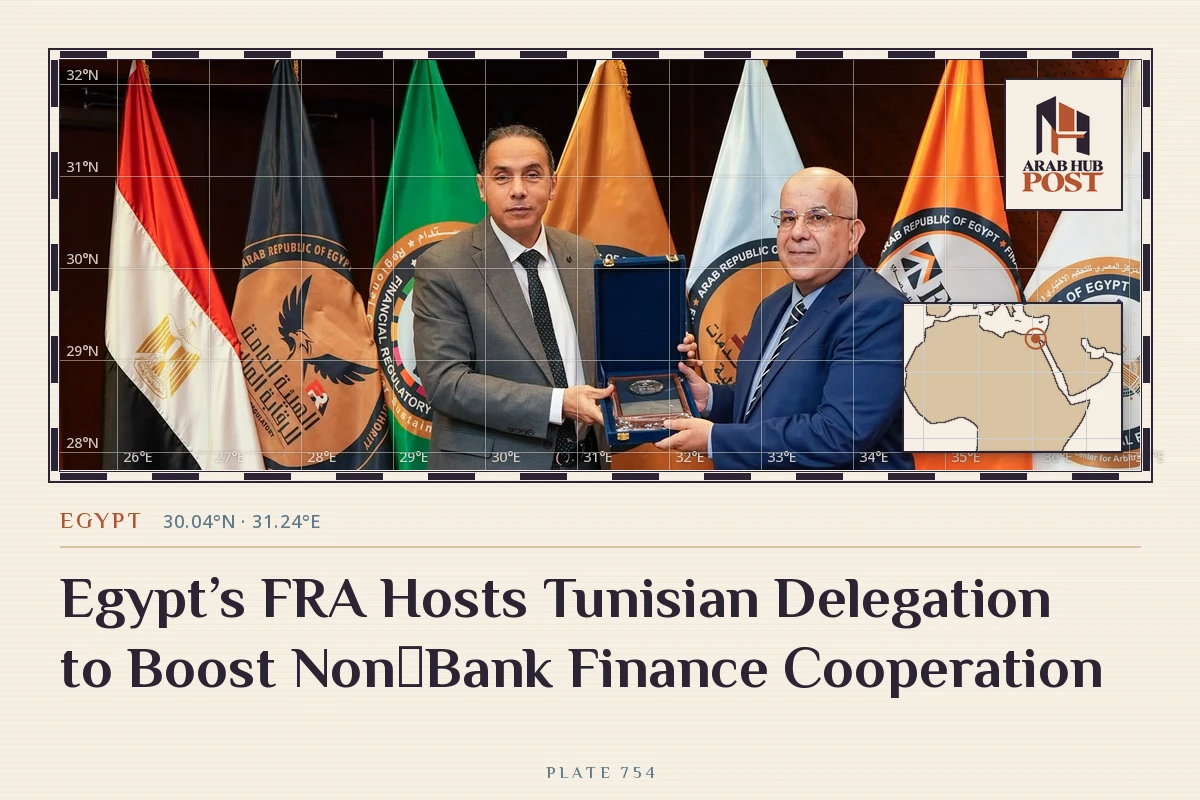
Egypt’s Financial Regulatory Authority (FRA) welcomed a delegation from Tunisia’s Microfinance Supervisory Authority for talks on strengthening bilateral cooperation in non‑bank finance.
The engagement forms part of wider efforts to align regulatory practices across North Africa.
Meeting objectives and FRA priorities
FRA Chairperson Islam Azzam met with Mahmoud El-Montasser Mansour, Executive Director‑General and founder of Tunisia’s Microfinance Supervisory Authority, alongside FRA Assistant Chairperson Rehab Taha.
The session aimed to deepen bilateral ties, exchange regulatory and supervisory expertise in the non‑bank sector, and support market development, efficiency and sustainability.
According to Azzam, the FRA places high value on cooperation with fellow Arab and African nations, treating the sharing of expertise and dissemination of knowledge as a top priority.
He noted that the authority is eager to offer Egypt’s institutional and regulatory experience in overseeing non‑bank financial activities while also learning from the experiences of other countries.
Egypt’s non‑bank finance landscape
Azzam explained that non‑bank financing for enterprises is a key sector under the FRA’s remit because it reaches the vast majority of citizens.
He linked this activity to financial inclusion, a goal of Egypt Vision 2030 and the state’s plan to advance the national economy, and highlighted its expected positive effect on vulnerable groups, underscoring its role in sustainable economic and social development.
He pointed out notable growth in outstanding financing balances for medium, small and micro enterprises in recent years, with the combined total exceeding EGP 101 billion in the second quarter of 2026.
This financing benefited roughly 3.5 million people through about 4,400 outlets operated by licensed entities such as companies, associations and institutions across the country.
Azzam said the FRA has recently focused on improving the financing experience of beneficiaries, especially micro‑enterprises.
Measures include tightening standards for assessing clients’ repayment capacity to lower default rates, ensuring clear information and data protection, and encouraging providers to create innovative products that meet client needs.
The authority also works to make sure clients can effectively use available mechanisms to appeal decisions or lodge complaints, and to assess the tangible impact of financing on their lives and economic activities.
Further, the FRA chair highlighted recent decisions aimed at regulating debt collection practices and preventing misconduct, strengthening customer identity verification procedures, and enhancing the authority’s early‑risk detection to curb individual defaults.
Additional steps target improving the financial solvency of firms and entities in the sector and promoting the development of new products using financial technology to keep up with market shifts and changing customer circumstances.
Tunisia’s microfinance overview and joint discussions
Mansour traced the evolution of Tunisia’s microfinance sector since regulation began in 1999, noting the initial focus on associations, the restructuring in 2011, and the later introduction of supervision over commercial microfinance institutions.
He outlined the authority’s role since 2012 in regulating pricing and monitoring financing costs, and described the latest measures taken the previous year, which involved reviewing the prices of certain products offered by the seven licensed companies and 289 licensed microcredit associations operating in the sector.
Mansour stated that more than 856,000 clients currently benefit from microfinance in Tunisia.
In 2025, financing worth approximately TND 2.7 billion – equivalent to EGP 47.1 billion – was extended, reflecting continued expansion, and the number of financing transactions surpassed 524,000.
The meeting also covered the development of financial products and the diversification of financing instruments.
Discussions included both countries’ experiences with digital transformation, fintech applications, the use of artificial intelligence in supervisory tools, and modern mechanisms for risk management, compliance and consumer protection aimed at boosting the efficiency of activities of mutual interest.
Reader comments
No comments on this report yet.