Jordan Ride-Hailing Market Enters New Oversight Phase with Field Inspections
Published By Arab Hub Post Staff
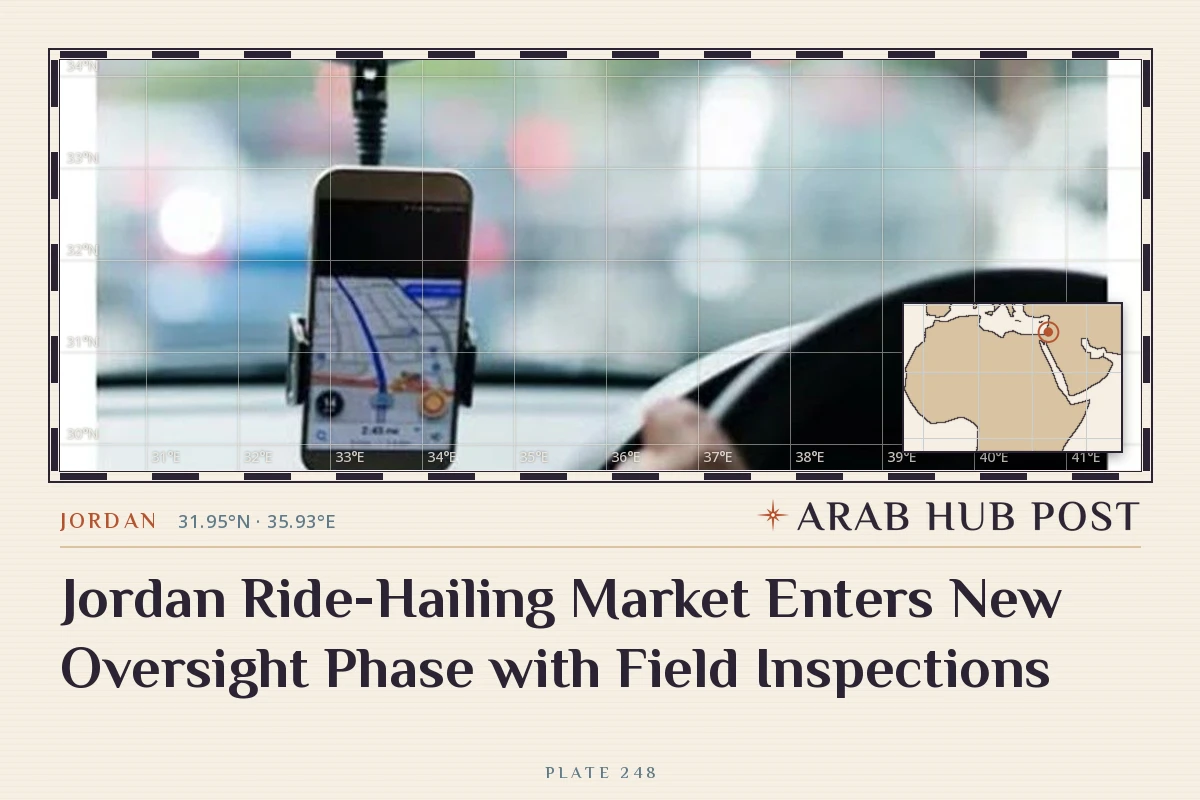
Amman — Jordan’s ride-hailing market enters a stricter oversight phase today as the Land Transport Regulatory Commission launches a field inspection campaign. The focus moves from regularising company and driver status to verifying actual compliance with fare rules, vehicle licensing, and driver permits.
The campaign coincides with efforts by the commission and licensed companies to meet the requirements of the 2025 Passenger Transport Regulation through Smart Applications No. 74. Licensed drivers have urged stronger oversight to ensure fair competition and protect their interests, while companies believe that clamping down on unlicensed operations could boost the number of trips received by compliant drivers.
Industry observers say the new measures go beyond detecting violations; their success hinges on achieving lasting compliance through a mix of monitoring, financial penalties, and incentives for companies that demonstrate high adherence.
The commission recently held an executive meeting with representatives of seven licensed smart-app companies: Uber, Careem, Jeeny, Petra Ride, Gojo, Taxi F and CAB. The parties agreed on measures covering fares, vehicle licensing, driver permits and field inspections.
According to the commission, inspection teams will begin ordering actual rides through the applications from today to check two conditions: the vehicle must be licensed for the sector, and the driver must hold the required permit.
The commission has set up a mechanism linking the number of violations to financial penalties for companies. Ten violations in one week involving vehicle licensing or driver permits lead to a JD5,000 deduction from the company’s guarantee. More than 20 violations in a single week result in a JD10,000 deduction.
A violation related to the approved fare leads to a JD50,000 deduction from the company’s JD100,000 guarantee, the commission said.
Fare oversight has gained importance after the commission confirmed that the 2025 instructions use the standard taxi fare plus 20% as the applicable tariff. The commission stressed that the 20% is a calculation method, not a separate new increase.
Drivers: Oversight Protects Compliant Operators
Yousef Abu Odeh, an app-based driver and advocate for drivers’ rights, said licensed drivers welcome tighter oversight. He noted that the new measures expand responsibility to companies and their registration of drivers who meet conditions, rather than focusing solely on individual drivers.
Abu Odeh said continuous oversight of companies is needed to ensure compliance and protect the rights of licensed drivers and passengers. Employing drivers without permits puts compliant drivers at an unfair disadvantage, especially since they bear the costs of permits and legal operations.
According to Abu Odeh, driver licensing costs can reach around JD600 in his estimate, plus an annual JD20 fee. He called for more facilities for licensed drivers, reduced financial burdens, and a review of the operational age limit for vehicles.
Driver Mahmoud Qweider said licensing is essential to protect both drivers and passengers, particularly in accidents or disputes over rights. However, he pointed to challenges for applicants, including requirements on vehicle age and the number of years a driver has held a licence.
Qweider called for a more flexible mechanism allowing drivers who meet requirements to work legally through apps. He proposed a unified annual subscription enabling drivers to operate on multiple apps rather than being tied to a single platform.
Companies: Curbing Unlicensed Activity Benefits Compliant Drivers
Mohammad Abu Tayeh, operations manager at Petra Ride, said the company supports inspection campaigns aimed at regulating the market, describing them as beneficial to licensed companies and drivers and helpful in tackling unlicensed activity.
He said the latest measures were coordinated between the commission and licensed app companies to regulate the market and protect drivers’ rights. Drivers who meet licensing requirements and bear associated costs should benefit from a more regulated market, he added.
Abu Tayeh said reducing the activity of unlicensed operators could increase the share of trips received by licensed drivers and improve their incomes. He noted that his company offers facilities and incentives to licensed drivers, including reduced commission rates on certain trips and other incentives.
He added that several previous challenges had been resolved through cooperation between the commission and other authorities, including lifting previous limits on the number of companies and opening licensing to any company meeting requirements without a specific numerical cap.
Jeeny, responding to questions from Al-Ghad, welcomed the commission’s efforts to regulate the sector. The company said it remains committed to legally approved fares and continues to meet regulatory requirements related to drivers and vehicles.
Jeeny said it had achieved an advanced level of driver licensing and, according to its statement, has the largest number of drivers meeting legal requirements in the market. It stressed that it would continue working to maintain high compliance levels.
At the same time, Jeeny called for consideration of the impact of fares on passengers, especially daily users, to strike a balance between sector sustainability and affordability.
The company said clear requirements applied consistently and fairly to all market participants, along with a combination of oversight and incentives, would strengthen compliance and create a more stable and organised environment for companies and drivers, ultimately improving service quality for passengers.
It added that incentivising companies with high compliance would encourage continued investment in regulatory compliance and service development.
Jeeny identified the spread of unlicensed applications as one of the main challenges to market regulation. Their continued operation creates unfair competition with licensed companies that bear compliance costs, while the absence of regulatory frameworks and complaint mechanisms could pose risks to passengers’ rights.
The company called for stronger coordination between the commission and relevant government agencies to take enforcement measures aimed at limiting unlicensed app operations.
From Penalties to Incentives
The new mechanism is not limited to penalties. The commission plans to publish the names of companies achieving high compliance levels on its website, along with details of their progress in licensing vehicles and issuing driver permits.
The move aims to use incentives alongside oversight to encourage companies to complete the process of correcting their regulatory status.
The commission has also allowed companies with more than 3,000 drivers to make advance payments to register batches of 250 drivers instead of 1,000 per batch, to facilitate gradual completion of registration procedures.
The new campaign builds on regulatory efforts launched earlier this year. In May, a commission oversight committee met with representatives of the Ministry of Interior, the Public Security Directorate, the Cybercrime Unit, the Ministry of Local Administration, the Companies Control Department and sector representatives to discuss ways of addressing applications and pages offering passenger transport services outside the licensing framework.
The key test for the new campaign will be reflected in the results of field inspections once they begin—not only in the number of violations recorded, but also in changes in the percentage of licensed vehicles and permitted drivers, the number of fare-related complaints and the extent to which unlicensed activity declines.
The smart-app market is therefore gradually moving from a phase of expanding licensing opportunities and correcting regulatory status to one focused on measuring compliance on the ground. The extent to which companies respond and the results of the inspection campaigns in the coming period will determine whether the new measures can establish a more organised market that protects the rights of passengers, drivers and companies alike.