
Libya’s Central Bank Governor Naji Issa Removed in Forcible Takeover
Published Updated By Arab Hub Post Staff
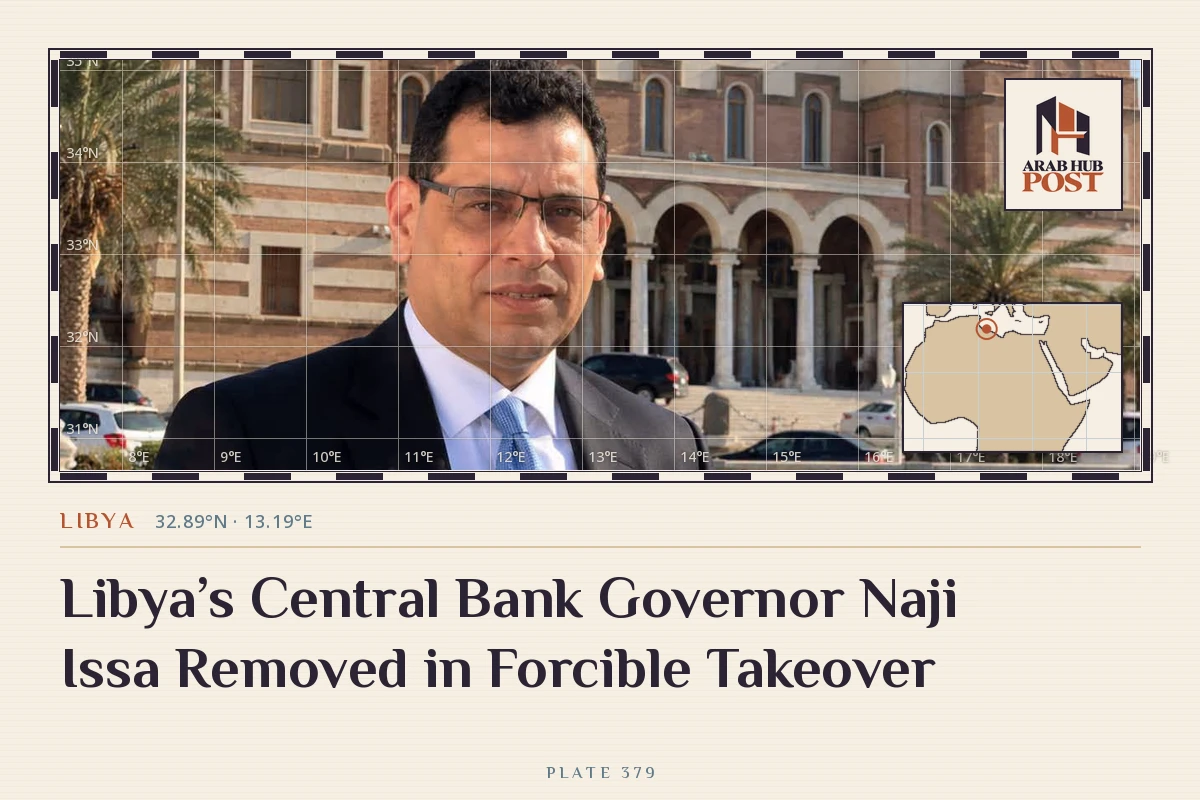
Libya’s Central Bank Governor Naji Issa has been removed from his post in a swift, forcible transition that saw security forces enter the bank’s headquarters in Tripoli and install a new governor, the latest upheaval in a country scarred by political turmoil since the 2011 revolution that ended Muammar Qaddafi’s 42-year rule.
Forcible Installation of New Governor
Video footage, reports and leaked statements emerged at midday on the day of the takeover, showing security personnel entering the Central Bank of Libya (CBL) and facilitating the appointment of a new governor. The newly installed governor was identified as Fawzi Abu Khazam, a member of the CBL’s board of directors who hails from the Al-Shati area near Sebha. Analysts describe him as a neutral choice in the polarized east-west political landscape of Libya.
Abu Khazam arrived at the CBL in Tripoli accompanied by a committee from the House of Representatives (HoR) and the High State Council (HSC) and was installed in the governor’s office by force, according to local accounts.
Issa’s Resignation and Spending Disputes
The takeover was followed by an announcement from the HoR that it had accepted Issa’s resignation, which he had originally tendered in August 2026. At the time, both the HoR and the HSC had rejected that resignation, and had ostensibly agreed to Issa’s demand that both the Tripoli and Benghazi regimes respect the US-brokered Unified Spending Agreement.
Issa had complained that both regimes were overspending, overheating the economy, weakening the Libyan dinar and depleting foreign currency reserves. His attempt to curb political spending—subsidising election campaigns of the Aldabaiba and Haftar regimes—appears to have contributed to his removal. On the day of the takeover, he told local media that he had come under pressure over his efforts to control spending.
Read also: Libya’s Energy Sector Rebounds as US Firms Stay on the Sidelines
Critics also point to Issa’s failure to defend the Libyan dinar on the parallel foreign exchange market. He had vowed initially to bring the exchange rate below 7 Libyan dinars per US dollar, and later below 9 dinars per dollar, but most of the week before his removal saw the dollar trading above 10 dinars. Economist defenders argue that it is the governments in the west and east that have overspent, not the CBL governor.
Political Reactions and Legal Questions
The HoR’s rejection of Issa’s resignation in August came under the speakership of Ageela Saleh; the parliament is now led by Al-Salheen Abdel Nabi, reflecting a policy shift and new domestic and international dynamics that may have led to Issa’s ouster. Both the HoR and the HSC, acting under the UN-brokered Libyan Political Agreement signed in Skhirat, Morocco on 17 December 2015, agreed that Issa must go and Abu Khazam should take over. The move appears to have put de facto ahead of de jure, with the two bodies taking advantage of Issa’s absence to install Abu Khazam quickly as interim governor pending formal legal procedures.
Issa himself has denied resigning, telling Libyan media that he had retracted his earlier resignation and that the HoR had not accepted it. The First Deputy Chairman of the HSC, Naji Mukhtar, rejected what he called a unilateral action by the presidency of the HoR, calling on Issa to refuse to allow any administrative or legal consequences from the decision. However, Mukhtar is seen as lacking the coercive power in Tripoli to remove Abu Khazam or reinstate Issa.
At the time of publication, there has been no comment from the Tripoli-based government of Prime Minister Abdel Hamid Aldabaiba, who also serves as defence minister, or from Interior Minister Emad Trabelsi. Both are ostensibly in charge of security in Tripoli, and analysts say it is unlikely the takeover could have occurred without their acquiescence. Their silence and lack of intervention signals their position.
A Pattern of Contested Authority
International backers who had supported Issa and urged both regimes to reject his resignation in August were caught off guard by the swift, coordinated move, which appears to be a fait accompli. The concepts of legality and constitutionality in Libya remain fluid, with de facto often replacing de jure. Since the 2011 Transitional Constitutional Declaration issued by the National Transitional Council, legality has been contested repeatedly: the premature end of the General National Congress before it achieved its constitutional goals of drafting a permanent constitution, holding a referendum and electing a fully mandated government; contested elections that created the House of Representatives; a vote of no confidence in the Aldabaiba government by the HoR; numerous sessions and votes by the HoR since its inception, often with disputed quorums after western members boycotted; and several court rulings declaring various moves constitutional or unconstitutional. The forcible removal of CBL Governor Issa is the latest in a long series of contested actions since 2011.




Reader comments
No comments on this report yet.