
Morocco launches €10 billion rail plan as African financing forum opens in Rabat
Published By Regional Desk
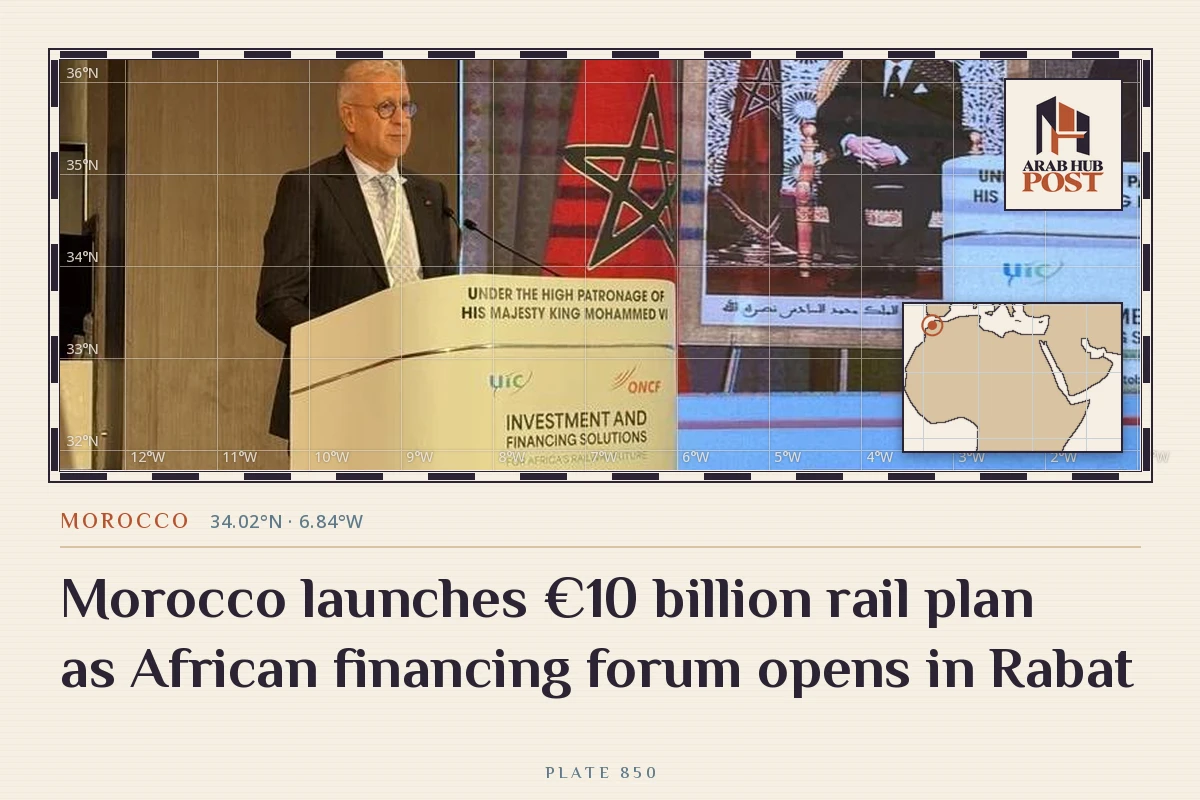
The second international forum on investment and financing solutions for the future of railways in Africa opened in Rabat on Wednesday, drawing financial institutions, development banks, investors and railway officials to discuss ways to speed up rail infrastructure development across the continent.
Forum opens in Rabat
Held on October 14‑15 under the patronage of King Mohammed VI, the forum seeks to turn Africa’s railway ambitions into bankable projects that can obtain financing and move toward implementation.
Morocco’s rail investment plans
Mohamed Rabie Khlie, director general of Morocco’s National Railways Office (ONCF), said the forum builds on the 2023 Dakar Declaration and urged an urgent shift from mere diagnosis to concrete action and sustainable partnerships.
He observed that transport infrastructure is undergoing unprecedented change, requiring a reassessment of mobility models to meet sustainability goals, and noted that rapid population growth, a expanding youth cohort and swift urbanisation make modernising transport systems ever more necessary, in line with the African Union’s Agenda 2063.
Khlie warned that infrastructure deficits cost Africa roughly 2 % of its annual economic growth and can cut productivity by as much as 40 %.
Highlighting Morocco’s experience, he described the launch of Al Boraq, Africa’s first high‑speed train, as a turning point. He added that the Moroccan rail network now carries more than 55 million passengers each year.
Khlie also presented an investment programme worth more than €10 billion to run through 2030. It envisages extending the high‑speed line toward Marrakech to create a 630‑kilometre network, procuring 660 new railcars and trains, and introducing rapid urban rail services in major metropolitan areas.
He said traditional public financing alone cannot cover the sector’s high costs, calling for innovative and sustainable financing mechanisms tailored to the financial resources and economic conditions of individual African countries.
In a speech delivered on his behalf by Zine El Abidine Ibritel, secretary‑general of the Ministry of Transport and Logistics, the outgoing transport minister said Morocco regards railways as a strategic priority for territorial development and economic competitiveness.
The minister outlined a separate investment programme worth 134 billion dirhams through 2030, covering the extension of the high‑speed line, rail links to Nador West Med port, the development of regional train services and the acquisition of 168 new trains. He linked the programme to preparations for the 2030 FIFA World Cup.
He urged a stronger contractual framework between the state and ONCF to clarify obligations, financing arrangements and risk management, which would help build confidence among lenders and financial partners.
At the continental level, he called on governments, financial institutions and investors to coordinate more closely and direct resources toward projects offering the greatest development impact. He also advocated linking ports and logistics platforms to rail networks and upgrading freight corridors to ease transit and strengthen economic integration.
Development banks, he said, should provide financing that matches the long horizons of railway projects, while private‑sector involvement should include commitments that protect service quality and financial sustainability.
The minister also stressed that judging rail projects solely on their upfront construction costs is inadequate, because reliable services need steady funding for operations and maintenance.
He pointed to opportunities from green financing, given railways’ environmental advantages such as electrification and improved energy efficiency. Morocco, he added, is ready to share its expertise in railway engineering, maintenance and operations with other African countries while supporting the growth of local rail industries and skilled employment.
Financing and environmental opportunities
François Davenne, director general of the International Union of Railways, highlighted the environmental and financing challenges facing the sector, describing Africa as a major priority for railway development and international cooperation.
Rail transport is among the most effective and sustainable tools for combating climate change, Davenne said, criticising what he described as the insufficient recognition of railways’ environmental benefits in existing financing mechanisms.
Carbon markets could, in principle, supply public funding without interest charges for projects whose financial returns take decades to appear, he said.
Citing a study by the union, Davenne said the railway sector could help avoid 1.8 gigatons of carbon emissions in developing countries by 2050, potentially generating between $27 billion and $72 billion in revenue.
He noted a gap between the carbon prices used in studies, around €100 per ton, and market prices, which he said were below €20.
Davenne also announced the launch of the “MORE Alliance,” a partnership with international stakeholders seeking to update carbon‑credit methodologies and win formal recognition under Article 6 of the Paris Agreement. He urged policymakers and financial actors to collaborate to turn railways’ environmental benefits into concrete financing opportunities.
Turning political priorities into bankable projects
Asmaa Bouraida, regional coordinator for the African Union Development Agency, stressed the wider social and economic gains from railway investment.
Reliable rail services can create jobs, open new markets for farmers and connect landlocked countries to global trade, she said.
Bouraida praised Morocco’s Atlantic Initiative, describing it as strategically important to the region’s geopolitical and economic landscape. She also commended the country’s progress toward the African Union’s Agenda 2063 and its operation of the continent’s only high‑speed rail service.
She highlighted Morocco’s 2022 green bond issuance, which attracted domestic and international investors to finance long‑term assets, and said the agency wishes to share this experience through South‑South cooperation.
The central challenge, Bouraida said, is turning political priorities into projects capable of attracting bank financing. She called for greater investment ambition and harmonised cross‑border technical standards, while raising questions about who would bear maintenance costs and construction and demand risks.
She also outlined agency programmes that support African countries, including infrastructure development initiatives and a joint guarantee platform backed by major African and international banks.
Bouraida said the forum should end with concrete projects backed by clear financing arrangements and partnerships. Developing Africa’s railways, she added, requires coordinated efforts from governments, banks, engineers and communities.
Reader comments
No comments on this report yet.