
Oman Launches Second Phase of Digital Economy Programme with RO 1.5 Billion GDP Target
Published Updated By Regional Desk
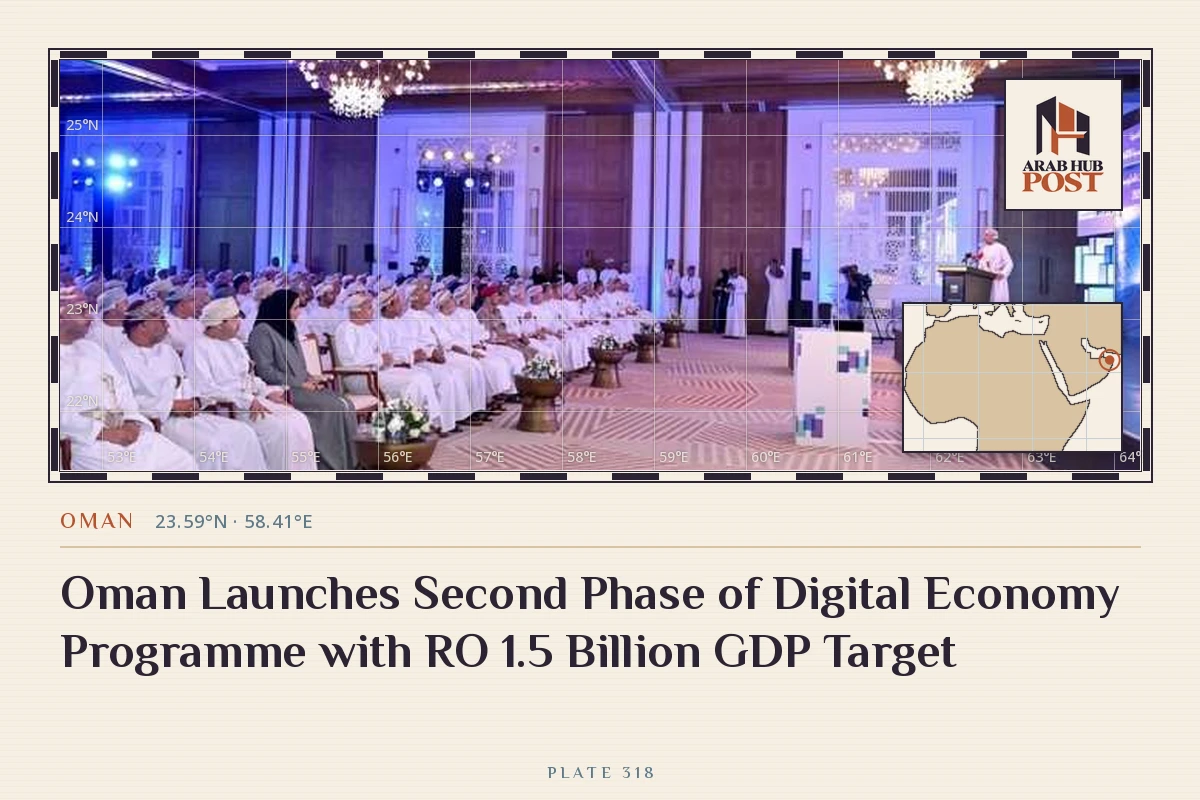
Oman’s Ministry of Transport, Communications and Information Technology launched the second phase of the National Program for Digital Economy, covering the period 2026–2030. The programme aims to increase the digital economy’s contribution to the gross domestic product (GDP) by RO 1.5 billion, attract technological investments worth RO 300 million, and create 3,000 direct jobs each year through digital economy initiatives.
Launch Ceremony and Digital Economy Contribution
The launch was held under the auspices of Sultan Salim Al Habsi, Minister of Finance. During the ceremony, officials announced that the digital economy’s contribution to GDP had reached 9 percent, based on a survey conducted this year by the National Centre for Statistics and Information in cooperation with the Ministry of Transport, Communications and Information Technology.
Focus Areas and Strategic Platform
The second phase focuses on digitising strategic economic sectors, promoting the adoption of digital solutions, e-commerce and electronic payment systems, and encouraging small and medium enterprises to undergo digital transformation. It also emphasises expanding the use of artificial intelligence applications to raise efficiency and productivity, foster innovation, and develop national digital industries.
The ceremony also saw the launch of a strategic intelligence platform for the National Program for Digital Economy, developed in cooperation with the World Economic Forum. The platform is designed to monitor future trends and transformations, and to employ data and knowledge to support policymaking and decision-making, thereby enhancing national priorities and supporting digital transformation in Oman.
Progress in Digital Competencies and Innovation
Dr. Ali Amer Al Shidhani, Undersecretary of the Ministry of Transport, Communications and Information Technology for Communications and Information Technology, said in his speech that the programme attaches great importance to qualifying national digital competencies and skills, and to enhancing the presence of Omanis in technological activities and professions. He noted that the Omanisation rate in technological activities rose from 33 percent in 2022 to 46 percent in 2026, and in technological professions from 50 percent to 72 percent over the same period, providing more than 5,000 new technological jobs for Omanis in the past five years.
Al Shidhani added that during its first phase, the programme included initiatives to develop future specialised skills. These included qualifying more than 170 specialists in semiconductors and 800 specialists in artificial intelligence, as well as launching a Master of Science programme in Digital Transformation and Innovation in cooperation with the University of Technology and Applied Sciences. This aims to build national competencies capable of keeping pace with rapid developments in the digital sector.
Read also: Oman Hosts Sixth Session of International Dates Council Members' Council
In the area of digital innovation and national industries, he said the ministry had achieved several qualitative milestones. These included developing a specialised zone for startups in artificial intelligence, establishing an artificial intelligence studio that produced 50 smart products, and supporting the establishment of 10 local startups in the space sector.
He pointed out that the ministry enhanced the participation of small and medium enterprises in implementing government technological projects by contracting with 251 companies, establishing 48 business incubators and accelerators to support tech startups, and providing funding exceeding RO 127 million. This contributed to strengthening the innovation and entrepreneurship ecosystem and supporting the growth of national digital industries.
Infrastructure, Space, and Investment
In the pillar of digital infrastructure and green advanced computing, Al Shidhani reviewed indicators of digital infrastructure development in Oman. He said Oman advanced to 22nd place globally in the United Nations Telecommunication Infrastructure Index for 2024, up from 48th place in 2022, and attained 33rd place globally in the Digital Readiness Index for 2025 issued by the International Telecommunication Union.
Read also: Omani actor Al Balushi reflects on theatre, identity and digital change
He indicated that the volume of data exchanged through the National Integration Platform in the government network increased by 391 percent between 2021 and 2025. Digital resilience and robustness are supported by 20 submarine cables, and the population coverage rate for high-speed mobile broadband reached 99 percent.
Al Shidhani also mentioned plans to establish specialised data centres for artificial intelligence with a capacity of up to 500 megawatts, which would enhance the readiness of digital infrastructure to accommodate advanced technologies and support the orientation toward green advanced computing.
In the space sector, he pointed to a 270 percent growth in private sector investments, a 163 percent rise in the number of workers, and a 136 percent increase in the number of companies operating in the sector. Among the most prominent developments are the launch of earth observation satellites owned by Omani companies, the start of designing and manufacturing the first Omani communications satellite “OmanSat,” the commencement of operations for a rocket launch pad, and the execution of two successful launch experiments, all enhancing national capabilities in employing space technologies across various sectors.
Read also: Art Basel Qatar reveals 2027 exhibitor lineup and launches year-round collector programme
In the pillar of digital investment, trade and economic value, he said the value of investment deals and projects during the COMEX 2025 exhibition amounted to RO 116 million, an increase of 45 percent compared to 2024. Furthermore, 200 tech companies participated in exhibitions outside Oman over the past three years, concluding agreements worth RO 30 million.
He pointed out that the volume of e-commerce in Oman reached RO 288 million in 2025, compared to RO 221 million in 2023, while investments in the semiconductor sector amounted to RO 88 million. He added that the volume of non-cash transactions increased by more than 700 percent between 2020 and 2025.
Digital Trade Programme and Future Phases
Eng. Ghalib Said Al Maamari, Undersecretary of the Ministry of Commerce, Industry and Investment Promotion for Commerce and Industry, said the launch of the second phase of the National Program for Digital Economy represents a new milestone in the country’s journey toward a more competitive and sustainable digital economy. It employs modern technologies to support economic growth, diversify income sources, raise sectoral productivity, and enhance the competitiveness of national institutions.
He pointed out that the ministry works within this orientation through the Digital Trade Programme, one of the executive programmes of the National Program for Digital Economy. The Digital Trade Programme aims to transform digital enablers into real economic opportunities for companies, small and medium enterprises and entrepreneurs, and to open broader horizons for Omani products and services to access markets.
Al Maamari indicated that digital trade has become an integrated system encompassing marketing, transactions, supply chains, logistics services, and business-to-business and cross-border trade, providing broader opportunities for Omani companies to grow, expand and compete.
He stated that the first phase of the Digital Trade Programme (2021–2025) established an important foundation for this transformation by regulating the market, enhancing trust, and expanding the adoption of digital trade. Its most prominent achievements include the launch of the “Maroof Oman” platform, the issuance of the executive regulation for e-commerce, and the expansion of its activity licenses, alongside building partnerships and supporting the access of small and medium enterprises to global markets.
Read also: UAE-led global operation uncovers $39 billion in fraud-linked assets
He mentioned that the second phase (2026–2030) will work on transitioning from building readiness and regulating the market to maximising the economic impact of digital trade. It will link digital trade more deeply with productive economic sectors and enhance the presence of Omani companies, products and services regionally and globally.
He pointed out that artificial intelligence and advanced technologies will be a key enabler in this phase, employed in marketing, consumer behaviour analysis, demand, inventory and supply chain management, and the development of customer experience. This raises the efficiency of national companies, particularly small and medium enterprises, and enhances their ability to compete and grow.
The National Program for Digital Economy is considered one of the strategic programmes supporting “Oman Vision 2040.” It includes eight executive programmes: National Digital Transformation, Artificial Intelligence, Cybersecurity Industry, Space, Digital Industry, Digital Trade, Financial Technologies, and Digital Infrastructure.
The programme is based on three strategic pillars: Digital Society, Digital Government, and Digital Sectors and Businesses. These are supported by four basic foundations: developing the digital infrastructure, enhancing digital policies and governance, developing digital talents and skills, and supporting innovation and national digital industries.
The programme is implemented across four phases: the first (2021–2025) to build an integrated digital government, the second (2026–2030) to digitise economic sectors, the third (2031–2035) to consolidate national digital industries, and the fourth (2036–2040) to enhance digital exports and global competitiveness.
The launch of the second phase extends national efforts toward enhancing integration between government institutions and the private sector, and expanding the utilisation of digital technologies in economic activities. It supports building a knowledge- and innovation-based economy and enhances Oman’s competitiveness and position in the digital economy regionally and internationally. The programme is part of Oman’s broader economic diversification strategy under Vision 2040, aligning with regional efforts to build knowledge-based economies.






Reader comments
No comments on this report yet.