
Ancient faience workshop in Sudan reveals how Kushite rulers controlled craft production
Published Updated By Arab Hub Post Staff
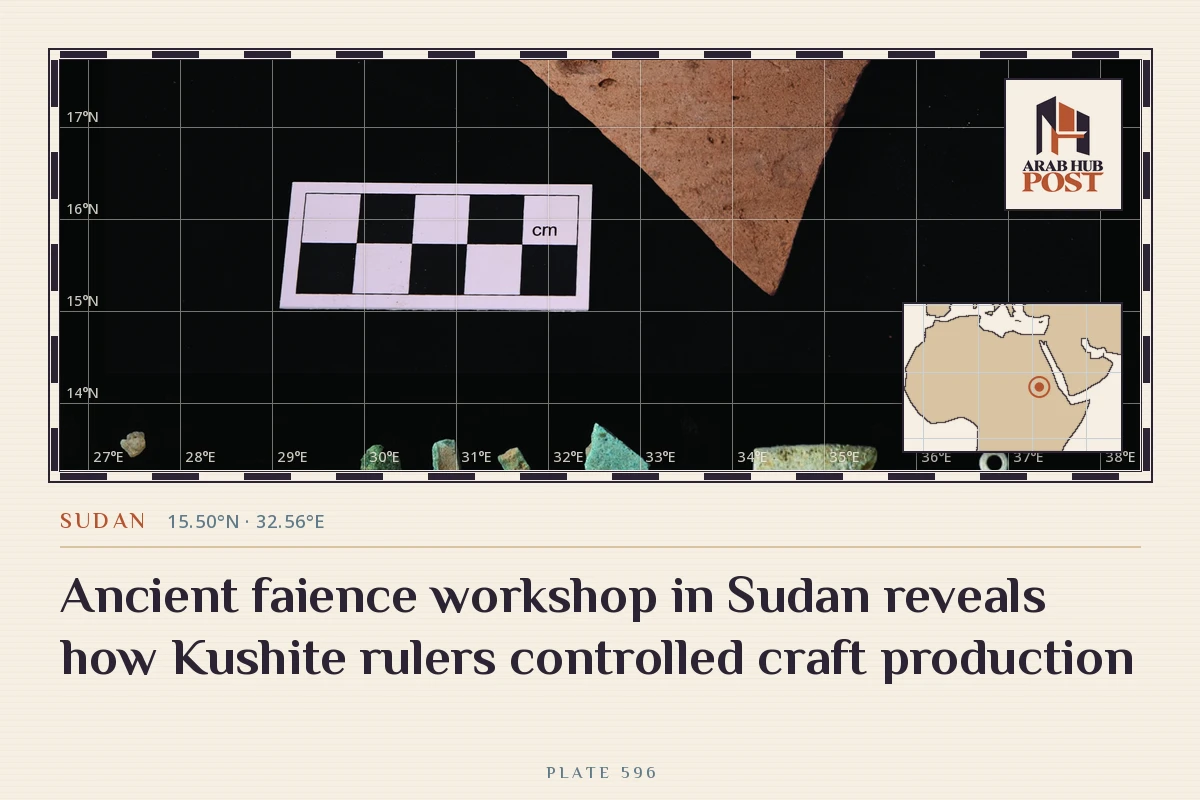
Archaeologists working in Sudan have uncovered an ancient workshop for producing faience, a bright glazed material, within a major temple complex in the former Kushite capital of Napata. The discovery offers fresh insight into how Kushite kings used specialised craft production to reinforce royal authority and control the manufacture of valuable goods. The Kushite kingdom, based in what is now Sudan, once extended its influence into Egypt, ruling the country during the eighth century BC, yet it has received far less archaeological attention than Egypt.
Workshop inside a royal temple
The Temple of Sanam, built by Kushite king Taharqo in the seventh century BC, was not merely a place of worship, according to a study published in the journal Antiquity by researchers from Durham University in the UK and New York University in the US. It also functioned as a production centre for objects linked to royal power and funerary traditions.
Excavations at the Sanam temple complex, led by Kathryn Howley of New York University, revealed the remains of a workshop specialising in faience production, alongside hundreds of faience beads and a small funerary figurine known as a shabti. Shabtis were typically placed in tombs in ancient Egypt and Nubia to perform work for the deceased in the afterlife, while faience was used for jewellery, amulets and decorative items because of its bright colours and glossy surface, often in blue, green and white.
The material was produced by mixing silica-rich ingredients with other substances and heating the mixture until a glassy layer formed. In ancient Egypt, faience symbolised brilliance and brightness. However, the researchers were most struck by the workshop’s location: inside a major religious complex. Producing faience generates smoke and unpleasant fumes, and in ancient Egypt such workshops were usually sited on settlement edges, away from central areas. At Sanam, production took place within the temple, suggesting that the manufacture of prestige objects was closely tied to institutions supporting royal authority.
“This evidence demonstrates that Sanam Temple was not simply a religious monument but also a centre of state-controlled production,” said Rennan Lemos, an archaeologist at Durham University and the study’s lead author. “The workshop produced faience objects associated with royal power, including shabtis destined for the royal cemetery at Nuri.” Nuri was a key royal burial site of the Kushite kingdom, containing tombs of rulers including Taharqo, who governed Egypt and Nubia during the Twenty-fifth Dynasty.
Nubian innovation rather than Egyptian imitation
The workshop also revealed a significant difference between manufacturing techniques in ancient Egypt and Kush. Egyptian craftspeople commonly used limestone as a source of lime in faience production, but the researchers found evidence that Kushite artisans may have used crushed seashells instead, an adaptation that makes sense given the scarcity of limestone across much of Sudan.
Read also: Khartoum airport drone attacks raise alarm over passenger safety
“The workshop reveals Kushite craftspeople adapted Egyptian-inspired technologies to local conditions,” Lemos explained. “Instead of relying on limestone, which is scarce in much of Sudan, they appear to have used crushed seashells as a source of lime in the faience recipe. This points to technological innovation rather than simple imitation.”
This challenges the long-standing tendency to interpret Kushite material culture mainly through its similarities with ancient Egypt. While Kushite craftspeople knew Egyptian technologies and artistic traditions, they did not necessarily adopt them unchanged. Instead, they selected techniques that suited their needs, modified production methods, and created objects carrying meanings unique to Kushite society.
Control over prestige goods and royal power
The researchers argue the workshop also provides rare physical evidence of how the Kushite state exercised economic and political control. By organising the production of prestige objects within a royal temple, authorities may have controlled not only the finished goods but also access to raw materials, skilled labour, and the specialised knowledge needed to manufacture them.
This suggests a possible difference from Egypt, where political and economic power was closely linked to control over agricultural land and production. The new findings indicate that Kushite rulers also placed considerable importance on controlling the manufacture and distribution of luxury and ceremonial objects. However, the discovery offers direct evidence from one royal temple complex, not a complete picture of the Kushite economy, and does not establish that all craft production across the kingdom was organised similarly.
For Lemos, the significance extends beyond the workshop itself. “This highlights the creativity and agency of ancient Nubian societies,” he said. Rather than simply adopting Egyptian cultural practices, the Kushites adapted foreign technologies to local circumstances, developed their own production methods, and created objects with distinct political and social meanings. The discovery at Sanam adds an important dimension to the history of Kush, showing that temples could function as centres of economic production as well as religious worship, and revealing how artisans who made beads, ornaments and funerary figures contributed to the political authority of one of the Nile Valley’s most influential ancient civilisations.



Reader comments
No comments on this report yet.