
Khartoum airport drone attacks raise alarm over passenger safety
Published Updated By Regional Desk
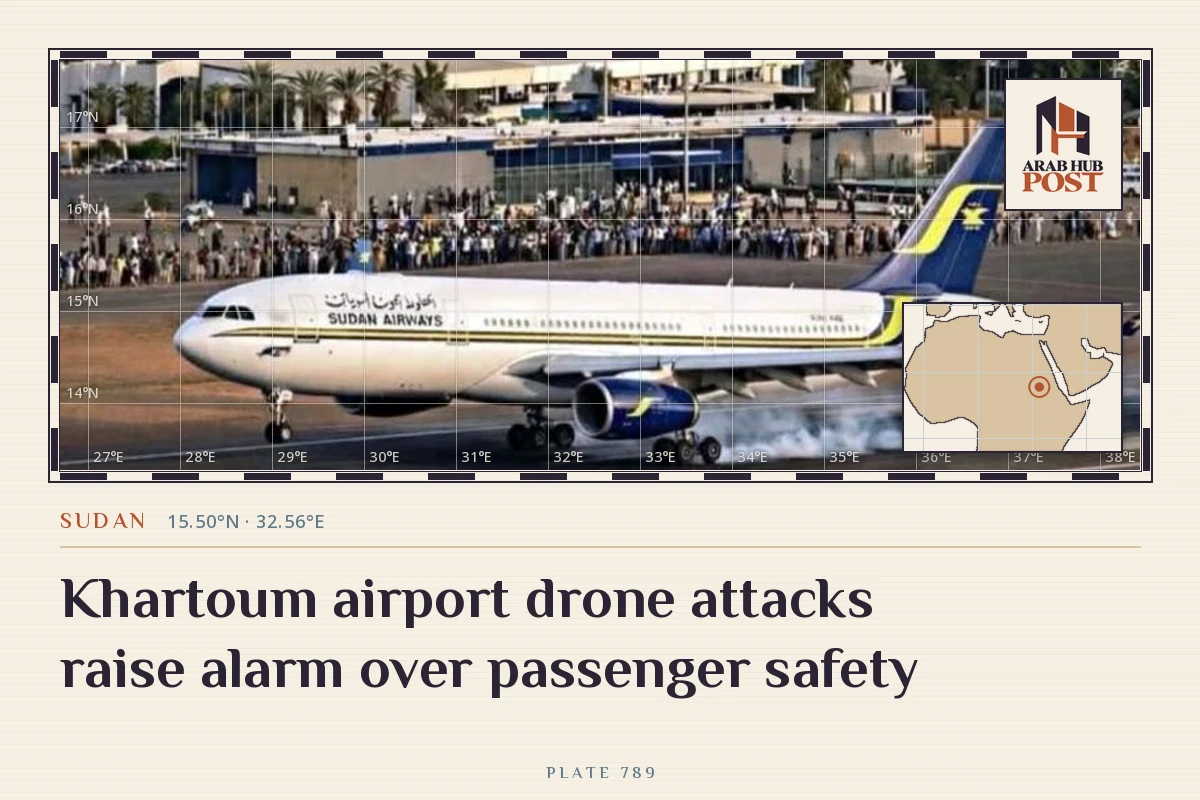
Sudan has witnessed five consecutive waves of drone strikes near Khartoum International Airport, attributed to the Rapid Support Forces (RSF), according to Radio Dabanga. The attacks killed one man and four children and have heightened concerns about aviation security in the capital.
The strikes hit seven locations across Khartoum, radio reports said. Air defences allegedly intercepted threats directed at the airport and its facilities. A drone came down in an unoccupied area east of the runway, with no casualties reported at that site.
Passengers face confusion over flight status
The UN Office for the Coordination of Humanitarian Affairs (Ocha) in Sudan noted that some flights had been disrupted by the attacks. Passengers said they arrived at Khartoum airport only to learn that their flights had been cancelled without prior notification.
One woman said she discovered her flight had been cancelled only after reaching the airport. When she contacted her travel agency, she was told the flight was still listed in the electronic booking system. At the same time, another flight departed as scheduled. She said she supports security measures to protect lives but argued that airlines and authorities have a moral and administrative responsibility to officially notify travellers of cancellations.
A senior airport official, however, insisted that flights were continuing according to airlines’ published schedules. He described the situation as stable, services as operating normally, and air traffic as unaffected by the bombardment.
Sudan’s national carrier, Sudan Airways, continued to operate through the airport. One of its flights from Cairo landed on Tuesday morning before departing for Port Sudan International Airport. The aircraft later returned to Khartoum and left for Jeddah, demonstrating the authorities’ determination to maintain operations despite the attacks.
Amjad Farid, an adviser to the head of Sudan’s Sovereignty Council, posted on X that Khartoum airport was continuing to operate normally under established procedures and that life in the capital was returning to normal. He accused unnamed parties of spreading rumours that the airport had closed, describing this as an attempt to achieve what the indiscriminate drone attacks had failed to accomplish: preventing the restoration of normal life and the return of Sudanese people.
Read also: Ancient faience workshop in Sudan reveals how Kushite rulers controlled craft production
Aviation experts call for temporary suspension
The Sudanese Centre for Civil Aviation Research and Studies recommended temporarily suspending commercial operations at Khartoum airport in response to the worsening security situation and increasing risks. In a professional assessment issued in October 2026, the centre stressed that any decision on operations should be based on a formal safety risk assessment and an independent, evidence-based evaluation of safety standards, rather than economic considerations or political pressure to demonstrate a return to normality in the capital.
The centre said its recommendation was not intended to undermine efforts to reopen the airport, which resumed operations in October last year after a shutdown imposed by the war. Instead, a temporary suspension would help protect the reopening process and ensure its long-term sustainability. A single accident in an active conflict zone, it warned, could have consequences beyond loss of life and property, including loss of confidence among international airlines, higher insurance premiums, and international warnings or restrictions that might force the airport to close for a longer period.
The centre outlined several measures: temporarily suspending commercial flights until a comprehensive, updated risk assessment is completed; establishing a multidisciplinary team to assess immediate security, operational and technical risks around the airport; separating reopening decisions from political timetables and allowing access to Sudanese airspace only when acceptable safety standards are met; resuming operations in stages, beginning with restricted services before moving systematically towards full operations; and involving airlines, air navigation personnel and insurance companies in the risk assessment process. The recommendations place the emphasis on independently assessed safety conditions rather than the symbolic significance of restoring airport operations.
Information vacuum fuels rumours
The security concerns have been compounded by a lack of official public information about the airport’s operational status. While social media users and journalists circulated reports that the airport had closed, its verified Facebook page, which has more than 250,000 followers, provided no clarification or operational updates. Its published content was limited to condolence messages.
Journalistic inquiries found that the page, originally established through an initiative of airport officers with previous administrative support, had stopped publishing news and operational updates following strict management instructions prohibiting such posts. Specialists quoted in the report warned that withholding official information and maintaining media silence on security grounds created a dangerous vacuum that could be filled by rumours and inaccurate speculation. This, they said, risked confusing passengers and damaging the reputation of Sudan’s national aviation institutions.
The report argues that official communication and transparency are integral to crisis management and aviation safety, particularly when attacks threaten critical infrastructure and leave travellers uncertain about whether flights are operating. The competing accounts of airport operations, together with calls for an independent safety review, have brought into focus the challenge facing Sudanese aviation authorities: how to restore commercial air travel while ensuring that security risks are properly assessed and passengers receive timely, reliable information.



Reader comments
No comments on this report yet.