Meta’s Face‑Worn Computers Aim to Redefine Personal Technology
Published By Arab Hub Post Staff
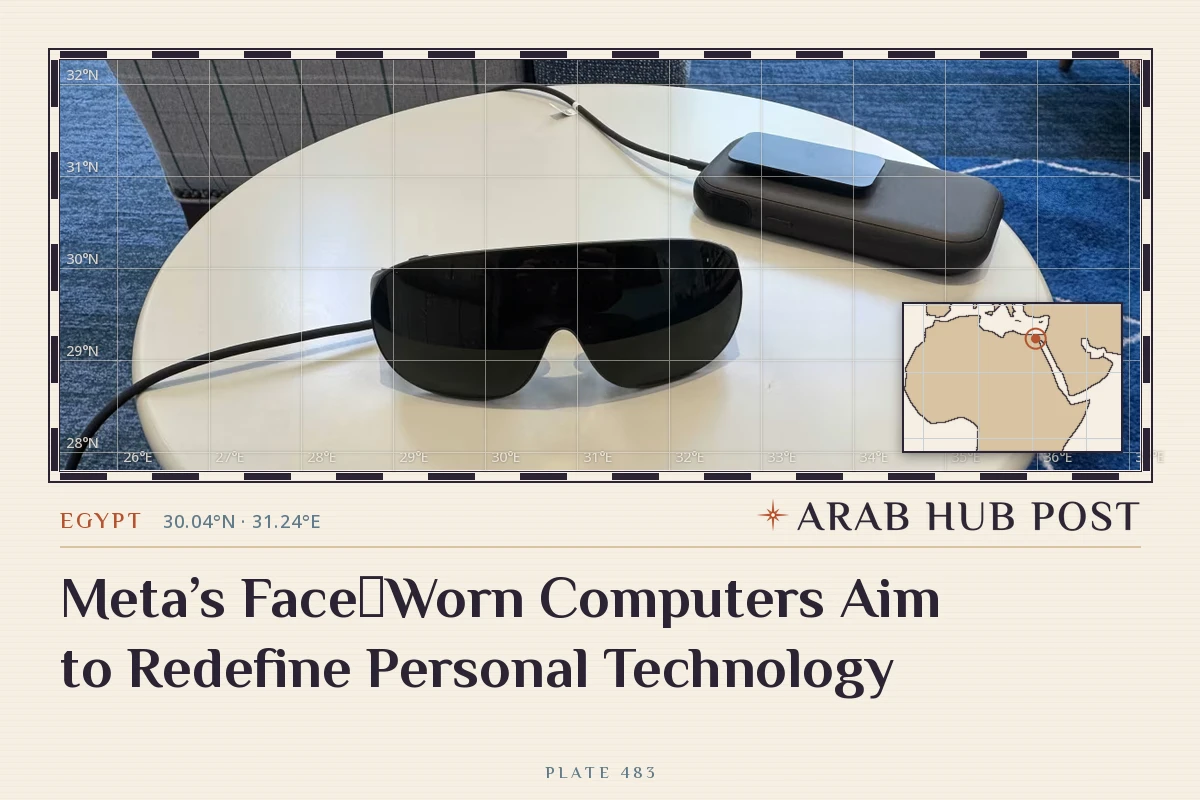
In Egypt, coverage of Meta’s latest wearable technology highlights the company’s push toward face‑worn computers, as reported by Egypt Independent. The development could influence how consumers across the Arab world interact with digital content.
Immersive VR Experience
The piece opens with a description of a concert that felt unlike any typical show; the viewer hovered near the stage alongside Billie Eilish as she held a fan’s hand in the front row, a perspective created by watching a clip from her 3D tour special filmed in Arizona and Manchester, England, using Meta’s new VR glasses. CNN tested the glasses at Meta’s New York offices last week, ahead of the spring launch, and Meta is banking on experiences like this to make its eyewear a success.
Those glasses, together with the camera‑free Ray‑Ban Meta Audio glasses set to launch Tuesday, are presented as part of the social media giant’s decade‑long ambition to build what it sees as the next generation of the personal computer. Meta acknowledges that its earlier efforts in this arena, including its big bet on the metaverse, have largely fallen short, but the firm remains convinced that the outcome will be different this time, staking its future on the integration of AI agents, refined styling and more advanced display technology to win over consumers despite lingering privacy worries that have triggered bans and resistance worldwide.
Design and Interaction
Meta positions the forthcoming VR glasses as a computer, game console and movie theater combined. Priced at roughly $1,300, they differ markedly from the Quest headsets the company has sold for years, which weigh about 18 ounces and resemble a visor or helmet. Instead, the new model looks like an oversized pair of sunglasses and tips the scales at around 3.5 ounces because the computing hardware resides in a separate module tethered to the frames by a wire.
Users control apps by treating their gaze as a mouse pointer and tapping the thumb against the index finger to execute a click. The gestures are described as easy to pick up, although scrolling demands a bit of practice—forming a fist and sliding the thumb along the index finger as if it were a trackpad.
The glasses can stand in for a personal computer or a television; a wearer can stream a film or spread work across several virtual screens just as they would with a laptop or a flat‑panel monitor.
Ryan Cairns, Meta’s vice president of VR, said the objective is not to supplant existing computers but to broaden the contexts and ways in which people can use them. He added, “I can put VR glasses on in the plane and basically have like three monitors’ worth of work in front of me.”
AI‑Enabled Audio Glasses and Broader Strategy
The Ray‑Ban AI glasses, by contrast, are intended for all‑day wear like ordinary spectacles while handling selected smartphone functions such as obtaining directions, playing music and answering questions. The latest iteration omits a camera, thereby avoiding the controversial feature that provoked widespread privacy apprehension; it includes speakers and microphones, with Meta stating that the microphone is restricted to phone calls and conversations with its AI assistant, likening the arrangement to having AirPods built into the glasses.
This concept is not unprecedented. Amazon has been offering Alexa‑enabled smart glasses with microphones and speakers since 2019, and a number of startups have released audio‑only glasses without cameras. Meta revealed two years ago that it planned to launch audio‑only AI glasses in 2026 because people frequently employ their glasses for phone calls or listening to podcasts, according to Alex Himel, Meta’s vice president of wearables.
Meta continues to sell camera‑equipped models as well. Last month it introduced an upgraded version called the Ray‑Ban Meta Gen 3, noting a lighter design, a shortcut button and extended battery life.
Meta’s Quest to Own the Future of Computing
Meta’s failure to capitalize on the mobile boom left it dependent on devices supplied by Apple, Google and Samsung, which serve as the gateway to its services and intrude on its core advertising business. In 2022, Mark Zuckerberg warned that an iPhone setting that blocks apps from tracking users across the internet would cost the social‑media behemoth $10 billion in earnings that year.
For more than a decade the company has tried to lessen its reliance on external hardware makers by releasing products ranging from a Facebook‑branded phone to a smart‑home hub and VR headsets.
Ash Saulsbury, chief executive of AI firm Awear and a former member of Meta’s wearables division from 2017 to 2019, recalled, “There was always a very strong desire: ‘How do we have people on our own platform so we have a little bit more control?’”
Smart glasses are gaining traction; shipments are forecast to rise 263 % in the first half of 2026, and EssilorLuxottica, the parent of Ray‑Ban, reported selling more than seven million AI glasses in the preceding year. Nevertheless, privacy concerns persist, and Meta’s earlier hardware attempts have failed to excite consumers. The Reality Labs division, which covers both smart glasses and VR headsets, continues to lose money while VR headset sales decline across the industry.
Daniel Newman, chief executive of technology research firm Futurum, observed, “The glasses are still a little bit of a solution chasing a problem.”
For Meta, the stakes extend beyond merely capturing a share of the market for the devices needed to run its applications.
The firm argues that its forthcoming hardware could grant users more direct access to its Muse AI agent, a factor that will be important in measuring Meta’s position against rivals such as OpenAI and Google in the AI race. With the Ray‑Ban Meta glasses, individuals can simply speak to the assistant and show it their surroundings instead of opening an app, typing a query or snapping a photograph.
Regarding the VR glasses, Cairns explained that Muse will be capable of operating across multiple projects and tasks managed in various virtual windows and applications. He added that the glasses will ship with Muse, including support for the newly announced Muse Wonder model and any further updates released between now and the launch date.
Meta acknowledges that it is asking consumers to adopt another device, especially as AI assistants become more commonplace in the gadgets people already own. The optimistic outlook rests on the extent to which AI mirrors the smartphone boom, a view articulated by Jitesh Ubrani, who covers consumer technology for market‑research firm IDC.
Ubrani likened Meta’s AI‑and‑glasses wager to the emergence of Uber or Lyft, noting that hailing a ride through an app only became widespread after smartphones achieved mass adoption. He said, “Consumers essentially are just seeing AI today as a simple chatbot,” he said. “They don’t realize how powerful and capable it can be. And both AI and these glasses kind of go hand in hand right now.”