
Sudanese refugees in Egypt face shifting asylum landscape as UNHCR role wanes
Published Updated By Arab Hub Post Staff
UNHCR’s Role and the Performing of Victimhood
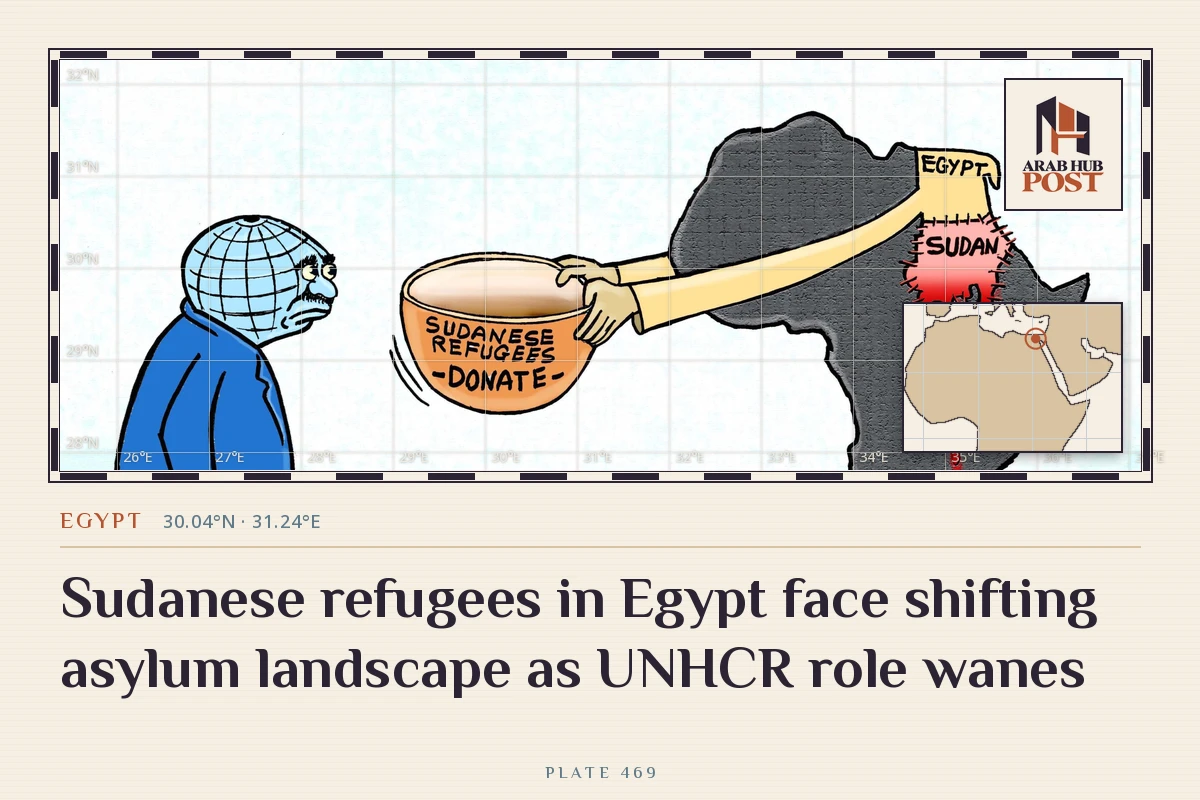
Egypt is the focus of an op-ed by Joseph A. Owens for Radio Dabanga, accompanied by a cartoon by Omar Dafallah / RD, examining how Sudanese refugees might cope with the country’s forthcoming asylum system.
Egypt has gradually reduced its obligations under the 1951 Refugee Convention, and attention now turns to the enactment of Asylum Law No. 164, which transfers authority over protection decisions from UNHCR to the Egyptian government.
For Sudanese who were already in Egypt before 2023, the routine of registering with UNHCR and enduring a lengthy, often years‑long wait for an interview that determines refugee status has become a familiar and exhausting experience.
Under the new framework, refugee‑status determinations will no longer be made by UNHCR; analysts warn that this shift opens the door to arbitrary denial or withdrawal of asylum, especially given Egypt’s record of documented abuses against Sudanese.
Read also: UNHCR Urged to Inform Tindouf Camp Residents of Durable Solutions
The climate of distrust has deepened amid rising deportations, intensified police patrols and a violent raid on gold miners in the Aswan and Red Sea governorates, prompting the question of how Sudanese will navigate an asylum service administered by those who persecute them.
UNHCR’s presence in Egypt is frequently described as that of a surrogate state, supplying modest cash aid, residency endorsements and medical referrals in an effort to make life bearable, while also presenting itself as a shield against deportation and violence.
Yet this protection is conditional; it must be earned, contrary to the idea that it is an automatic right under the Refugee Convention. Interviewees told Owens that they felt compelled to embellish their narratives when dealing with UNHCR staff. As Eltahir put it, “You just call them and play the role of victim,” noting that he contacted them thirteen times to address repeated arbitrary detentions and street violence linked to Sudanese government agents, receiving only one return call advising him to relocate.
Read also: Egypt Offers Military Support to Saudi Arabia as Houthi Attacks Redefine Gulf and Red Sea Security
Performing for the UN
For Sudanese, the pivotal moment is the Refugee Status Determination (RSD) interview, a direct confrontation between the UNHCR‑appointed officer and the applicant that decides whether legal residence in Egypt can be granted on the basis of a well‑founded fear of persecution.
Before leaving Sudan, Abdelrahman recorded every violent incident he endured in Sudan and Egypt so he could recall them precisely—a habit commonly recommended by refugee‑led groups and community members in Cairo and Giza.
Others rehearse with fellow Sudanese through mock interviews or exchange tips on WhatsApp, warning newcomers about difficult interviewers and what to expect.
While such preparation is normal, the manner in which the story is told is decisive. Applicants are expected to recount violent episodes in strict chronological order, highlighting concrete details such as the colour of a torturer’s shirt or the number of people confined in a cell; the narrative of violence and the ensuing sense of victim‑hood are essential to persuade the officer that protection is warranted.
Hassan, originally from North Darfur, explained that he omitted motives like personal wellbeing, academic pursuits or job prospects, stating, “The other reasons [for leaving Sudan], I did not mention. These are about personal wellbeing, doing a master’s degree and finding a good job. These are not reasons which will convince their claim … they would say, ‘We are not a charity.’ I focused on the conflict, the casualties, the people who were killed in my family, the safety of my life and the persecution,” and added that he felt he had no alternative but to perform the victim role well: “I should play that role well and just make sure that I send the message across well. If they think I really am a victim, then I can get some assistance.”
Banda, described as “fresh from the trauma in Sudan,” found the interview overwhelming: “I know there are times you test if someone is consistent or not, but you feel they’re quite intense. It reminded me of my detention experiences.” He was turned down, believing his rejection stemmed from being insufficiently passive and “too articulate” to fit the UNHCR image of a true victim, which, he said, expects sufferers to appear poor, illiterate and uneducated. After an appeal before a more meticulous officer, he was eventually recognised.
Scholars have examined the optics of refugeehood—how appearance and presentation influence aid access—and referenced Didier Fassin’s notion of humanitarian reason. Although the 1951 Refugee Convention contains no hierarchy of suffering, in practice such a hierarchy often determines whether an applicant is deemed worthy of recognition.
Read also: French ISIS Suspects Face Justice in Iraqi Courts for Terrorist Ties
UNHCR officers typically approach interviews with suspicion; while fraud does occur, the line between truth and falsehood frequently hinges on the interviewer’s temperament and expertise. Abdelrahman’s initial dismissal was attributed to doubts about his Fur identity, which he linked to the officer’s limited knowledge of Darfur and scepticism of his confident grasp of refugee law—essentially, being “too” educated. A subsequent appeal before an officer who had studied his hometown more thoroughly led to his acceptance.
Demanding Justice
Adopting a victim persona can secure residency, yet many Sudanese have compelled UNHCR to acknowledge their demands for justice. Hassan was expelled from Jordan together with hundreds of fellow Sudanese after a sit‑in outside UNHCR offices calling for protection and labour rights; despite the threat of removal, he declared, “we’re gonna fight,” and held UNHCR responsible for ignoring their pleas and failing to prevent their forced return to Sudan.
Following detention and release, Hassan travelled to Egypt, met other deportees and confronted a UNHCR Cairo officer, presenting the Jordan document that promised protection. The officer conceded that the episode constituted a violation of his rights and advised Owens, “You have to hold them accountable.”
Likewise, after his own rejection, Abdelrahman detailed to the appeal‑conducting officer how little the first interviewer knew about Darfur, besides citing the Refugee Convention. By continuing to play the victim game while asserting his rights, he sought not only recognition but also dignity and ownership over his personal story.
Organised resistance in Egypt remains limited because the tacit agreement with UNHCR and its promises of protection are fragile. Many Sudanese still recall the fatal Mustafa Mahmoud sit‑in of 2005 outside the agency’s offices, blaming UNHCR for not acting swiftly enough to resolve protection concerns before Egyptian police opened fire on demonstrators.
Between UNHCR and the Egyptian State
Dealing with Egyptian bureaucracy is a protracted and aggravating ordeal for Sudanese. Residency appointments arranged via UNHCR now stretch months ahead and necessitate multiple visits; securing a birth certificate often requires Egyptian lawyers; obtaining medical or police reports sometimes entails a bribe.
UNHCR has attempted to streamline these procedures by partnering with hospitals, referring clients to local law firms and negotiating with immigration officials in Abbassia. Nonetheless, attracting UNHCR’s attention remains draining—calling for hours or travelling to the agency’s office in 6th of October City before sunrise to claim a place in the queue is routine for many of the nearly 900,000 Sudanese registered with the body. In turn, UNHCR laments the scarcity of funds from wealthy donor states while observing that European financing is increasingly diverted to policing migration.
Read also: Egypt will defend Saudi Arabia, not attack Yemen, Sisi tells forum
Convincing Europe and Egypt
The European Union is identified as the architect of Asylum Law No. 164, one of several accords with North African nations designed to keep asylum‑seekers and refugees away from Europe in exchange for billions of euros. To foster “local integration,” the EU obliges Egypt, through the new law, to provide pathways to citizenship, freedom to leave and re‑enter the country, and unrestricted labour‑market access—measures that could, in theory, lift Sudanese out of the precarious work that pervades the nation.
Under this emerging asylum architecture, Sudanese will have to craft narratives that persuade a state actively hostile toward them to grant protection. The perceived hierarchy of suffering and the pressure to perform victimhood are set to intensify. Given the EU’s aim to curb migration from countries of origin—including its financing of the paramilitary Rapid Support Forces to police migrant routes across and out of Darfur and its closure of maritime lanes off the Egyptian coast—there is little expectation that deportations will decline.
Community‑driven initiatives and information‑sharing networks that explain how to maneuver the forthcoming asylum service will require stronger backing. Pursuing justice amid such hostility may necessitate adopting the language of the Egyptian state, as illustrated by Hassan and Abdelrahman in their dealings with UNHCR.
Living Otherwise
Despite the repression, Sudanese have cultivated a sense of belonging in Egypt. Communities established decades ago were later joined by South Sudanese and, after 2003, by Darfuris and Nuba. Sudanese‑run organisations proliferate across Cairo and Giza, offering mutual‑aid networks that deliver support and basic safety nets which neither UNHCR nor the Egyptian state supplies.
Beyond these formal groups, informal solidarity thrives: during phone interviews, interviewees were often interrupted by community members requesting assistance with aid distributions or asking to meet newly arrived compatriots. This spirit of camaraderie has travelled with the displaced, and, even under relentless state pressure, solidarity “makes you feel powerful,” as one interviewee told Owens.
Sudanese may need to fashion fresh accounts as the asylum apparatus shifts to a persecutor state, yet the existing solidarity and mutual‑aid frameworks will persist in nurturing a feeling of place.
The note clarifies that the state’s administrative hub for the General Department of Passports, Immigration and Nationality is situated in Cairo.


Reader comments
No comments on this report yet.