
Egypt will defend Saudi Arabia, not attack Yemen, Sisi tells forum
Published Updated By Arab Hub Post Staff
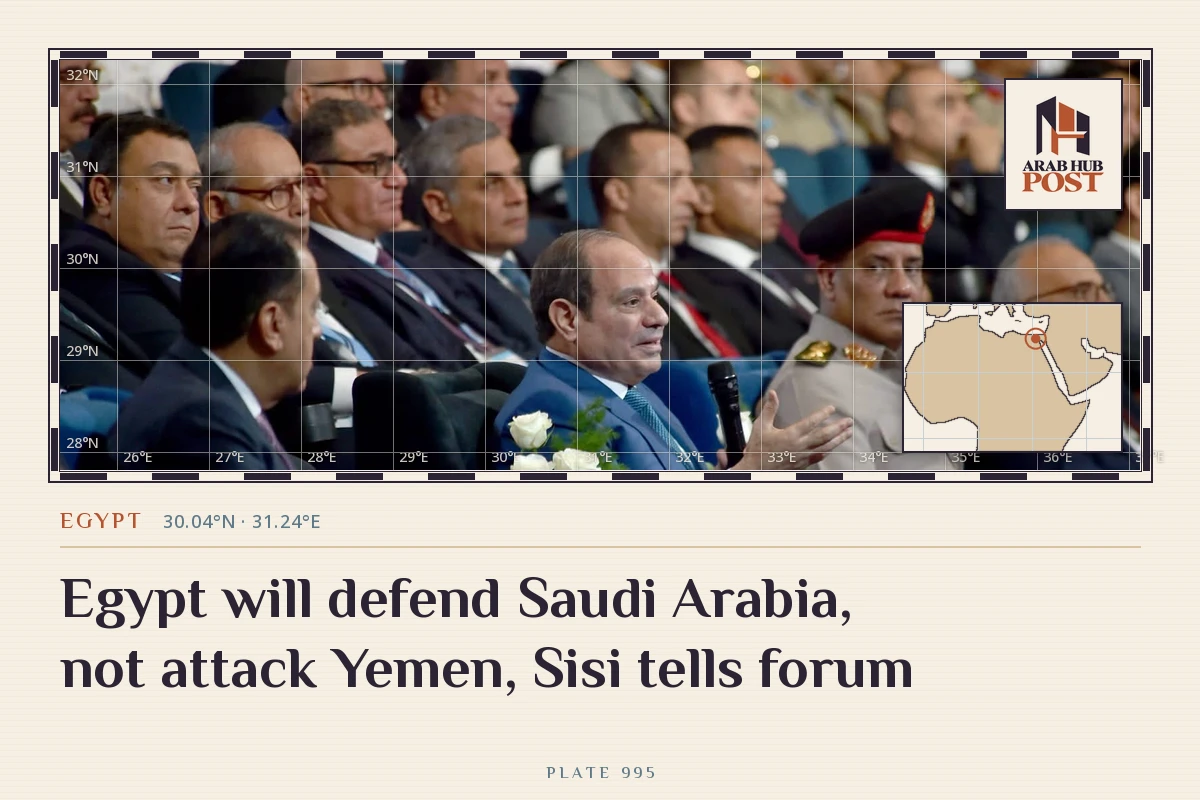
Egyptian President Abdel Fattah Al-Sisi stated on Wednesday that his country’s proposed military deployment aims to protect Saudi Arabian territory and does not involve any offensive action against Yemen. He added that Egypt would also defend the territory of any other Arab state if requested.
Speaking through his presidential spokesperson, Sisi said the objective is to safeguard Saudi land and borders, and that Egypt’s military effort does not extend beyond Egyptian borders or those of any brotherly state whose security and stability Egypt is keen to preserve.
Addressing the Homeland and Citizen Security session on the third day of the Egypt Forum 2026, Sisi described Arab national security as indivisible. He emphasised that the stability of Egypt’s Gulf allies is a matter of national security for Egypt, and that Cairo’s support for Gulf states is an extension of common Arab national security. He stressed the need to restore stability across all Arab countries, including Sudan, Libya and Somalia.
Call to strengthen state institutions
Concluding his remarks, Sisi said Egypt must continue to strengthen itself and that Egyptian public opinion must remain solid and strong, as the risks are numerous and not limited to the Ethiopian dam.
The session was attended by Prime Minister Mostafa Madbouly, Minister of Defence and Military Production Lieutenant General Ashraf Salem Zaher, Interior Minister Major General Mahmoud Tawfik, Minister of Foreign Affairs, International Cooperation and Egyptians Abroad Badr Abdelatty, and Lieutenant General Mohamed Abdel Rahman Rabie, Chief of Operations of the Armed Forces and head of the National Authority for Crisis and Emergency Management.
Read also: Egypt's pound steadies near EGP 53.7 as reserves hit record $57.5bn
In an intervention during the session, Sisi said targeting state institutions has always been part of efforts to topple states, as was evident in 2011. He described the armed forces and the Interior Ministry as the two pillars of state security and said attempts to target the Interior Ministry in its role as a security institution have never stopped.
A review of events over the past few years shows that efforts to target the ministry and create a negative impression of its practices have continued, he said, adding that people sometimes contribute unintentionally to that impression through their daily engagement with events. This places a burden on the ministry to launch initiatives to improve and preserve citizens’ perceptions of it, he said.
Sisi reiterated that the targeting of the security establishment in 2011 was part of a plan against the Egyptian state. He stressed the need to preserve state institutions, warning that failure leads to state collapse and major problems. He noted that the situation in the region demonstrates this.
He called for revisiting the events of 2011 and shedding light on them to ensure they are not repeated, citing the targeting of security forces, the storming of police stations and prisons, and the escape of 33,000 prisoners, along with the consequences that followed. Targeting the police and armed forces was also intended to cast doubt on their competence and merit, he said, stressing that it is difficult to bring down a state as long as its institutions remain strong and trusted by the people.
Read also: Saudi Aramco Headquarters Struck as Houthis and Riyadh Exchange Strikes
Sisi directed the armed forces and the Interior Ministry to put forward more ideas and initiatives to maintain continuous communication with the public and convey the facts, which he said would help create a positive impression.
Reform and rehabilitation centres
Sisi said the construction, redevelopment and modernisation of reform and rehabilitation centres stems from moral, religious and humanitarian considerations, with the aim of ensuring that no person is punished twice for the same crime. The focus has therefore been on rebuilding character and turning convicts into productive members of society, prompting the state to convert prisons into reform and rehabilitation centres, he said.
He stressed the importance of arranging visits to the centres to see the efforts made there. He said the enormous scale of the damage before 2011 prompted a reassessment of the detention environment as part of the security establishment, which was also being targeted. He directed the defence and interior ministries to put forward ideas and initiatives to maintain continuous communication with the Egyptian people and ensure there is no separation between the public and state institutions.
Sisi described the National Authority for Crisis and Emergency Management as a parallel arm supporting the Egyptian state and government in managing the country during crises and emergencies across the republic, particularly through the database it has built. He said the authority has the capabilities needed to carry out its tasks and has become another source of support for state bodies, helping the state and government perform more effectively.
Foreign policy principles
Sisi said the constants of Egyptian foreign policy since 2014 include non-interference in the internal affairs of other states, refraining from conspiracy, preserving the unity of the national state and its institutions, refusing to deal with armed militias, cooperating in construction, development and reconstruction, and engaging positively in balanced relations with all parties.
He stressed the need to maintain strategic balance and said the state should not be drawn into taking action or making decisions in response to popular pressure.
The session opened with a film titled “Your Message Is Heard… A Journey of Response”, which addressed the efforts of state institutions, particularly the Interior Ministry, to provide security for citizens, especially since the events of January 2011, the presidential spokesperson said.
Tawfik highlighted efforts to develop the security system, combat criminal activity, work steadily to restore security to Egyptian streets and respond quickly to citizens’ reports. He cited car theft, which he said has fallen sharply by as much as 94%.
He said the ministry has drawn up an integrated plan to reshape security work, particularly as methods of committing crimes evolve. The plan is built on five pillars.
Read also: Sudanese refugees in Egypt face shifting asylum landscape as UNHCR role wanes
The first is developing police facilities and equipping them with modern technology to keep pace with developments across various fields. The second is creating an integrated system based on a scientific approach to security work, using artificial intelligence to detect crime patterns early and draw up plans to counter them. This requires upgrading operations rooms across the governorates and linking them to the main centre.
The third pillar is developing personnel, which Tawfik said is essential to the system’s success. This involves creating and developing various areas of security work and training personnel in cybercrime, intellectual property and the early monitoring of terrorist organisations’ movements.
The fourth pillar is raising citizens’ awareness, as citizens are the first line of defence against attempts to undermine the nation’s stability and the security of its people. The fifth is modernising penal policy for convicts.
Presidential spokesperson Mohamed El-Shenawy said Rabie reviewed the working mechanisms of the National Authority for Crisis and Emergency Management and the State Defence Coordination Centre. Rabie said the authority is a sovereign public body with legal personality and security, administrative and technical independence, reporting to the presidency. It aims to safeguard Egyptian national security, protect public and private property, and ensure citizens’ security and stability, he said.
Rabie said the administrative and legal aspects of the authority have been completed and that it has the executive bodies needed to manage any crisis efficiently.
Abdelatty opened his remarks by saying foreign policy has become a matter of interest to all segments of Egyptian society, mainly because it is an extension of domestic policy and the two have a reciprocal relationship. Effective foreign policy stems from internal stability, while events abroad affect the domestic situation, he said.
Egypt is surrounded by countries experiencing crises and conflicts, situations that affect Egyptian national security, Abdelatty said. He added that Egypt has strategic relations and partnerships with various global powers and manages them wisely in line with the doctrine of “strategic balance” established by the president.
On Red Sea security, Abdelatty said Egypt is working to achieve security and stability in the region alongside the littoral states through cooperation and partnerships in logistics, economic development and tourism.
On Africa, he said Egypt’s economic and developmental future is linked to development across the continent. He noted that Sisi has made 38 visits to African countries, a number he described as unprecedented, and said this openness to the continent aims to strengthen solidarity with African states.
Abdelatty described water security as an existential issue and said the lives of 110 million Egyptians cannot be held hostage to the unilateral will of any party, stressing that Egypt is asking only for the application of international law. He said Egypt’s policy towards the countries of the Horn of Africa is governed by a set of principles, foremost among them non-interference in states’ internal affairs, affirmation of their unity and independence, complete rejection of secession, division and the dismantling of states in the Horn of Africa, and the handling of maritime access through coordination and agreement with neighbouring states.
On Sudan, he said Egypt has historic ties with the country and supports its unity and stability, adding that Egypt will not allow Sudan to be divided or its state institutions to collapse. Egyptian efforts, alongside those of other regional parties, to find a political solution in Sudan are continuing, he said.
On the Palestinian issue, Abdelatty reaffirmed Sisi’s consistent rejection of displacement and outlined Egypt’s efforts to keep aid flowing. He said more than one million tonnes of aid have entered through the Rafah axis, adding that Egypt is working to protect the Palestinian cause from plans to liquidate it and achieve Palestinian consensus.
Water and the Ethiopian dam
Minister of Water Resources and Irrigation Hani Sewilam outlined past efforts to protect Egypt from the risks posed by the Ethiopian dam, saying the directive has been to ensure that Egyptian citizens suffer no harm. Water treatment plants have been built and various projects implemented, including canal lining and the New Delta project, he said, adding that the volume of treated and reused water has reached 23.2bn cubic metres a year. These efforts aim to protect citizens from the effects of any unilateral measures, address the consequences of climate change and respond to population growth, he said, outlining some of the water-saving projects implemented in Egypt.
On the Ethiopian dam, Sewilam said Egypt has been patient and has consistently acted calmly, doing everything possible on the issue through negotiations and the Declaration of Principles agreement, which he described as a step demonstrating Egypt’s good intentions towards the Ethiopian people. He said the Ethiopian side has unfortunately failed to implement the Declaration of Principles.
Negotiations hosted in Washington produced an agreement approved by Ethiopia, Sudan and Egypt, which he described as balanced for all parties. However, the Ethiopian side withdrew before signing it, he said. The issue subsequently proceeded along different tracks that yielded no results, until Egypt decided to stop negotiating.
Sewilam said the Nile Basin comprises more than Ethiopia alone, adding that Egypt’s relations with the other southern Nile Basin countries have reached their highest level under Sisi. He cited Egyptian investments worth $120m in those countries, as well as water wells, dam and flood-protection projects, technical support for establishing weather forecasting centres, and mutual visits.
Solutions exist, but they require genuine intentions from all parties, he said. He noted the possibility of establishing an electricity grid linking all Nile Basin countries with Egypt, saying electricity should therefore not be used as a pretext for building dams, as it is a technical matter that can be resolved in the future.


Reader comments
No comments on this report yet.