
Egypt Offers Military Support to Saudi Arabia as Houthi Attacks Redefine Gulf and Red Sea Security
Published Updated By Arab Hub Post Staff
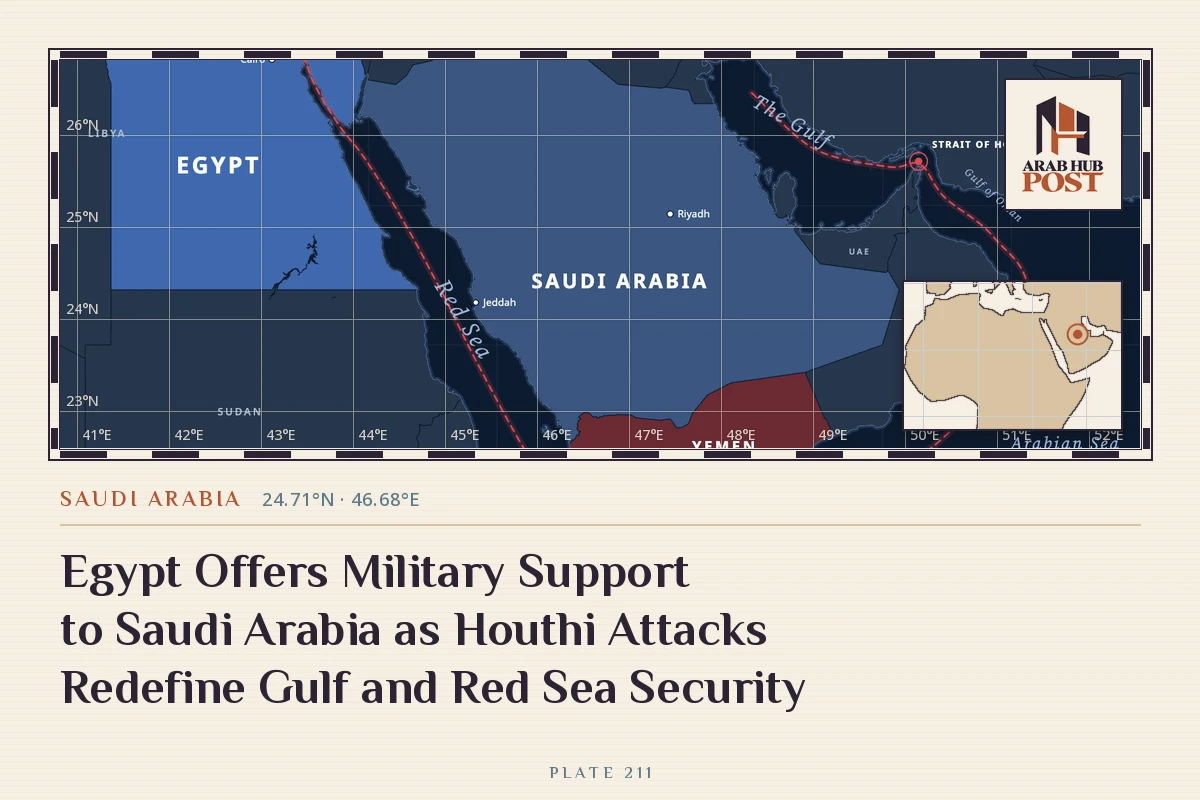
The security of the Gulf and the Red Sea can no longer be considered separate issues, just as the war in Yemen is no longer a local conflict that can be contained apart from regional and international rivalries, according to a new analysis. Developments in October 2026, including renewed Houthi confrontations with Saudi Arabia and attacks on critical infrastructure and civil aviation, have changed the nature of these threats: maritime routes, energy facilities and national economies are now being used as leverage in regional conflicts.
The region faces a fundamental question: whether Arab states can protect their interests and prevent adversaries from dictating security terms without being forced to choose between escalation and strategic exposure.
Egyptian Pledge Amid Growing Threats
On 17 October 2026, Egyptian President Abdel Fattah Al-Sisi said Egypt was ready to take necessary measures to defend Saudi Arabia if the kingdom formally requested assistance. He stressed that Cairo had no intention of attacking anyone and called for an emergency parliamentary session to consider authorising potential military support if Saudi Arabia submits such a request. The following day, Egypt’s National Defence Council announced it would provide the required and feasible forms of support to Saudi Arabia while intensifying political and diplomatic efforts to reduce tensions.
Read also: Sudanese refugees in Egypt face shifting asylum landscape as UNHCR role wanes
Egypt’s position came as Saudi security became directly tied to the Yemen war, maritime navigation in the Red Sea and the protection of energy facilities and civil aviation. But Cairo faces a delicate balance: translating commitments to a regional partner into practical action without becoming entangled in an open-ended conflict that carries military and economic costs that could be difficult to manage.
Egypt views Saudi Arabia’s security as an integral part of its own national security, given the impact of Gulf stability on its economic and strategic interests and the importance of the Red Sea to the Suez Canal and international trade. However, this interdependence does not mean every threat to Saudi Arabia automatically warrants Egyptian military intervention. A prudent response requires assessing the threat, choosing the appropriate tools and maintaining strategic flexibility to prevent a crisis from escalating into a regional war.
Read also: Khartoum airport drone attacks raise alarm over passenger safety
Weakness of Conventional Military Superiority
Recent developments have exposed the weakness of the assumption that military superiority, defence spending and security partnerships are enough to guarantee security. Houthi attacks have shown that a less conventional actor can use missiles, drones and pressure on maritime corridors to cause disruption far beyond its material capabilities.
A weaker adversary does not need to win a conventional battle to impose significant political and economic costs. It may be enough to make protecting airports, oil facilities, ports and shipping lanes a continuous and expensive task, while eroding confidence in the state’s ability to maintain stability.
Attacks on King Khalid International Airport in Riyadh and on facilities operated by Saudi Aramco have highlighted the scale of this challenge. On 11 October, United Nations Secretary-General António Guterres condemned the airport attack, called for an end to the strikes and warned that attacks on civilians and civilian infrastructure violate international law.
The consequences of such attacks go far beyond immediate physical damage. Airports and energy facilities underpin investment, tourism and the movement of goods and people. As confidence in their security declines, insurance, transport and protection costs rise, forcing governments to balance development priorities with growing defence requirements.
Read also: Egypt will defend Saudi Arabia, not attack Yemen, Sisi tells forum
Economic Transformation Under Pressure
This is particularly important for Saudi Vision 2030, which depends on economic diversification, attracting investment and expanding tourism. These ambitions require a stable operating environment, while persistent attacks may lead investors to reassess regional risks even if economic activity does not stop entirely.
It cannot be concluded that these attacks will derail Saudi Arabia’s economic transformation. But their continuation could create tension between economic openness and the need to devote more resources to protecting critical assets. The central challenge may ultimately be the cost of keeping the economy open in an unstable environment, rather than the ability to retaliate against any single attack.
Red Sea as Strategic Vulnerability
These concerns become even more serious when the focus shifts to the Red Sea, where Saudi, Egyptian and Yemeni interests intersect with global trade. The Bab el-Mandeb Strait is a critical link on the maritime route connecting the Indian Ocean to the Mediterranean through the Suez Canal. Prolonged disruption could force shipping companies to reassess routes, transit times and costs, with potential repercussions for supply chains and shipping rates between Asia and Europe.
In a briefing to the United Nations Security Council on 15 September, Khaled Khiari, the UN Assistant Secretary-General, warned of mounting security volatility around Bab el-Mandeb. He noted that Houthi advances towards the strait had heightened market concerns amid disruptions in the Gulf. He called for respect for freedom of navigation, restraint and engagement in political efforts.
Read also: King Hamad and President Macron discuss strategic cooperation, regional security
The available evidence does not show that the maritime corridor will be closed. However, it does suggest that elevated risks or repeated attacks could prompt shipping companies and insurers to revise their calculations. Geography can thus shift from an economic advantage to a strategic vulnerability, as the importance of a maritime corridor gives those who threaten it influence far beyond their borders.
For Egypt, a decline in the attractiveness of the Red Sea-Suez Canal route could pressure one of the foundations of its economic position. Potential losses for the Suez Canal cannot be quantified in advance; they depend on shipping volumes, the duration of disruption, corporate decisions and the availability of alternative routes. Nevertheless, persistent risks make preventing escalation an essential part of protecting Egypt’s economy, not just a diplomatic objective.
The Gulf and the Red Sea should therefore be understood as a single strategic security space. Escalation in the Gulf may redirect pressure towards the Red Sea, while threats to Bab el-Mandeb may constrain the ability of states to rely on alternative routes. In this environment, maritime security becomes inseparable from energy, food supplies, trade, investment and governments’ capacity to prevent the costs of regional conflicts from spilling over into everyday life.
This analysis is based on an article by Dr Marwa El-Shinawy, academic and writer.




Reader comments
No comments on this report yet.