
Syrian Security Forces Intensify Preemptive Raids Against ISIS Cells Across Multiple Governorates
Published Updated By Arab Hub Post Staff
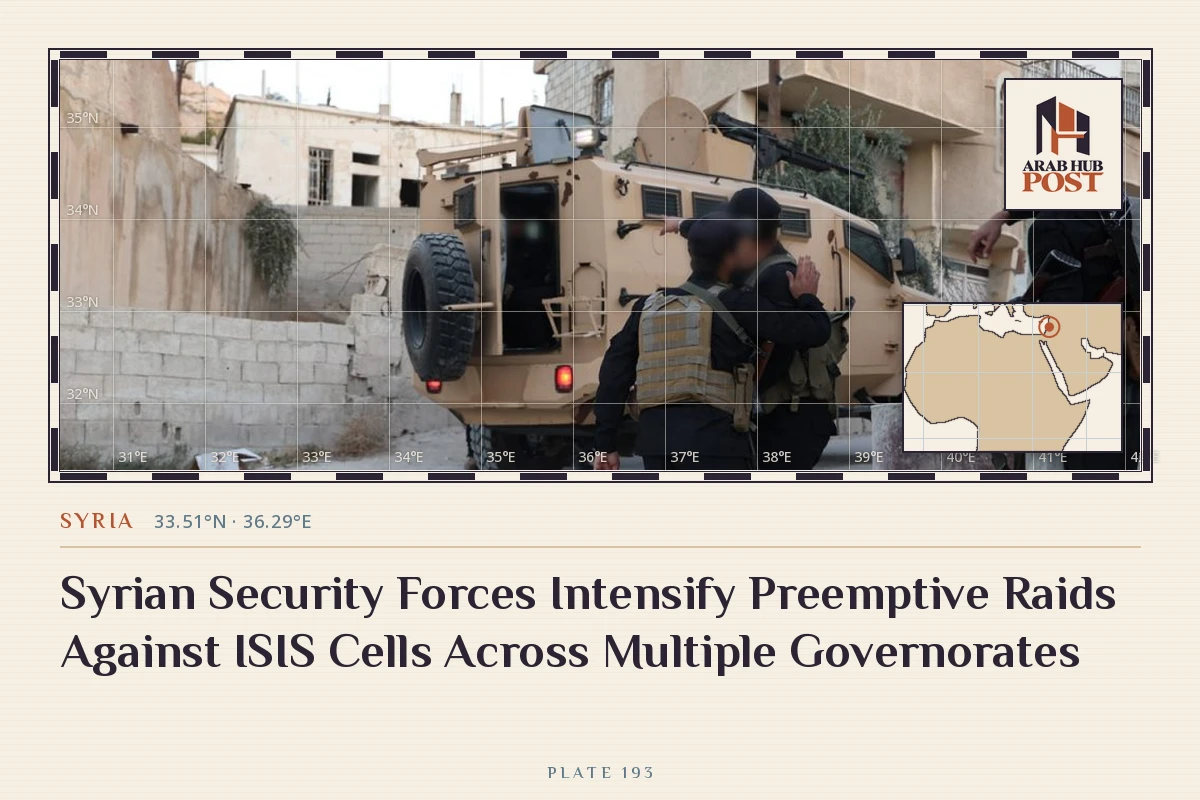
On 22 October, Syrian security forces carried out a coordinated operation in the town of Rankous, west of Damascus, which has been described as one of the most significant clashes with ISIS this year, according to The Syrian Observer. Internal Security Forces, working with the General Intelligence Service, raided an ISIS cell, killing five militants and arresting six others. They also seized weapons and explosive belts that were ready for immediate use.
Two members of the Internal Security Forces were killed and five were wounded in the operation, marking the highest single-day casualty toll among Syrian security personnel in 2026. The intensity of the fighting and the presence of suicide belts indicated that the cell consisted of trained operatives prepared for sustained resistance, rather than a marginal group.
Series of Operations Foil Multiple Plots
The Rankous raid came less than a week after authorities prevented an attack on a police patrol in rural Damascus, reflecting an accelerated tempo of preemptive actions against ISIS cells embedded in urban and semi-urban areas. Throughout October, Syrian security agencies conducted multiple proactive raids across several governorates.
On 6 October, in Hajjira, south of Damascus, authorities arrested Khaled Raed Biruni, also known as “Abu Hassan Doushka,” who was identified as ISIS’s general military commander for the former “Homs Province.” Officials described him as the group’s operational arm in the area, responsible for planning sectarian attacks in Homs and overseeing the preparation of improvised explosive devices.
Three days later, on 9 October, a cell was dismantled in the Houla region of northern rural Homs. Two individuals were arrested, and two IEDs intended for attacks on places of worship and security patrols were seized. Investigations revealed that one detainee was responsible for receiving and transporting explosives, while another had attempted to rig a railway track with explosives. On 16 October, a joint operation disrupted a plot targeting a police patrol in rural Damascus, securing a ready-to-detonate device and arresting the suspects.
Broader Campaign and Autumn Resurgence
These operations were part of a larger campaign announced by the Ministry of Interior, which reported 61 raids across multiple governorates, resulting in 71 arrests and the confiscation of weapons and explosives. The surge in activity followed a relatively quiet summer period, when ISIS attacks declined sharply due to sustained pressure and logistical constraints.
ISIS, which relies heavily on mobility across the vast Syrian Badia, appears to be facing operational limitations. The summer lull reflected a recalibration to unfavorable field conditions rather than a cessation of intent. With the arrival of autumn, certain cells resumed low-cost attacks, mostly in open terrain on the outskirts of cities or along transit corridors linking central governorates to the desert and eastern regions.
Read also: Syria's Oil Contract Audit: $104 Million Freeze Not Embezzlement, Officials Say
The most notable attack occurred on 13 October along the Salamiyah–Athriya road in eastern rural Hama, where gunmen suspected of ISIS ties ambushed two road security patrols, killing four personnel and injuring several others. A separate assault targeted the Al-Hamra checkpoint nearby. The execution style — a swift ambush on motorcycles followed by immediate withdrawal — mirrored tactics ISIS has used in the desert in recent years.
Energy Infrastructure Under Attack and Regional Displacement
In Deir ez-Zor, the same period saw sporadic assassinations of security personnel, IED attacks on secondary roads, and incidents near the Iraqi border, including in Al-Baghouz. Energy infrastructure also came under repeated attack. The Jibsa gas export pipeline suffered multiple strikes since August, while petroleum transport pipelines between Baniyas and Homs were damaged. Additional incidents were reported near Damascus. Some were classified as sabotage, while others remain under investigation.
ISIS has historically targeted oil and gas infrastructure for extortion or to demonstrate its ability to disrupt the economy. However, the rapid frequency and wide geographic spread of recent attacks raise the possibility of involvement by other actors, including smuggling networks or groups seeking to maintain instability. Repeated attacks in the eastern Badia align with ISIS’s capacity to maneuver across open terrain and conduct low-overhead operations that yield limited direct military gains but carry significant economic and psychological impact.
Read also: Syria's Transitional Parliament Grapples with Legislative Backlog and Reform Priorities
These developments reveal a clear pattern: ISIS cells are being pushed onto the defensive in residential areas and suburbs, while attempting to maintain symbolic presence through low-cost strikes in the desert and along highway corridors. Field data indicates that Syrian preemptive operations have penetrated the group’s urban networks, leading to the arrest of field commanders and the interception of explosives before detonation. As a result, planning complex attacks in populated centers has become significantly more difficult and costly for ISIS.
Improved intelligence capabilities have been central to this shift. The precision of the raids in Rankous, Hajjira, Houla, and rural Damascus reflects advancements in information gathering, analysis, timely deployment, and inter-agency coordination. The ability to strike ISIS cells before execution narrows the group’s operational space, forcing a pivot from offense to defense. In urban environments, survival has become increasingly precarious, prompting remaining operatives to seek safer havens — a dynamic that underscores the cross-border dimension of the threat.
According to intelligence assessments, sustained pressure inside Syria is pushing portions of ISIS networks toward Iraq, where rugged terrain, vast spaces, and security gaps persist in certain areas, particularly around Kirkuk and parts of Diyala and Saladin. Increased activity recorded in those regions, especially in Kirkuk where ISIS carried out several notable operations during the same period, aligns with this outward shift.
This report is based on information provided by The Syrian Observer.





Reader comments
No comments on this report yet.