
Syria’s Oil Contract Audit: $104 Million Freeze Not Embezzlement, Officials Say
Published Updated By Regional Desk
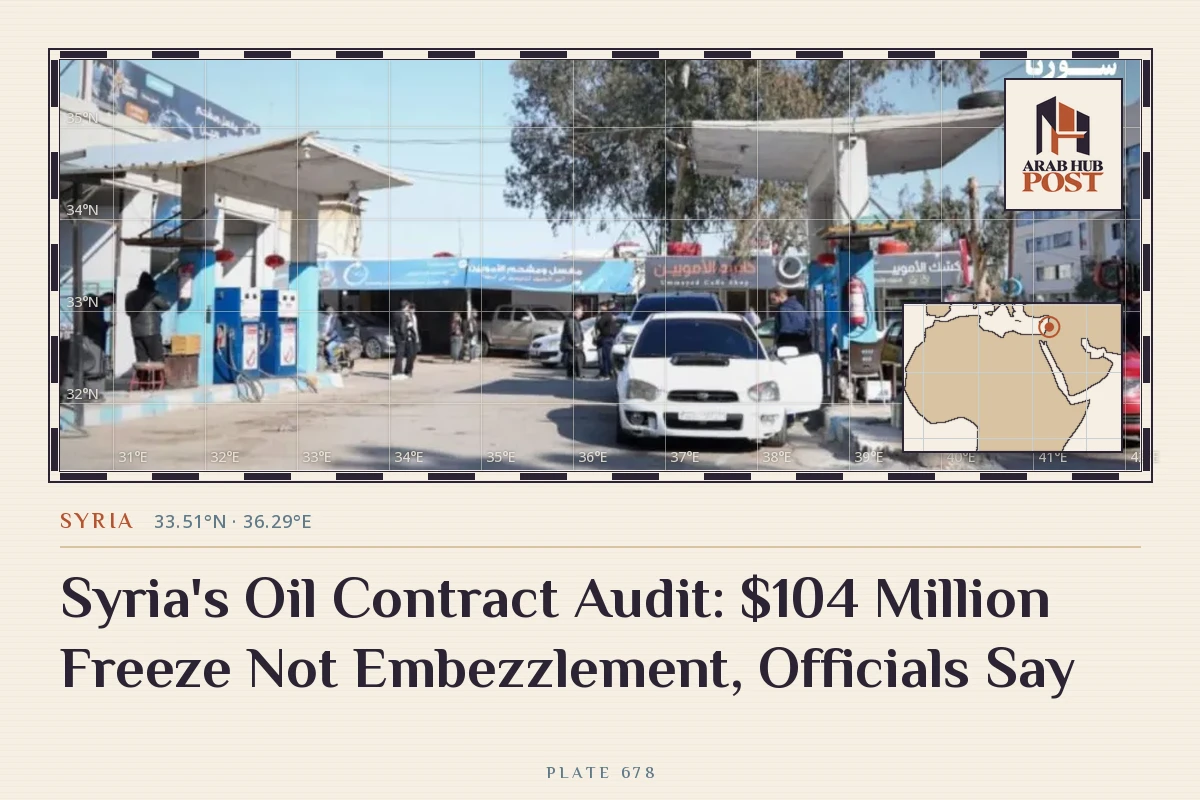
Syria’s oil sector is facing renewed scrutiny over contracts worth millions of dollars, following social media posts and news reports alleging corruption and embezzlement of around $110 million. The controversy has focused on the Syrian Petroleum Company (SPC), its chief executive Youssef Kablawi, and speculation about his possible dismissal or referral for investigation, according to a report by The Syrian Observer.
Official statements, however, paint a more nuanced picture than the online narratives. The SPC has denied that the $110 million figure represents verified embezzled funds. The Central Authority for Inspection and Control (CAIC) clarified that the sum corresponds to a precautionary asset freeze of approximately $104 million imposed on several contracting firms, with investigations still ongoing.
Read also: Syria's Transitional Parliament Grapples with Legislative Backlog and Reform Priorities
How the $104 Million Figure Emerged
The debate began with reports of financial irregularities in multiple oil-sector contracts. Within days, public discussion escalated into headlines alleging the embezzlement of $110 million. On 26 September, the SPC issued a statement rejecting claims that funds had been stolen or lost from its accounts. It explained that the circulating figure does not reflect the value of the audited contracts, but rather a preliminary estimate of potential damages in files still under review. No final findings have confirmed actual losses or assigned legal responsibility.
Read also: UAE Data and AI Company CNTXT AI Reaches $300 Million in Committed Revenue, Opens First US Office
The distinction between estimated damage and proven embezzlement is central to the case. On 29 September, Amer Al-Ali, head of the CAIC, told state news agency SANA that the ongoing audit covers several oil-sector contracts and focuses on performance issues after contract execution. He noted that the authority had already been reviewing these files before they attracted media attention. Al-Ali stressed that the $104 million figure does not represent stolen funds. It is a precautionary lien placed on the assets of specific contracting companies under investigation—protective measures to safeguard public money until investigations conclude, not final rulings establishing embezzlement. He also emphasised that auditing contract performance does not constitute an indictment of the SPC or its employees. Individual responsibility will be determined strictly by the final investigation results. The company is cooperating fully by providing all requested documentation, and any legal referrals will depend on the investigation’s final findings.
SPC’s Position on the Contracts
The SPC rejected the notion that the contracts under review form a single case, noting that each was signed under different circumstances. According to the company, several contracts were executed during exceptional conditions surrounding the recovery of oilfields and facilities in the eastern region. These operations took place amid complex security and logistical challenges that required urgent measures to protect wells, facilities and crude oil, and to treat contaminated water before it reached the Euphrates River.
Read also: Syrian Security Forces Intensify Preemptive Raids Against ISIS Cells Across Multiple Governorates
The SPC also denied claims that all contracts were awarded through direct negotiation. It stated that many were conducted through formal tenders and competitive bidding processes involving technical and financial evaluations. Direct contracting, when permitted under standard regulations, does not inherently indicate corruption, the company added.
Local sources identified three firms linked to the disputed contracts: Star Petronova, Golcon and Ta’zeez. CEO Youssef Kablawi publicly defended the agreements, denying corruption or procedural violations. He said the contracted companies possessed the technical capacity required for the work and that most personnel involved were locals from the eastern region. An informed source familiar with the file told Ultra Syria that the issue is not the existence of contracts with private firms, but rather the auditing of execution stages and compliance with contractual terms. The source cautioned that figures cited in media coverage should not be treated as a definitive loss to the state before investigations are concluded and documents, books, quantities and executed works are fully audited. Investigators aim to distinguish administrative or technical observations from violations that may carry financial or criminal liability.
Read also: Algerian Saharan Blend Tops Arab Oil Prices in September 2026
CEO Youssef Kablawi Remains in Post
Responding to rumours about Kablawi’s fate, the SPC denied that its CEO had been detained or referred for investigation. No official decree has relieved him of his duties. On 29 September, sources confirmed that Kablawi was actively performing his responsibilities and appeared in his capacity as CEO during an official event related to the Arab Gas Pipeline in rural Homs. Kablawi also addressed a separate public controversy stemming from comments he made during a media appearance defending the company’s contracts. His remarks about public reaction on social media drew criticism, prompting him to issue a video apology on 28 September.
Broader Oversight in Syria’s Energy Sector
The current probe coincides with wider regulatory reviews across Syria’s energy sector. In August, the CAIC announced findings of procedural violations, operational gaps and management issues related to oil production, transport and calibration in Deir ez-Zor fields, estimating damages to public funds at approximately $28 million. That investigation resulted in the suspension and referral of several officials.
Based on official statements and available data, the situation can be summarised as follows: a formal regulatory audit of specific oil-sector contracts is ongoing; the $104 million figure represents a precautionary asset freeze on contracting firms, not proven embezzlement; the SPC considers the $110 million figure a preliminary estimate of potential damage, not an established loss; no final rulings have assigned individual liability; and no official decision has been issued regarding the dismissal or detention of CEO Youssef Kablawi. The final outcome will depend on the results of regulatory and judicial procedures once investigations conclude.



Reader comments
No comments on this report yet.