
Syria’s Transitional Parliament Grapples with Legislative Backlog and Reform Priorities
Published By Regional Desk
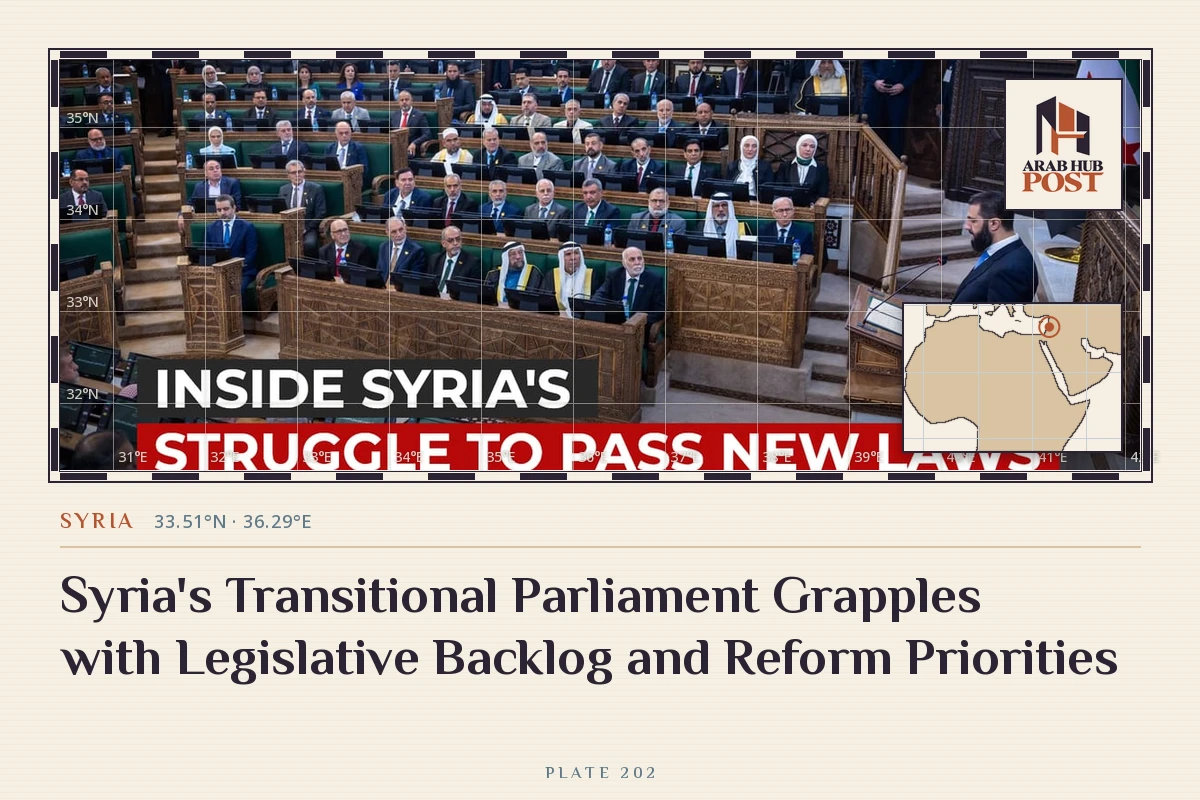
Syria’s transitional legislative machinery has started to advance, though not at the pace many citizens anticipate. Recently, the Constitutional and Legislative Affairs Committee of Parliament took delivery of a batch of draft laws from the Presidency, even as ministries continue to scrutinise other bills. Meanwhile, lawmakers are attempting to clarify which proposals have formally entered the legislative pipeline and which are still lodged within the executive branch.
This uncertainty mirrors a wider challenge facing Syria’s transitional bodies: a draft law does not advance merely because an issue has been identified or a text prepared. A bill must traverse ministries, consultations, the Presidency and parliamentary committees before it reaches the People’s Assembly floor. At every step, debates over priorities, implementation and coordination can cause delays. For ordinary Syrians awaiting reforms in property, investment, justice, public administration and other spheres that affect daily life, these procedural nuances carry real‑world impact.
Ministry Files to the Parliamentary Floor
The most concrete sign of movement came from Abdulnasir al‑Hushan, head of the Parliamentary Legislative and Constitutional Committee, who informed Levant24 that the panel had received 10 draft laws submitted by the President. The committee examined seven of them, with several needing swift endorsement and three slated for referral to specialised committees.
Al‑Hushan said some drafts had already been approved, among them a bill that would bar administrative decisions from being shielded from judicial review. He added that several new draft bills had arrived while the committee awaited their formal referral to the Constitutional Committee.
However, al‑Hushan warned against seeing lawmaking as a process that can be sped up simply by funneling drafts to Parliament. He explained that legislation starts with pinpointing root problems, followed by consultations with stakeholders, civil society and experts before any drafting or solution development begins.
Al‑Hushan stressed that Parliament retains the right to initiate legislation independently. “The original principle of the legislative process is for MPs to propose laws,” he said. Nevertheless, the legacy of the Assad era has shifted priority toward government‑sponsored bills, since the executive bears implementation responsibility and is best placed to grasp legal complexities and repercussions.
Lawmakers can draft bills, al‑Hushan noted, but the need for consultations and expert input may slow their progress or debate. Although government approval is not strictly mandatory, governmental consultation remains indispensable when a proposal carries financial or social ramifications.
Read also: Bahrain MPs urged to rethink financial aid, housewives insurance and other bills
Ahmad al‑Omar, a lawyer and member of the Assembly’s Constitutional and Legislative Affairs Committee, told Levant24 that the slow pace of draft submissions is not attributable to ministerial negligence. He highlighted the sheer volume of legal baggage inherited from the Assad regime, noting that ministries and public agencies must first set priorities before undertaking comprehensive legal reviews.
The Ministry of Interior, he observed, initially focused on human resources before addressing its legal framework. Other ministries may likewise have drafts at varying stages, making it inaccurate to label every unsubmitted proposal as a bill merely “stuck” before Parliament.
Hisham al‑Afyuni, another member of the Constitutional and Legislative Affairs Committee, drew a similar distinction. Drafts can be finalised within a ministry or forwarded to the Presidency or another body for review without becoming formal legislative proposals before the People’s Assembly. In an interview with Levant24, he argued that the core problem is a lack of procedural transparency, which makes it hard to ascertain which bills are under preparation, who is accountable for them, and when they are slated for completion.
A Multi-Stage Process
The legislative process resembles less a single choke point than a chain of institutional handovers. Government‑drafted legislation may pass through ministries and other state bodies before reaching the Presidency and, ultimately, the People’s Assembly. Parliamentary committees then assess its constitutional and legal compatibility before it advances to substantive debate.
The government itself helps decide whether a problem actually requires a law. Al‑Hushan emphasised that some issues can be resolved via ministerial or government decisions, while others demand judicial or administrative action. Legislation, he said, is meant to set general rules, not to address individual cases.
This helps explain friction between the executive and legislative branches. Lawmakers have been holding back for government drafts to avoid duplicating work already under way in ministries. Al‑Hushan said specialists are now visiting ministries with relevant draft laws so parliamentary committees can coordinate their efforts rather than independently crafting legislation on the same topics.
Read also: Syria's Oil Contract Audit: $104 Million Freeze Not Embezzlement, Officials Say
The system has nonetheless started yielding tangible results. Judge Saad al‑Sheikh, director of the Legislation Department, told Levant24 that a committee reviewing exceptional laws had finished its work aside from final wording or notes.
The contentious Cybercrime Law is also approaching completion. Al‑Sheikh said the legislation had been finalised but then received further comments from the Ministry of Communications, prompting a meeting with the drafting committee. He added that the ministry’s observations would be incorporated before the law is submitted.
Laws Waiting Behind Syria’s Wider Transition
The content of legislation matters as much as the mechanics of passing it. Al‑Omar identified several measures addressing laws that clash with the Constitutional Declaration, including curbs on legal recourse against administrative decisions and provisions on income tax for taxpayers in areas that lay outside the former regime’s control during the Syrian Revolution.
He also cited legislation on tourism fees and tourist zones, plus a proposed amendment to the Penal Code article that criminalises abandonment of employment. Other priorities extend well beyond individual legal provisions. Al‑Afyuni said the transitional period demands a comprehensive review of laws governing justice, public rights and freedoms, public institutions, investment, the economy and real estate.
Property legislation is especially critical because reconstruction must tackle ownership claims, displacement and the rights of those who remain absent from their properties. Property rules can determine whether the displaced can reclaim homes and land. Investment laws affect whether businesses are willing to commit capital.
Al‑Hushan said proposed legislation on property in border regions does not wholly restrict property rights but introduces a licensing process to monitor ownership and investment on national security grounds. He maintained that the relevant ministries — Defence, Interior and Agriculture — should be involved in amending the law to ease licensing requirements for citizens and speed up applications. He added that the amended law was ready for presentation at the next parliamentary session.
The Directorate of the Interim Registry in Damascus launched a project to restore real estate records to preserve property and guarantee rights in December 2025, according to SANA.
Justice reforms affect access to courts and legal remedies. Administrative legislation shapes how public institutions operate and how citizens engage with the state. Al‑Afyuni said delays have repercussions beyond Parliament, stressing that citizens are awaiting legal solutions on property rights, litigation, employment, investment and public services. He specifically tied unresolved real estate issues to reconstruction challenges.
A System Searching for Balance
Can the Assembly become more proactive without duplicating ministerial work or encroaching on executive responsibilities? Al‑Omar argues that Parliament must manage expectations. “Enacting a law that cannot be implemented effectively renders both the law itself and the role of the Assembly as a legislative authority meaningless,” he said.
Al‑Afyuni, meanwhile, urged Parliament to shift toward proactive legislative work by drafting proposals, strengthening specialised committees and exercising oversight over executive institutions. He also proposed a periodic mechanism to track legislative projects, identify reasons for setbacks and keep the public informed of progress.
The emerging picture is not simply one of ministries withholding legislation or Parliament passively awaiting bills. Some laws are being crafted within government institutions, some have reached the Presidency, others have entered parliamentary review, and a few are near completion. The 10 drafts recently received by the Constitutional Committee indicate movement, while the unfinished review of other legislation shows the process remains uneven.
Syrian authorities must rebuild a legal system inherited from decades of Assad rule while establishing institutions capable of producing new laws in a coordinated and predictable manner. Whether that process can keep pace with the country’s demands for justice, reconstruction and economic recovery depends not only on how quickly Parliament votes, but on whether institutions upstream can turn identified problems into workable legislation.
More in Syria




Reader comments
No comments on this report yet.