
Syria President al‑Sharaa Urges Deeper Ties With Iraq, Backs Baghdad Reform Push
Published By Regional Desk
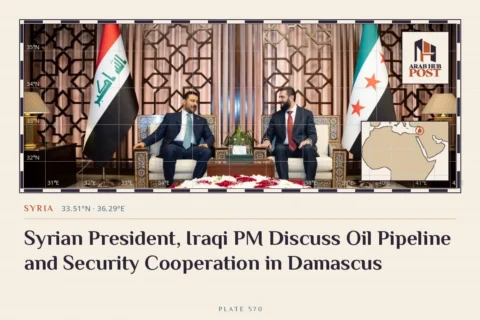
Syrian President Ahmad al‑Sharaa said in a televised interview that Syria and Iraq stand at a historic moment to strengthen cooperation, reclaim independent regional decision-making, and build capable states to protect shared interests and drive development. Speaking to Iraq’s Dijlah TV on Tuesday evening, the Syrian leader stressed the need to centralise military authority under the state, intensify anti-corruption efforts, and expand economic and commercial ties between the two neighbours.
Al‑Sharaa said both countries possess the fundamental building blocks for strong, sovereign statehood, describing the current juncture as a chance to move beyond decades of conflict, coups, and internal fragmentation. He underlined the importance of creating conditions for the return of refugees and investing in human capital, while voicing full support for Iraqi Prime Minister Ali al‑Zaidi’s programme to combat corruption and ensure that all weapons remain exclusively under state control.
Foundations of Bilateral Relations
The president emphasised that bilateral ties must be rooted in deep societal and grassroots connections rather than shifting political moods. He pointed to historic, familial, and tribal bonds linking Syrians and Iraqis, as well as shared hydrological resources: the Euphrates river flowing across large areas of Syria and the Tigris forming part of the international border. These natural ties, he argued, reinforce a common past, present, and future.
Describing Syria as Iraq’s maritime gateway to the Mediterranean, al‑Sharaa outlined his country’s role as a strategic corridor linking Western markets to Iraq and onward to the Arabian Gulf. This connectivity, he explained, is reflected in the integration of the ports of Tartus and Fao, overland trade routes connecting Saudi Arabia to Syria through Iraq, and corridors stretching from Türkiye across Syrian territory into Iraq. He also stressed the enduring importance of oil export routes to Mediterranean ports, recalling the historic Tapline pipeline of the 1950s.
Al‑Sharaa welcomed Baghdad’s positive stance toward the new administration in Damascus, praising former Prime Minister Mohammed Shia’ al‑Sudani for steering policy in the right direction. Regional stability, he argued, is mutually reinforcing: a stable Iraq benefits Syria, and a stable Syria benefits Iraq. Over the past eighteen months, he added, Syria has undergone rapid transformations, rebuilding international relations, strengthening national unity, and revitalising its geopolitical position and economic infrastructure.
Security Coordination and Border Stability
On security, border management, and counter‑terrorism, al‑Sharaa said Damascus has maintained a clear and consistent policy: the state must hold the exclusive monopoly on armed force. Reflecting on Syria’s own experience with multiple factions during its transition, he noted that integrating armed groups was achieved through consensus, prioritising economic development, institution-building, and security stabilisation.
He confirmed that high-level security coordination between Damascus and Baghdad ensures stable borders and continuous communication to address emerging threats. Regarding ISIS, the president cautioned that although extremist capabilities have sharply diminished, complacency would be dangerous. Regional fragmentation, he warned, creates fertile ground for extremist ideologies, making sustained cooperation and the integration of armed entities into formal state institutions essential.
Turning to the issue of Syrian detainees transferred to Iraqi authorities by the international coalition during a period of border clashes, al‑Sharaa said discussions with Iraq’s Supreme Judicial Council — including a visit by its president to Damascus — resulted in an agreement to establish a structured review mechanism. The programme will categorise detainees, assess any affiliation with ISIS, and determine the framework for repatriation.
Economic Integration and Agricultural Vision
Al‑Sharaa described economic ties as the natural foundation of bilateral relations, pointing to ongoing cooperation in energy and trade. He referenced discussions on oil projects involving regional and American firms, stressing the priority of restoring pipeline infrastructure to Baniyas. He also noted a surge in commercial transport, with tens of thousands of transit and import‑export trucks crossing the border in recent months, alongside growing Iraqi investments in sectors such as cement production.
On agriculture and water resources, the president called for a strategic vision treating the estimated 80 to 100 million dunums of arable land across Syria and Iraq as a shared food basket capable of serving 100 to 130 million people. By integrating modern agricultural technologies in partnership with countries such as Denmark and the Netherlands, he said, both nations can optimise water use and significantly increase yields.
Reflections on the Past and a Vision for the Future
Reflecting on his personal history, al‑Sharaa recalled travelling to Iraq in 2003 at the age of 18, driven by a personal conviction to stand with the Iraqi people against the American invasion rather than by any organisational or security affiliation. Imprisoned from 2005 to 2011, he expressed deep respect for the resilience, generosity, and hospitality of Iraqis, noting that many figures in contemporary Iraqi politics share similar formative experiences opposing foreign occupation.
In his closing message to the Iraqi people and political leadership, al‑Sharaa said the region stands at a critical juncture that requires leaders to speak honestly to their populations and prioritise development over historical grievances. He affirmed that Prime Minister Ali al‑Zaidi’s reform programme offers the right path for overcoming more than two decades of instability, enabling both nations to harness their sovereign resources, secure their borders, and chart an independent, prosperous future.
Reader comments
No comments on this report yet.