
Syria’s Textbook Revisions Remove Girls from Illustrations, Spark Concerns Over Gender Erasure
Published By Regional Desk
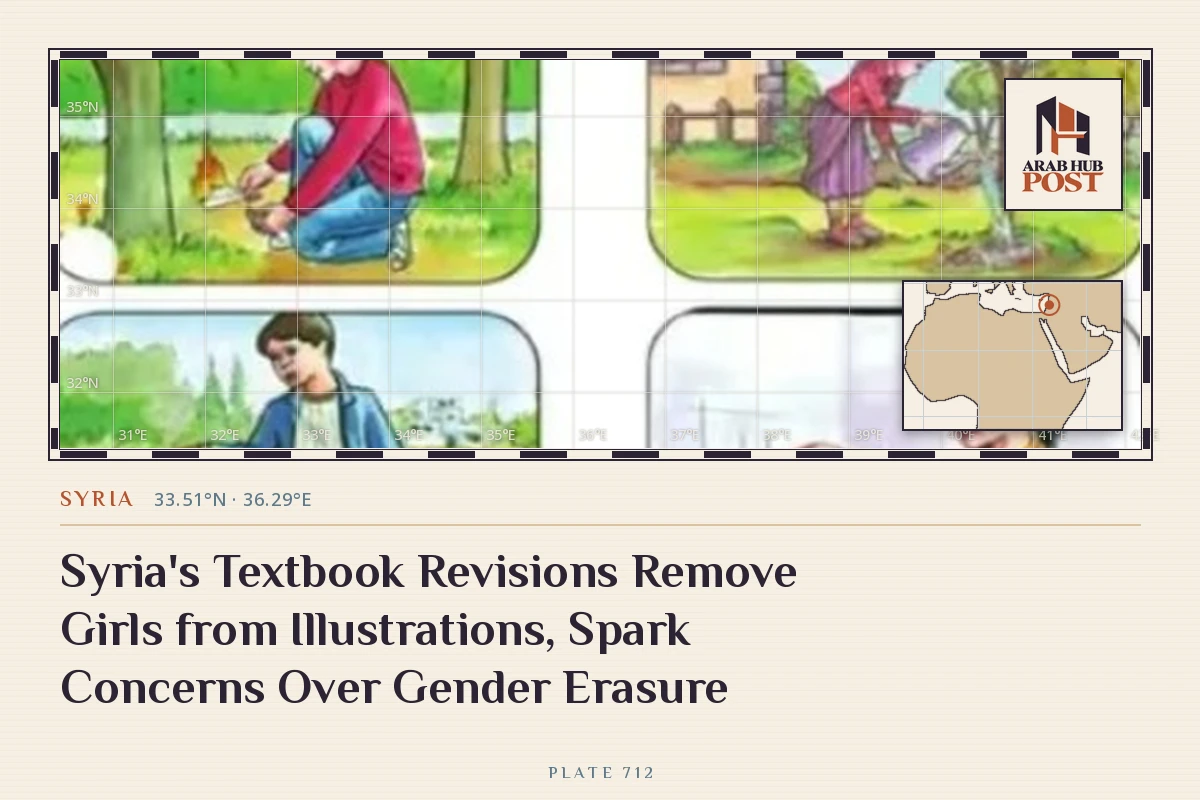
A recent revision of Syrian school textbooks has sparked controversy after images of girls were removed or replaced with boys, prompting criticism from educators and activists. The changes, which affect multiple grades and subjects, were verified by the fact-checking platform Verify-Sy and reported by journalist Mohammed Al-Saloum, who compared old and new editions.
Images of Girls Deleted or Replaced
In the 2014–2015 Islamic Education textbook for fourth graders, a girl skipping rope between two boys playing with a ball was depicted. In the current edition, the girl has disappeared, leaving only the two boys and the grass. A third-grade lesson titled “The Virtue of Cooperation” originally showed a girl digging with a shovel alongside peers planting saplings; in the new edition, the girl is removed while her peers and the pile of dirt remain. In other instances, a boy replaces the girl: two girls greeting each other at the door in a hospitality lesson have been turned into two boys, and a tree watered by a girl in an environmental lesson is now watered by a boy.
Hijab Added, Niqab Introduced
The revisions also include the addition of the hijab to women and girls who were previously depicted unveiled. A female doctor explaining vaccines to first-grade students now wears a head covering, and a girl drinking water from a tap was replaced by a veiled girl. In a fourth-grade lesson titled “Etiquette of Dress in Islam,” which previously showed a veiled girl, an unveiled girl, and two boys standing together, the image was replaced by two men wearing short robes, skullcaps, and beards alongside two women in full-face veils (niqab), each pair in a separate frame. The male attire—ankle-length robe and skullcap—does not match traditional Syrian dress, such as the rural sirwal or urban qumbaz, and represents a specific religious faction.
Historical Women Altered or Removed
The changes extend to historical figures. In a sixth-grade Social Studies textbook, Queen Elissa, previously depicted riding a horse into battle with a bow, was reduced to a stationary, covered head. In the twelfth-grade history textbook, text praising Lalla Fatma N’Soumer and Djamila Bouhired for their resistance against French colonialism remained, but their photographs were removed. The editorial effort was inconsistent: the same female doctor remained unveiled on the preceding page, and schoolgirls in a vaccination illustration kept their pigtails.
Education Ministry Responds
On 26 October 2025, the Ministry of Education issued a statement claiming that the only revision since the liberation in 2025 aimed at removing symbols of the former regime and “correcting images and related content” to “reflect the diversity of Syrian society.” The statement cited “inaccurate information” without specifying errors. The ministry referred the national curriculum standards to the Supreme Council for Education, established in August 2025 and chaired by the President of the Republic. Among its ten named members are the Minister of Religious Endowments and the Head of the Advisory Office for Religious Affairs, with no women. The four appointed experts remain undisclosed.
Criticism and Calls for Review
Critics argue that the changes amount to “symbolic annihilation,” excluding female representation and teaching children that girls are non-existent or irrelevant. The twelfth-grade Islamic Education textbook now adds that a woman’s status “grows” from daughter to wife to mother. A lesson on marital obedience for wives and financial support revocation for disobedient wives (nashiz) from the 2017–2018 edition was transferred intact. A seventh-grade Arabic language lesson stating that the constitution guarantees equality between men and women in rights and duties—and that Syrian women have had the right to vote since 1949—was removed. Syria acceded to CEDAW in 2003 without reservations on Article 10, which obligates states to revise textbooks to eliminate stereotypical concepts of male and female roles.
The ministry stated that implementation of new curricula will begin incrementally. Critics demand that the national framework and standards be published for public debate, subjected to an independent review of gender portrayal, and that the list of announced modifications be verified against actual changes. They also call for disclosing the four experts, including female specialists in the Supreme Council and authoring committees, and consulting teachers and parents. The article was translated and edited by The Syrian Observer, which has not verified the content.
Reader comments
No comments on this report yet.