
Kuwait Heart Association Urges Nationwide CPR Training and More Defibrillators to Boost Survival
Published By Arab Hub Post Staff
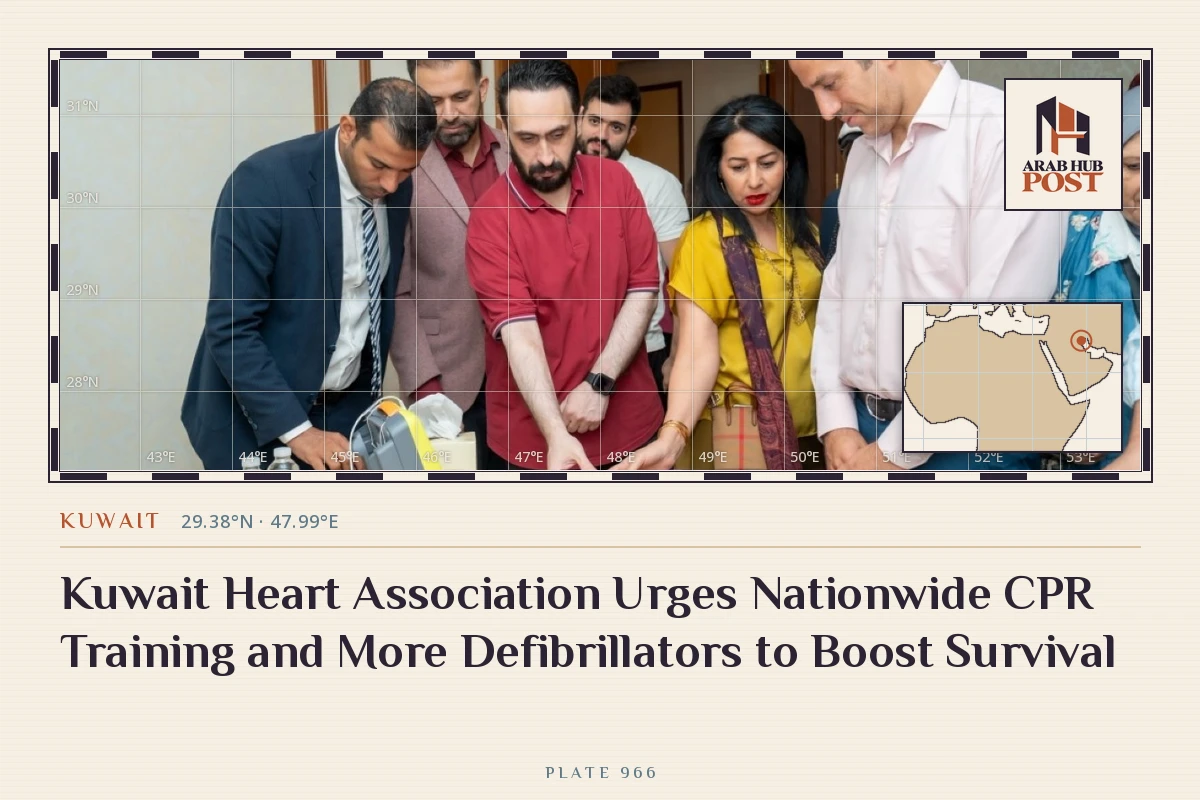
Kuwait’s Heart Association has urged broader public training in cardiopulmonary resuscitation and wider placement of automated external defibrillators to improve survival from sudden cardiac arrest.
The call comes as Gulf states intensify efforts to strengthen emergency response capabilities.
Workshop Highlights Gaps in Bystander Response
The association organized a workshop entitled ‘CPR in Public Places’ to raise awareness of the value of immediate help and to give community members basic lifesaving skills before emergency crews arrive.
Dr Ismail Habash, an emergency medicine specialist at Al‑Adan Hospital, said that roughly 70 percent of cardiac arrests happen outside hospitals and that the by‑stander CPR rate in Kuwait is only about 8.7 percent.
He also noted that bystander CPR rates are about 77 percent in San Francisco and Norway and around 48 percent in Singapore, highlighting the gap.
He added that these numbers show the need to widen awareness campaigns and hands‑on training so the public is better prepared to act in emergencies.
Dr Mohammed Zubaid, vice president of the Kuwait Heart Association and professor of cardiology at Kuwait University’s College of Medicine, stressed that building a culture of CPR across all parts of society is essential because sudden cardiac arrest can strike anywhere – homes, streets, malls or other public venues.
He noted that quick action before an ambulance arrives can be the difference between life and death.
Steps and Challenges in Emergency Care
Zubaid outlined the basic steps for responding to a suspected cardiac arrest: first check if the person is responsive and breathing normally, then call emergency services, and start chest compressions if the victim is unresponsive and not breathing normally.
He also warned that fear or lack of knowledge often stops people from helping, and that greater public confidence in performing CPR could improve outcomes.
He recommended installing automated external defibrillators in places such as shopping malls, schools, sports clubs and airports, explaining that the devices give voice prompts and decide whether a shock is needed.
Habash pointed out that the brain can start to suffer from oxygen deprivation within four to six minutes after blood flow stops, while ambulance response times usually fall between eight and twelve minutes, making early help crucial.
He clarified the distinction between cardiac arrest and a heart attack: cardiac arrest is when the heart ceases to pump blood effectively, often due to a serious electrical problem, whereas a heart attack results from a blockage that reduces blood flow to the heart muscle; a heart attack can lead to cardiac arrest but the two conditions are not identical.
The main aim of CPR is to keep blood and oxygen flowing to the brain and other vital organs until professional help arrives, which raises survival odds and lowers the risk of complications such as brain damage or lasting disability.
Habash identified fear of causing harm and uncertainty about the correct procedure as the chief reasons people hesitate to intervene, and said that repeated practical training can lessen those worries.
He also noted that individuals without formal training can follow telephone instructions from emergency responders to begin chest compressions.
Expanding Training and Defibrillator Access
Habash urged that basic CPR instruction be extended to pupils, children and other sections of the population, and that the number of defibrillators in schools, shopping centres and other public locations be increased.
He also called for a review of the legal rules governing assistance to injured people, to clarify responsibilities and give proper protection to those who act in good faith.
Another priority, he said, is to set clear indicators to gauge the progress of awareness and training schemes, and to monitor intervention and survival rates over time so that the success of programmes can be measured and shortcomings identified.
Musaed Campaign Progress
Kuwait Heart Association Secretary‑General Dr Rashid Al‑Owayesh said the association continues to promote CPR awareness through its ‘Musaed’ campaign.
The initiative has so far trained about 1,000 high‑school students and faculty members in CPR, preparing them to give immediate aid to sudden cardiac‑arrest victims until professional medics arrive.
Al‑Owayesh explained that the programme has delivered training sessions in roughly 14 high schools as part of a drive to widen participation, especially among students.
He added that educating members of the school community helps foster a lifesaving culture both inside and outside educational institutions, because trainees can pass on what they have learned to relatives and neighbours.
The campaign also backs the Ministry of Health’s target of training at least ten percent of Kuwait’s populace in first aid and CPR, which is framed as a shared social responsibility for health.
According to Al‑Owayesh, spreading these abilities throughout society improves chances for early intervention and helps cut fatalities and complications arising from sudden cardiac arrest.
He concluded that equipping more people with lifesaving skills strengthens community readiness and raises the prospect that help will be available during the vital first minutes of a cardiac emergency.




Reader comments
No comments on this report yet.