Kuwait calls for enhanced international cooperation on African development, disarmament and human rights
Published By Arab Hub Post Staff
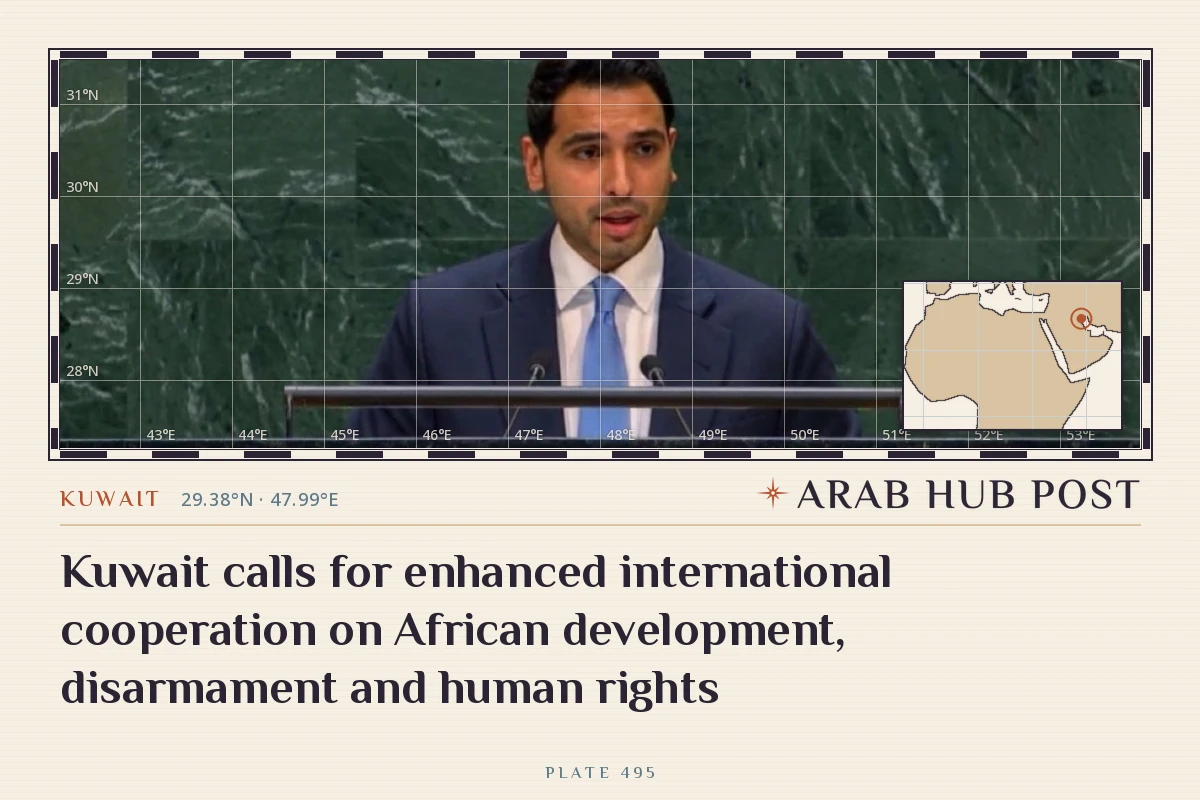
According to KUNA, Kuwait has reaffirmed its commitment to supporting sustainable development in Africa, strengthening international partnerships, promoting regional security and advancing human rights through multilateral cooperation at the United Nations.
According to KUNA, Kuwaiti diplomats delivered the statements on Monday evening before the UN General Assembly and its main committees, highlighting the country’s development assistance to Africa, calling for respect for state sovereignty and nuclear disarmament, and reaffirming Kuwait’s commitment to international human rights mechanisms.
As a Gulf state, Kuwait routinely uses such forums to outline its foreign policy priorities.
Support for African development
According to KUNA, Kuwait reiterated its commitment to supporting development across Africa and strengthening international partnerships to achieve the African Union’s Agenda 2063.
According to KUNA, speaking before the UN General Assembly during discussions on sustainable development in Africa, international support, conflict prevention and lasting peace, Kuwaiti Diplomatic Attaché Yousef Al-Mansour said, “Agenda 2063 and the 2030 Agenda for Sustainable Development were complementary frameworks for eradicating poverty, reducing inequalities and strengthening the resilience of African societies.”
According to KUNA, he stressed that peace and development were interconnected and that neither could be achieved in isolation.
According to KUNA, he highlighted the African Union’s “Silencing the Guns in Africa” initiative as an important effort to consolidate peace and create conditions conducive to development.
According to KUNA, he noted that the Kuwait Fund for Arab Economic Development had extended its activities to approximately 96 percent of the African continent through loans, grants and development contributions covering infrastructure, energy, water, transportation and essential services.
According to KUNA, he recalled the Arab-African Summit hosted by Kuwait in 2013, which saw the launch of several development initiatives, including the Dr Abdulrahman Al-Sumait Prize for African Development, worth $1 million annually.
According to KUNA, the summit also featured an announcement of $1 billion in soft loans for African countries through the Kuwait Fund, alongside an initiative to invest and guarantee an additional $1 billion in cooperation with international institutions.
According to KUNA, he stressed the need to address the development financing gap, mounting debt burdens and the economic consequences of climate change and armed conflicts.
According to KUNA, he called for greater access to concessional financing and the mobilization of long-term investments aligned with African countries’ development priorities.
According to KUNA, he underscored the importance of strengthening cooperation between the African Union and the United Nations and expanding Arab-African partnerships in renewable energy, food security, digital transformation and education.
According to KUNA, emphasizing African ownership and leadership of development programs, he called for greater investment in building young people’s capabilities.
According to KUNA, Al-Mansour concluded by reaffirming Kuwait’s support for African peoples and its continued humanitarian and development assistance to promote sustainable development, peace and stability.
Nuclear disarmament
According to KUNA, in a separate statement before the First Committee on Disarmament and International Security, Third Secretary of Kuwait’s Permanent Mission to the United Nations Abdulaziz Al-Saidi said addressing insecurity in the Middle East required confronting occupation, aggression and impunity.
According to KUNA, he warned that continued attacks by Zionist entity against Palestinians and countries in the region undermined prospects for peace and perpetuated cycles of violence.
According to KUNA, Al-Saidi reiterated Kuwait’s condemnation of Iranian attacks targeting Kuwait, other Gulf Cooperation Council (GCC) countries and Jordan since February, including attacks attributed to Iran-backed factions and militias in Iraq.
According to KUNA, he stressed that Kuwait was not a party to the ongoing conflict and had not permitted its territory, airspace or territorial waters to be used to launch attacks against Iran.
According to KUNA, he called on Tehran to fully implement UN Security Council Resolution 2817 (2026), cease direct and indirect attacks and threats, and respect the sovereignty of neighboring countries and the principles of good neighborliness.
According to KUNA, on nuclear disarmament, Al-Saidi reiterated Kuwait’s call for Zionist entity to join the Treaty on the Non-Proliferation of Nuclear Weapons (NPT) and place all its nuclear facilities and activities under the International Atomic Energy Agency’s (IAEA) comprehensive safeguards.
According to KUNA, he warned that Zionist continued exclusion from the treaty undermined the credibility of the international nuclear non-proliferation regime.
According to KUNA, Al-Saidi reaffirmed Kuwait’s support for establishing a Middle East zone free of nuclear weapons and other weapons of mass destruction, calling for a legally binding treaty involving all concerned parties and guaranteeing security for all on an equal footing.
According to KUNA, he also expressed regret that the 11th NPT Review Conference in 2026 failed to reach consensus on a final document, stressing the need to fulfill obligations relating to nuclear disarmament, non-proliferation and the peaceful use of nuclear energy.
According to KUNA, Al-Saidi highlighted Kuwait’s assumption of the presidency of the IAEA Board of Governors for 2026-2027 following unanimous endorsement, reaffirming the country’s commitment to strengthening the agency’s independence and credibility and supporting technical cooperation and the verification of nuclear commitments.
According to KUNA, regarding conventional weapons, he stressed the importance of safe and sustainable ammunition management and preventing illicit trafficking.
According to KUNA, he also noted Kuwait’s election as one of the vice-chairs of the preparatory meeting for the Global Framework for Conventional Ammunition Management.
According to KUNA, Al-Saidi concluded by calling for international commitments to be translated into concrete national measures and effective international cooperation to strengthen confidence in the global disarmament and international security system.
Human Rights Council mandate
According to KUNA, meanwhile, Kuwait has reaffirmed its commitment to playing an active and responsible role in international human rights efforts, as it seeks re-election to the UN Human Rights Council for the 2027-2029 term.
According to KUNA, speaking before the General Assembly’s Third Committee, which handles social, humanitarian and cultural affairs, Kuwaiti Diplomatic Attaché Omar Al-Saeed said the candidacy built on Kuwait’s contributions and initiatives during its current membership and reflected its determination to strengthen cooperation with member states.
According to KUNA, Al-Saeed reiterated Kuwait’s support for the Human Rights Council and its mechanisms, stressing that its work should be guided by universality, objectivity and non-selectivity and remain free from politicization and double standards.
According to KUNA, such principles, he said, were essential to strengthening the council’s credibility and its capacity to protect human rights and preserve human dignity.
According to KUNA, he noted that Kuwait, during its 2024-2026 membership, had actively participated in the council’s work, including interactive dialogues and the Universal Periodic Review mechanism, while supporting initiatives and resolutions related to human rights.
According to KUNA, he highlighted Kuwait’s particular attention to humanitarian issues and the protection of humanitarian workers.
According to KUNA, Al-Saeed also stressed the importance of strengthening coordination between the Human Rights Council, the General Assembly and treaty bodies while respecting their respective mandates, avoiding duplication and translating international commitments into practical action.
According to KUNA, he concluded that the promotion of human rights should be measured not merely by the number of commitments made, but by the extent to which those commitments improve people’s daily lives.
According to KUNA, Al-Saeed reaffirmed Kuwait’s determination to continue cooperating internationally to protect human rights and preserve human dignity without discrimination or selectivity.