Kuwait urges UN Security Council reform to correct African representation gap
Published By Regional Desk
Kuwait calls for UN Security Council reform to address African representation
Kuwait has stressed the importance of moving forward with reform of the UN Security Council to ensure fair representation for member states, correct ‘historical injustice’ to Africa, make it more representative, effective and able to fulfil its responsibilities for maintaining international peace and security.
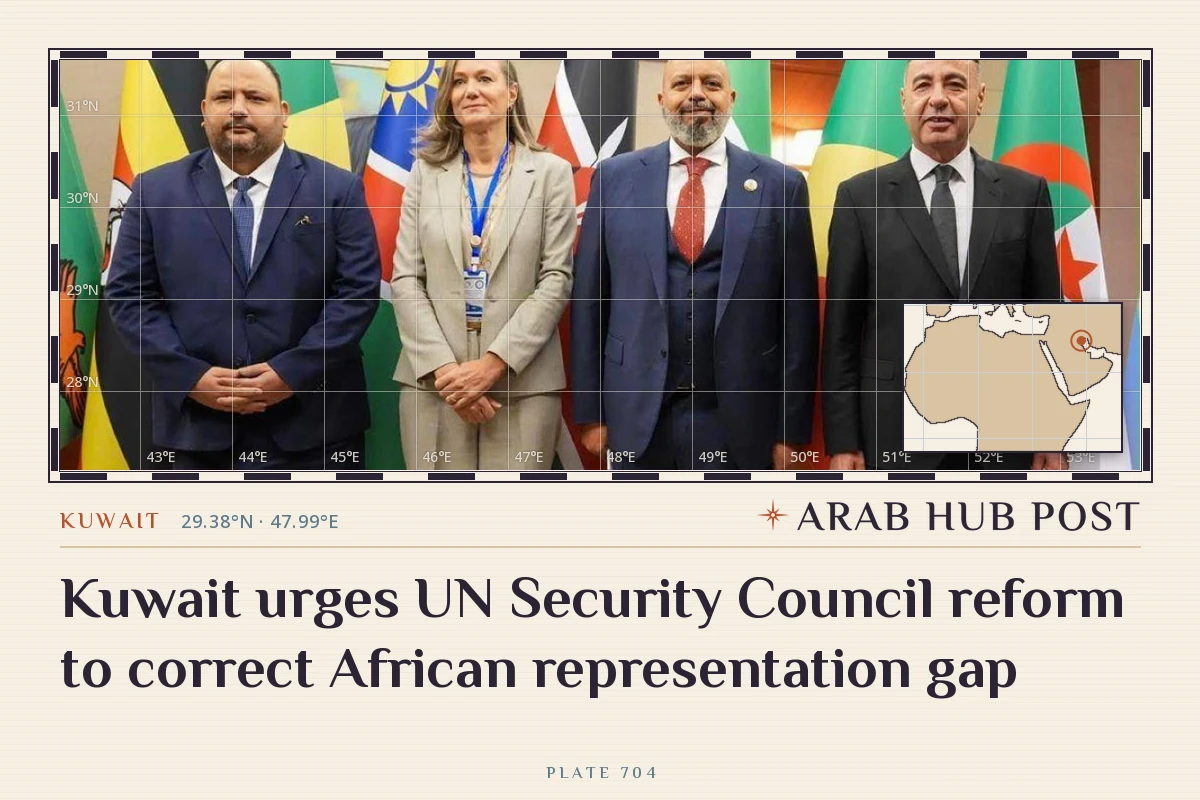
The remarks were made by Kuwait’s Permanent Representative to the UN, Ambassador Tareq Al‑Banai, in his capacity as one of the two co‑chairs of the Intergovernmental Negotiations (IGN) on Security Council reform, at the 14th ministerial meeting of the African Union’s Committee of Ten (C‑10) on reform, held in the Libyan capital Tripoli, according to a statement from Kuwait’s Permanent Mission to the UN.
The meeting on Monday was co‑hosted by Sierra Leone, which coordinates the C‑10, and Libya, and was also attended by the other IGN co‑chair, the Netherlands’ Permanent Representative to the UN, Ambassador Lise Gregoire‑van Haaren.
African model and proposed compromise
Al‑Banai stressed the need to address the historical injustice suffered by Africa, which has no permanent seat on the council and is underrepresented among its non‑permanent members, and said the council’s composition should reflect today’s geopolitical realities and the aspirations of member states.
He welcomed the African model presented by Sierra Leone during the 80th session of the General Assembly, based on the Ezulwini Consensus and the Sirte Declaration, which calls for Africa to have at least two permanent seats with all the prerogatives of permanent membership, plus five non‑permanent seats in total.
He explained that Africa opposes the veto in principle, but demands that new permanent members enjoy the same rights and privileges as current members for as long as the veto exists, and noted the African Union’s role in choosing the continent’s representatives before their election by the General Assembly.
Al‑Banai said the idea of permanent regional seats had emerged as a possible compromise between states that want more permanent members and those that want expansion limited to non‑permanent seats.
Under this formula, six or seven seats would be added and distributed by region, with the General Assembly electing countries to hold them for terms longer than the current two years, with the possibility of re‑election, which would strengthen institutional continuity while keeping members accountable through regular elections.
The proposed seats would have the same powers as the current permanent members, including the veto, bringing the council’s total membership to 21 or 22, with a mechanism for periodic review of the new arrangements.
He stressed that these elements were proposed as a basis for discussion, and that any compromise must take the African position seriously and reflect the continent’s demands for representation in both categories.
Progress, challenges and next steps
Al‑Banai said the Pact for the Future had given new political momentum to council reform by recognising the priority of correcting the historical injustice to Africa and encouraging member states to submit and refine reform models to find common ground.
But he acknowledged that deep divisions remain among member states over expanding both categories of membership, and that negotiations have not yet reached consensus on a single model.
He stressed the need for flexibility and for exploring common ground between the proposals, to achieve a reform with broad support that strengthens the council’s legitimacy and effectiveness.
At the end of the meeting, the co‑chairs briefed ministers on the latest developments in the negotiations, including the proposals submitted, among them the African Group’s.
The meeting was chaired by Sierra Leone’s Foreign Minister Mohamed Rahman Swaray and Taher Salem Al‑Baour, who is in charge of Libya’s Foreign Ministry.