Morocco’s new Parliament Speaker calls for deeper public ties and stronger oversight
Published By Regional Desk
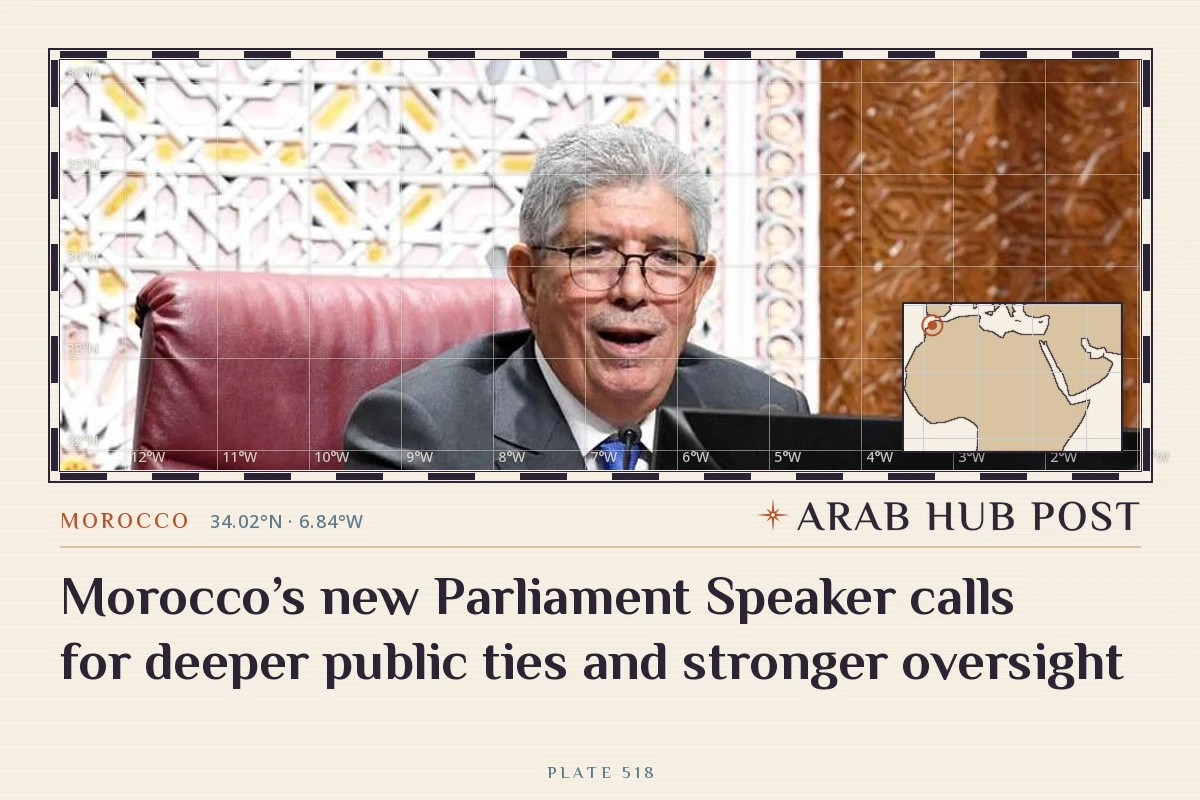
Morocco’s lower house of parliament on Tuesday elected Ahmed Touizi, leader of the Authenticity and Modernity Party (PAM), as its new speaker, after which he outlined a vision for closer ties between the legislature and the public.
In his inaugural speech, Touizi received 220 valid votes, defeating opposition candidate Idriss El Azami El Idrissi of the Justice and Development Party (PJD), who secured 59. A total of 369 ballots were cast, including 279 valid and 90 invalid.
Call for openness and engagement
Touizi argued that the quality of lawmakers’ constitutional work depends on their ability to understand social changes and respond to citizens’ concerns and expectations. “The parliamentary institution, as a representative of the nation, also draws its strength from being open to citizens,” he said.
He urged greater engagement with journalists and media organisations, civil society groups, professional bodies, universities and research centres, describing regular institutional openness as a shared responsibility. The approach, he said, was intended to build “bridges of communication and trust between the House and society,” allowing citizens’ concerns and proposals to be reflected in parliamentary work.
Legislative quality and government oversight
Touizi said parliament must exercise its constitutional powers in legislation, oversight and the evaluation of public policies while maintaining institutional cooperation between the two chambers and the executive branch, with full respect for each institution’s constitutional powers.
He singled out legislation as a central parliamentary responsibility, arguing that its purpose extends beyond passing laws to ensuring that legislation is well-designed, coherent and responsive to social change. “The true value of legislation is not measured by the number of texts adopted, but by the rights it enshrines, the guarantees it provides and the practical answers it offers to society’s needs and concerns,” he said.
Touizi called for more effective use of legislative initiatives, whether introduced by lawmakers or the government, to address economic and social developments and translate national policy priorities into legal frameworks that support development and meet citizens’ expectations.
He also emphasised the complementary roles of parliamentary oversight and public-policy evaluation, saying they allow lawmakers to monitor the implementation of government commitments and assess their actual impact on citizens. By combining legislation, oversight and evaluation, he said, parliament could improve public decision-making, strengthen the effectiveness of government policies and reinforce public trust in constitutional institutions.
National context and royal guidance
The PAM leader said the new legislative term began at an exceptional moment, presenting both opportunities and challenges as Morocco seeks to strengthen its position as an emerging and reliable economic power. He stressed the need to translate major national development projects into tangible improvements in people’s lives, with economic growth accompanied by social and regional justice.
Touizi said the king’s address at the opening of the legislative term should serve as a key reference for parliament in identifying priorities and responding to the challenges facing the country. He called for lawmakers to translate those priorities, within parliament’s constitutional remit, into coordinated institutional work focused on delivering results.
Morocco’s parliament, comprising the House of Representatives and the House of Councillors, plays a central role in the country’s constitutional framework, with the new speaker pledging to enhance its oversight and legislative functions.