
Qatar Renews Disaster Relief Commitment and Advocates for International Protection Convention
Published By Regional Desk
Qatar’s Humanitarian Response Mechanism
Qatar has reaffirmed its commitment to use its resources and expertise to assist countries and communities hit by disasters and crises. Through the Qatar Fund for Development and national humanitarian bodies, it has set up air bridges that incorporate the International Search and Rescue Group of the Internal Security Force (Lekhwiya), medical staff and field hospitals, alongside medicines, food baskets, shelter materials and advanced equipment for those affected.
Legal and Institutional Framework for Emergencies
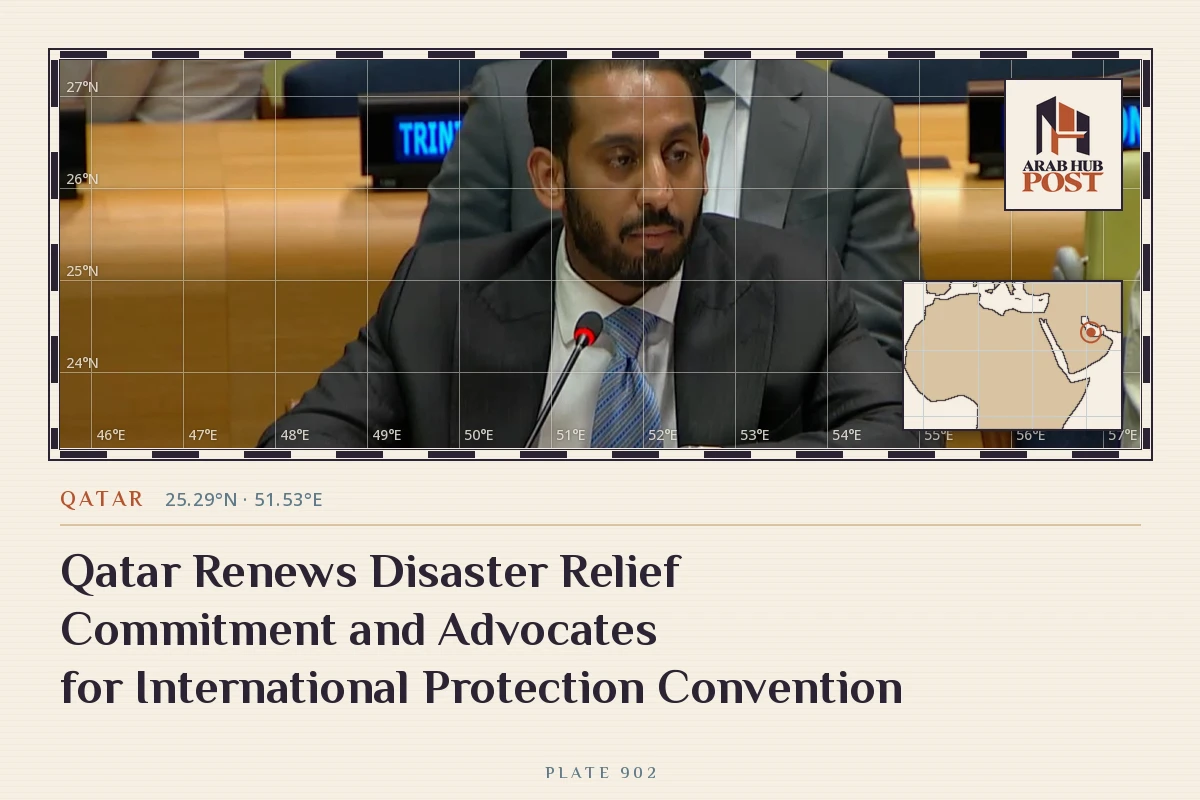
These remarks were made in a declaration by the State of Qatar, presented by Abdulaziz Fadala Al Sulaiti, Second Secretary at Qatar’s Permanent Mission to the United Nations, during the 81st session of the Sixth Committee of the UN General Assembly. The discussion concerned agenda item 88, titled ‘United Nations Conference of Plenipotentiaries on Protection of Persons in the Event of Disasters’, held at the UN headquarters in New York.
Al Sulaiti said Qatar attaches special importance to protecting individuals during disasters, a concern that has grown as such events become more frequent and severe. He observed that every country worldwide faces the threat of devastating natural hazards such as earthquakes, floods and hurricanes, which can cause loss of life and damage that may overwhelm a single state’s capacity to respond. Consequently, he stressed the need to strengthen international cooperation to safeguard lives and preserve human dignity, in line with the principles of the UN Charter.
He explained that Qatar has built a comprehensive legal and institutional system for managing emergencies and disasters, overseen by specialised national bodies. These comprise the Supreme Committee for Crisis Management, the Civil Defense Council, the Doha Joint Rescue Coordination Center, the Standing Committee for Rescue and Relief Operations and Humanitarian Aids for Areas Afflicted by Catastrophes in Brotherly and Friendly Countries, and the Regulatory Authority for Charitable Activities.
Advocacy for an International Disaster Protection Convention
Al Sulaiti added that Qatar backs the adoption of an international convention on the protection of persons in disaster situations, viewing it as a logical step that would create a unified global framework for reducing disaster risk and delivering relief assistance in accordance with international law. He pointed out that no explicit rule in public international law currently obliges states to provide humanitarian aid after disasters; such a convention would furnish a legal basis for necessary actions and establish a new mechanism for international cooperation in disaster response.
He emphasised that any agreement must strike a balance between guaranteeing the right of individuals to receive humanitarian aid and respecting the sovereignty of states and the principle of non‑interference in their internal affairs. This includes affirming the affected state’s right to select the provider of assistance, ensuring that aid is not imposed without a formal request, covering all stages of a disaster, clearly defining the parameters for aid delivery, protecting relief workers, and setting up effective coordination and implementation mechanisms within the UN framework.
Outlook for the UN Conference in Bangkok
The State of Qatar welcomed the forthcoming United Nations Conference on Protection of Persons in the Event of Disasters, scheduled to take place in Bangkok from 25 January to 12 February 2027. Qatar expressed the hope that the conference would lead to a legally binding instrument based on the draft articles, thereby strengthening protection for disaster‑affected populations and facilitating the delivery of humanitarian aid in line with international law.
Finally, Qatar reiterated its support for international initiatives aimed at enhancing the protection of individuals during disasters and affirmed its commitment to participate constructively in the conference proceedings, with the aim of establishing an effective international legal framework that respects state sovereignty and the tenets of international law while upholding human dignity and rights.


Reader comments
No comments on this report yet.