
Emir of Qatar Delivers Urgent Message on Global Responsibilities in Shura Council Address
Published By Arab Hub Post Staff
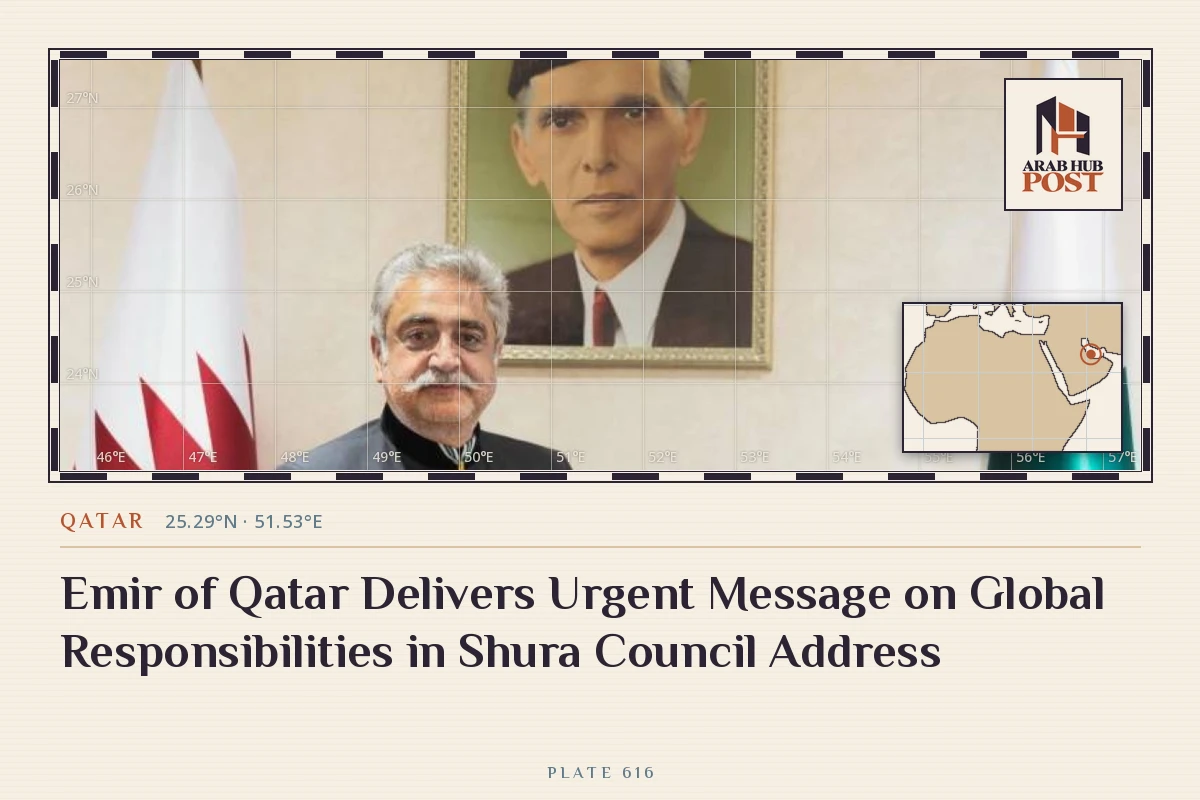
Qatar’s Emir, Sheikh Tamim bin Hamad al-Thani, delivered a powerful address at the opening of the Shura Council’s 55th annual session, issuing a warning that extends well beyond the Gulf state. In a year when conflict reached Qatari soil, he called on citizens, residents, and the international community to acknowledge that crises demand preparation, honest confrontation, and collective accountability.
Pakistan, which condemned the attacks on Qatari territory immediately, has observed Doha’s handling of the situation with admiration. The Emir outlined a clear doctrine: protect national sovereignty, maintain Qatar’s role in global energy security, and keep diplomatic channels open. This approach involved a firm defense of the homeland without escalating into full-scale war, ensuring supply chains continued to function, and pushing for a ceasefire and renewed negotiations. His strategy was a textbook example of crisis management.
Doctrine of Defense and Diplomacy
The Emir stressed that pursuing dialogue does not imply neglecting defense, and that protecting sovereignty does not preclude preventing a broader conflict. His remarks, he said, should be heard in capitals around the world. He was equally transparent about the costs: the closure of the Strait of Hormuz and damage to energy facilities at Ras Laffan, the center of Qatar’s gas industry, disrupted exports. State revenues dropped by 42% in the first half of the year. Yet spending was reduced by only 14%, with no cuts to essential services, and the non-hydrocarbon sector—now roughly 80% of real GDP—continued to expand. Few leaders present such figures so openly, a sign of confidence.
Resilience, the Emir observed, emerges not during a crisis but from the planning that precedes it, as years of military preparation and prudent fiscal management have demonstrated. Qatar’s recovery, he said, will serve as a springboard rather than a return to the past, backed by approximately 221 billion Qatari riyals in projects and investment opportunities over five years.
Pakistan’s Stake and Regional Interdependence
Pakistan attaches particular importance to this address. Qatar has long been its primary supplier of liquefied natural gas, so when the Emir notes that his country provides about one-fifth of the world’s LNG trade, and that any disruption affects consumers everywhere, Pakistani households and industries need no convincing. Nearly 300,000 Pakistanis live and work in Qatar, and it was significant to them that the Emir praised residents alongside citizens for their solidarity. Having helped broker this year’s ceasefire and hosted talks in Islamabad, Pakistan also understands the value of those who keep diplomacy’s doors open.
For the broader world, the speech serves as a timely reminder of shared responsibility. The Emir warned that regional and global security are intertwined, and that instability anywhere cannot be contained, a reality reflected in energy markets worldwide this year. Securing navigation through the Strait of Hormuz and protecting energy, water, and civilian infrastructure is therefore an international obligation, not a burden for the Gulf alone. Accountability also matters: Pakistan stands with the Emir in describing what has happened in Gaza as a genocide whose perpetrators must not escape justice, and in pursuing fair, comprehensive settlements in Sudan, Libya, Yemen, and Somalia.
A Shared Strategic Vision
The Emir’s candid assessment of the regional crisis demands careful international reflection. His emphasis on the interconnected nature of security, the vulnerability of vital energy infrastructure, and the consequences of disruptions to maritime navigation underscores an unavoidable truth: instability in the Gulf is never merely a regional concern. The international community must recognize that preventing escalation is a shared strategic responsibility, not solely an obligation for the countries directly affected.
Above all, the speech calls for a critical rather than comfortable appreciation of the situation: to strive for the best, prepare for the worst, and accept that both institutions and citizens must take responsibility. That creed—based on preparedness, a diversified economy, efficient institutions, and social solidarity—applies to any nation, including Pakistan. Both Qatar and Pakistan have worked tirelessly, often through painstaking and discreet diplomatic engagement, to help bridge differences between American and Iranian positions at various stages and through different channels. Their complementary diplomatic efforts, grounded in mutual trust, regional understanding, and a shared preference for de-escalation, represent a strategically important convergence on the international stage.
Qatar’s established mediation capabilities and Pakistan’s longstanding relationships with key regional and international stakeholders offer considerable scope for facilitating communication, narrowing differences, and preventing dangerous miscalculations. At this critical juncture, this partnership deserves to be strengthened as an instrument of regional stability and constructive diplomacy. In conclusion, the Emir said the truest way to honour the late Father Emir, Sheikh Hamad bin Khalifa al-Thani, whose vision strengthened the institutions that held firm this year, is to safeguard his achievements. Pakistan, which observed a day of national mourning at his passing, stands shoulder to shoulder with Qatar as it does exactly that.


Reader comments
No comments on this report yet.