
Bahrain MPs urged to rethink financial aid, housewives insurance and other bills
Published By Arab Hub Post Staff
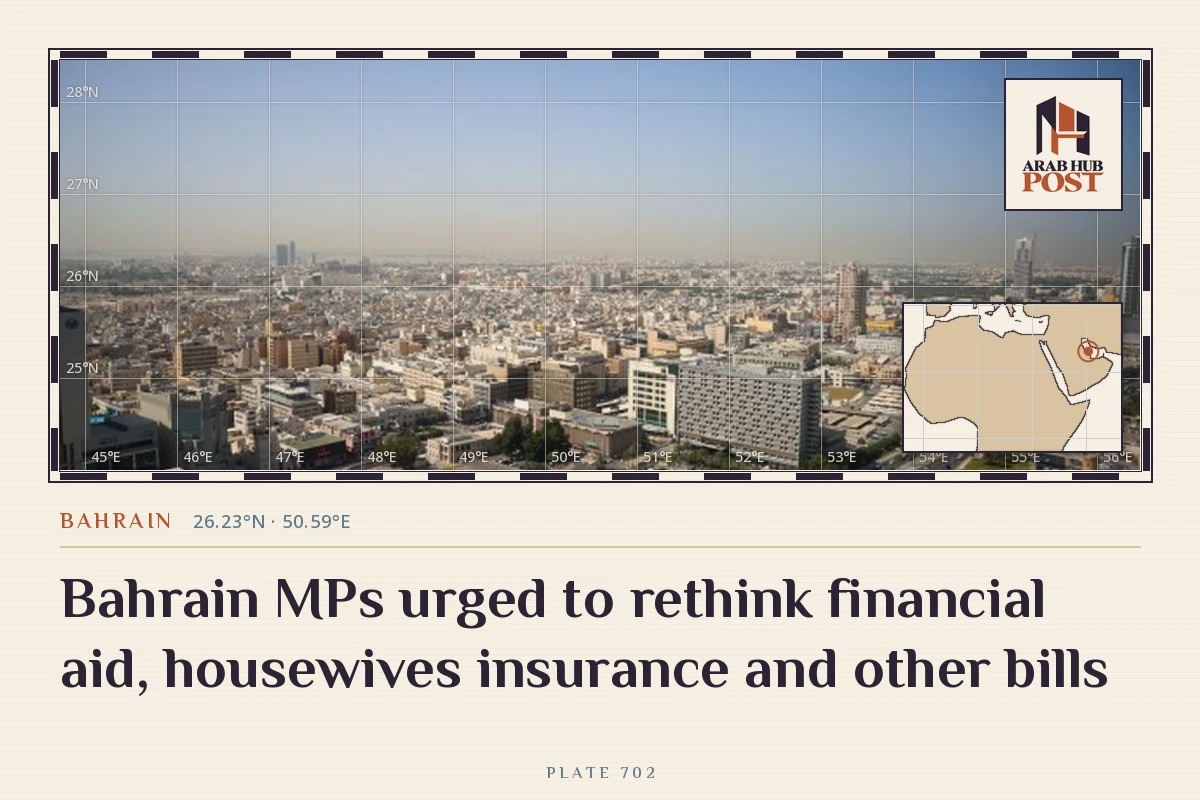
Financial support and social insurance proposals
Bahrain MPs have been urged to reconsider a proposed law to create a dedicated financial support account for low‑income citizens, with the government warning that the measure could weaken public‑budget principles and reduce flexibility in managing state finances.
The proposal would allocate one dollar for every barrel of oil exported from Bahrain whenever the export price exceeds forty dollars per barrel, and the proceeds would be placed in a special account earmarked for annual assistance to heads of Bahraini households, divided into three categories according to their monthly entitlement levels.
Officials said establishing a separate account tied to a specific revenue source runs counter to the constitutional requirement that all state revenues and expenditures be channelled through the general budget.
At the same time, the government has also urged Parliament to review a draft law that would allow Bahraini housewives to join the social‑insurance scheme on a voluntary basis, cautioning that the plan lacks sufficient financial studies and could jeopardise the long‑term sustainability of the insurance system.
The draft would permit housewives to make monthly contributions based on an income bracket of up to five hundred Bahraini dinars, with benefits covering old‑age, disability, death and lump‑sum compensation.
While acknowledging the need to protect housewives from financial hardship, the government argued that the proposal does not adequately explain how the new insurance category would be integrated into the existing framework.
Health tourism, renewable energy and abortion regulations
Regarding health tourism, MPs have been urged to reconsider a Shura Council‑proposed law to regulate the sector after the government pointed out legislative shortcomings that could undermine licensing, oversight and implementation of the envisaged framework. The draft, submitted to Parliament by His Royal Highness Prince Salman bin Hamad Al Khalifa, Crown Prince and Prime Minister, aims to oversee health‑tourism services and promote a segment that blends healthcare with tourism.
The government said the draft lacks a provision for a prior licensing mechanism for entities offering health‑tourism services, even though such licensing is essential to confirm compliance with technical, professional and administrative standards. It added that health‑tourism activities go beyond medical treatment to include accommodation, transport, reception, tourism programmes, marketing and other ancillary services.
Furthermore, the authorities noted that the proposal introduces a “health‑tourism visa” without supplying enough detail on its legal basis, eligibility criteria, application process, validity period, renewal arrangements or the authority that would issue it.
On renewable energy, legislators are set to debate a Shura Council‑proposed law designed to stimulate clean‑energy production, regulate connections to the electricity distribution network and encourage investment in the field. The government’s memorandum contends that much of the proposed text is already covered by existing rules, notably a 2017 decision that governs the link between renewable‑energy generation units and the power grid.
That 2017 framework already sets out technical and administrative requirements, manages surplus electricity fed into the network and defines the duties of producers and the competent authority.
The administration said it backs the goals of expanding clean energy, boosting energy security and cutting carbon emissions in line with Bahrain Economic Vision 2030, but stressed that any new legislation must sit within the current regulatory structure.
Turning to abortion, the Cabinet has endorsed a Shura Council‑proposed bill to tighten Bahrain’s abortion regulations while permitting termination in cases of severe fetal abnormalities or incurable mental disorders before the 120‑day mark of pregnancy. Deputy Prime Minister Shaikh Khalid bin Abdulla Al Khalifa forwarded the government‑supported draft to Parliament Speaker Ahmed Al Musallam.
The government’s accompanying memorandum outlines amendments intended to balance the protection of the pregnant woman’s health and life with the preservation of human life and relevant Sharia, legal and medical considerations.
Under the revised wording, abortion would be allowed when medical evidence shows that the fetus would be born with a severe malformation or an incurable mental disability for which there is no prospect of recovery, provided the gestation has not exceeded 120 days.
The condition must be confirmed by a committee of three consultant physicians licensed to practice in Bahrain: an obstetrics‑and‑gynaecology specialist, a paediatrician and a consultant in the medical field relevant to the diagnosed condition.
The committee’s report must describe the nature and severity of the disorder, establish that it is incurable and explain the absence of any chance of recovery, relying on approved medical examinations and scientific standards.
The government also proposed that abortion‑inducing medication be prescribed, or the procedure carried out, by a licensed obstetrics‑and‑gynaecology consultant at a government hospital or an authorised private facility.
Expansion of Salman Industrial City
Bahrain is seeking up to three hundred thirty point zero seven million United States dollars (approximately one hundred twenty‑four point five million Bahraini dinars) in financing from the Islamic Development Bank to enlarge Salman Industrial City, under a draft law referred to Parliament by His Royal Highness the Crown Prince and Prime Minister.
The legislation aims to ratify the framework and agency agreements signed between Bahrain and the bank on 19 June 2026 to fund the industrial‑city expansion project.
According to the government’s explanatory memorandum, the financing will cover the purchase and supply of required assets through a deferred‑sale arrangement, whereby the bank will deliver the assets before selling them to Bahrain on agreed terms.
The draft has been forwarded to Parliament’s financial and economic affairs committee, with the legislative and legal affairs committee also asked to examine it.


Reader comments
No comments on this report yet.