
Bahrain Introduces Strict Railway Safety Law with Severe Penalties and Regional Link Plans
Published By Arab Hub Post Staff
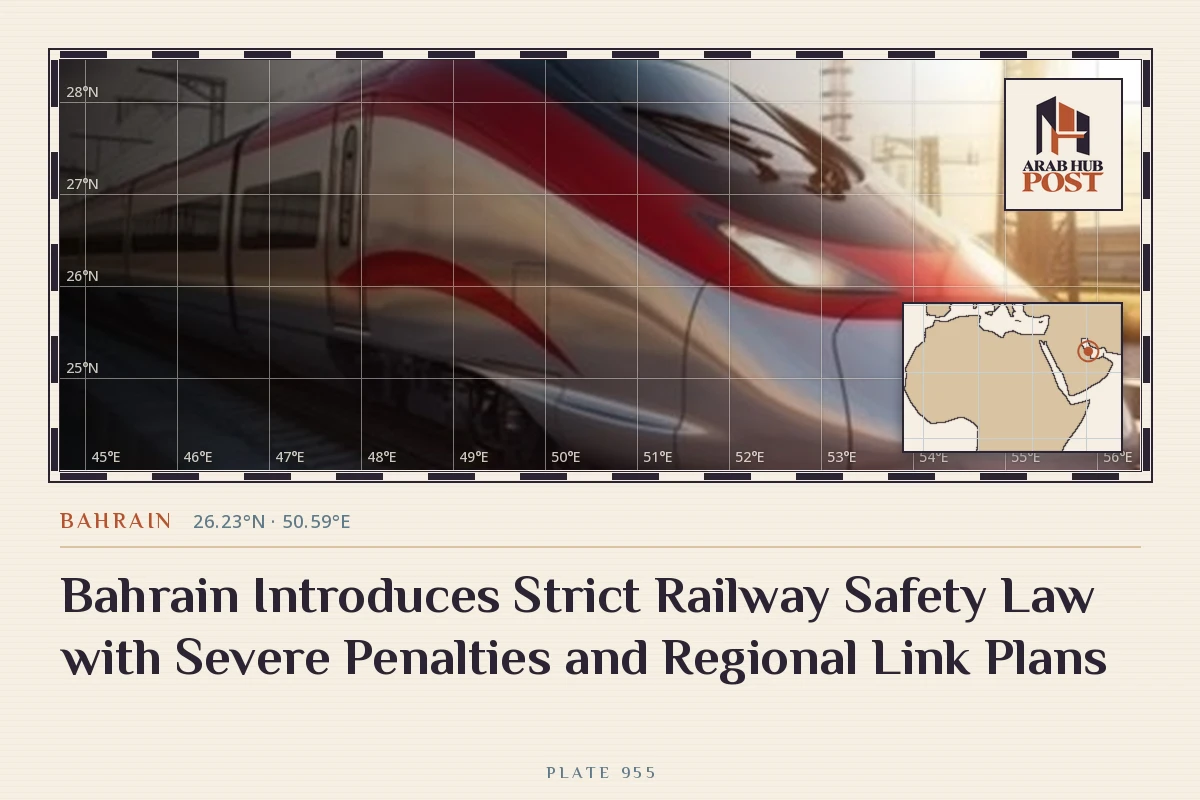
Bahrain’s Shura Council is set to receive notification on Sunday of a new railway regulation law issued by King Hamad under Decree‑Law No 42 of 2026.
New Railway Safety Law and Penalties
The legislation creates a comprehensive legal framework covering the construction, management, operation, maintenance and development of railway networks in the kingdom. It imposes strict safety requirements, licensing controls and passenger protections while preparing Bahrain to strengthen regional rail connectivity and attract private investment.
Under the law, anyone who destroys railway infrastructure or attacks a train and causes a death may face life imprisonment or the death penalty. Article 34 specifies that an attack on a train or railway infrastructure intended to seize it, its cargo, harm passengers or divert its route carries a prison term of five to ten years. If the attack destroys the train or infrastructure, the penalty becomes life imprisonment; if it results in one or more deaths, the offender could be sentenced to death or life imprisonment.
Deliberate sabotage, disruption or damage to railway infrastructure is punishable by five to ten years in prison and a fine ranging from BD3,000 to BD100,000, with the offender also required to pay for the damage or restore the property to its original condition where possible.
Those who deliberately endanger railway operations or passengers face at least six months in jail and a fine of BD1,000 to BD10,000, or either sanction. If such actions cause an accident that results in serious damage to people or property, the prison term may rise to up to ten years; if a death occurs, life imprisonment may be imposed.
Negligent behaviour that endangers railway safety, causes a collision or leads to a train leaving its tracks can lead to up to two years in prison and a fine of BD500 to BD5,000, or either penalty. If the negligence causes injuries, the prison term can increase to five years, and to ten years if it results in death.
Crossing railway tracks outside designated points carries a maximum penalty of three months in jail and a fine of BD100 to BD1,000, or either punishment. When such an act causes an accident that leads to injury or property damage, the penalty rises to between one and three years in prison and a fine of up to BD3,000, or either sanction.
Regional Rail Integration and Infrastructure
The law supports Bahrain’s participation in the GCC Rail Project, an integrated regional initiative designed to meet the transportation needs of Gulf states, contribute to economic growth, diversify transport options and lower costs. The GCC has pledged to complete its strategic rail network by the target date of December 2030.
Bahrain will be linked to neighbouring GCC countries through the King Hamad Causeway project, which will run parallel to the existing King Fahd Causeway. The new causeway will be 57 kilometres long, featuring four road lanes and two rail tracks, and will connect the proposed King Hamad International Station in the Ramli area of Bahrain to Dammam Railway Station in Saudi Arabia. The Ramli station is planned to link with Bahrain International Airport and other commercial and residential districts via the forthcoming Bahrain Metro network.
Operational Requirements and Passenger Protections
Licensing becomes compulsory for anyone undertaking railway activities, and operators must obtain safety certificates before running trains or providing services. Operating without a licence, submitting false information to authorities or obstructing inspectors and technical investigators can lead to up to three years in prison and fines ranging from BD1,000 to BD5,000.
Placing structures, obstacles or materials within designated railway corridors without prior approval, when such actions could threaten safety, is also prohibited and carries the same penalty of up to three years in prison and fines between BD1,000 and BD5,000.
The Transportation and Telecommunications Ministry’s relevant department is empowered to inspect railway facilities, examine records, investigate incidents independently and issue notices that require improvements or prohibit unsafe activities.
Licensed operators who violate the rules may be subject to administrative fines of up to BD20,000, suspension of their licences or safety certificates for a maximum of six months, or cancellation of their authorisations. Repeated administrative offences within a year can lead to doubled fines, subject to the prescribed maximum.
The legislation aims to guarantee passengers safe, regular services that meet approved quality standards and fares. Operators must publish clear information on timetables, fares and service arrangements, provide suitable facilities for people with disabilities and older passengers, and establish effective procedures for handling complaints. Passengers may also be entitled to compensation for delays, cancellations or service interruptions under conditions to be defined in the executive regulations.
Operators are required to maintain insurance covering potential damage to passengers, cargo and third parties for the duration of their licences. They are prohibited from suspending services without prior written approval, except in emergencies or force‑majeure circumstances specified by the regulations. Those wishing to discontinue a service must generally apply at least six months in advance and submit a plan ensuring continuity.
The ministry will prepare a comprehensive national railway network plan and coordinate with relevant authorities to integrate rail services with other transport modes and regional networks. Particular emphasis is placed on connecting Bahrain to the GCC railway network through common technical standards and arrangements that support cross‑border operations.
The minister must issue the executive regulations within one year of the law taking effect, while technical standards and guidelines are to follow within six months of the regulations.
For further information, contact [email protected]



Reader comments
No comments on this report yet.