Egypt Hosts El Alamein Meeting to Link Horn of Africa Security Issues
Published By Regional Desk
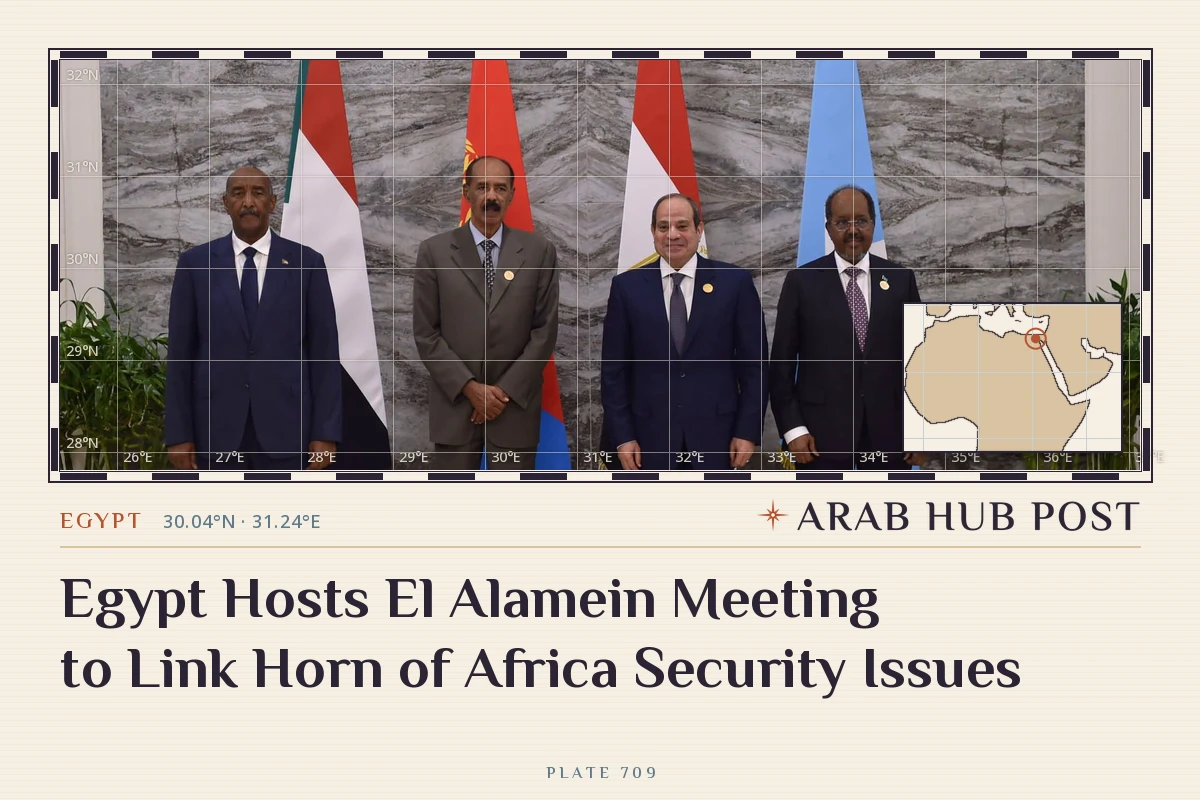
Egypt hosted a meeting in El Alamein on 4 October that brought together President Abdel Fattah al-Sisi, Eritrean President Isaias Afwerki, Somali President Hassan Sheikh Mohamud and Sudanese Sovereignty Council Chairman Abdel Fattah al-Burhan, producing the El Alamein Declaration. The Horn of Africa remains a pivotal corridor linking the Red Sea to global trade routes.
Linking Maritime and Territorial Issues
The declaration seeks to redraw some of the rules of the strategic balance in the Red Sea and the Horn of Africa, not by forming a new military alliance but by connecting issues that have usually been treated as separate crises. These include maritime security in the Red Sea, Ethiopia’s quest for sea access, the Grand Ethiopian Renaissance Dam dispute, Sudan’s territorial integrity and Somalia’s stance on the Somaliland question. By placing them in a single regional framework, the text reflects a growing recognition that the Horn’s crises have become so intertwined that managing them in isolation is increasingly difficult, if not impossible.
Ethiopia’s absence from both the meeting and the resulting document sends a clear political signal, yet it does not necessarily mean the four states aim to build an explicitly anti‑Ethiopian bloc. What they share is a conception of regional sovereignty that rejects attempts to create new realities through unilateral action, whether concerning ports and maritime corridors, transboundary resources or the territorial integrity of states.
Ethiopia’s Position and Sovereignty Principles
The emerging alignment is less about containing Ethiopia as a country than about establishing limits on how regional power may be exercised. Ethiopia remains too large, too strategically located and too deeply embedded in the political and economic architecture of the Horn of Africa to be excluded from any sustainable regional order. Therefore, the issue is not whether Ethiopia should have sea access, but under what political and legal conditions that access should be secured.
This becomes especially relevant in the Red Sea. The declaration’s emphasis that the management and security of the waterway should primarily be the responsibility of its littoral states reflects a political stance, not a rewriting of international law. It also shows the determination of coastal states to retain a central role in shaping the security and strategic arrangements of a passageway that has turned into an increasingly contested space where shipping routes, ports, military deployments, energy security and regional rivalries intersect. Any shift in the balance along its shores therefore carries consequences beyond the immediate countries involved.
Since losing direct sea access after Eritrea’s independence in 1993, maritime access has become a strategic and economic imperative for Addis Ababa. That imperative intensified after Ethiopia signed a memorandum of understanding with Somaliland in January 2024, an agreement Mogadishu rejected as an infringement on Somalia’s sovereignty and territorial integrity. Ethiopia’s need for reliable sea access does not grant it a right to exercise sovereignty over another state’s territory, and protecting the sovereignty of coastal states does not necessarily require denying Ethiopia stable, long‑term commercial access to ports.
The space for a future settlement lies in separating access from sovereignty, commerce from military presence and economic necessity from territorial control. Ethiopia could obtain predictable access to international maritime trade without that access becoming a vehicle for establishing sovereign or military footholds inside another country. If Ethiopia’s legitimate economic needs are treated as inherently illegitimate, the result would be greater securitisation of the dispute and deeper regional polarisation. Conversely, if maritime access is negotiated through transparent, internationally recognised and commercially grounded arrangements, the issue could become a point of managed interdependence rather than a trigger for confrontation.
Implications for Egypt and Regional Framework
A similar logic applies to the Nile dispute. Reaffirming the principles of avoiding significant harm, consultation and prior notification does not create new rules of international law, but it does place the Grand Ethiopian Renaissance Dam issue within a broader conversation about regional security and stability, moving it beyond the traditional trilateral framework involving Egypt, Sudan and Ethiopia. This broader framing matters because the GERD dispute has evolved from a technical disagreement over water management into a matter intertwined with trust, sovereignty, development, strategic influence and the distribution of power in the Horn of Africa. Any durable arrangement will therefore need to address not only water flows and operating rules but also the wider security environment in which the dam dispute has developed.
The Sudan and Somaliland questions are linked in the declaration through an even broader principle: resistance to altering the region’s political geography through unilateral faits accomplis. In both cases, sovereignty and territorial integrity are placed at the centre of the four countries’ understanding of regional order.
However, the limits of the emerging alignment are apparent. The four states do not share identical political interests, security priorities or foreign‑policy calculations, so their cooperation is better understood as an alignment of interests than as a coherent regional alliance. The declaration does not establish mutual‑defence obligations, create joint forces or announce the establishment of military bases; its immediate significance lies in political coordination, diplomatic signalling and the collective ability to raise the costs of unilateral action.
For Egypt, the real test will be how this diplomatic leverage is employed. A strategy aimed at permanently containing Ethiopia would be neither realistic nor sustainable, as Addis Ababa will remain a central actor in any long‑term political, economic or security arrangement in the Horn of Africa, driven by its geography, demographic and economic weight. Egypt’s strategic objective should therefore be to shape the rules under which Ethiopia participates in the emerging regional order, rather than to exclude it. This requires a delicate balance: strengthening coordination with Red Sea and Horn of Africa states while keeping open channels for negotiation with Addis Ababa, making unilateral moves costlier without rendering negotiated compromise politically impossible. That balance constitutes the strategic value of the El Alamein Declaration.
The declaration’s importance will not be measured by the sharpness of its language or by the number of issues it brings together. It will be judged by whether the four countries can transform their overlapping interests into a durable negotiating framework—one capable of deterring unilateral action while leaving sufficient political space for diplomacy. The Horn of Africa needs clearer rules for managing competing interests before those interests harden into permanent confrontation. If the El Alamein Declaration attempts to alter the negotiating balance before the balance of power shifts again, its success will depend on whether it can move beyond a declaration of positions toward the construction of workable regional arrangements.
The real challenge, therefore, is not to create another bloc in an already fragmented region but to establish a regional order in which sovereignty is protected, maritime access remains open, transboundary resources are governed through negotiated rules, and no single actor can alter the strategic map simply by creating facts on the ground. Achieving that would make the El Alamein Declaration more than a diplomatic statement; it would become an early blueprint for a new regional balance.
Marwa El-Shinawy, Academic and Writer