Egypt’s Foreign Minister Advances Food Security, Financing and Gulf Cooperation at Bangkok Talks
Published By Regional Desk
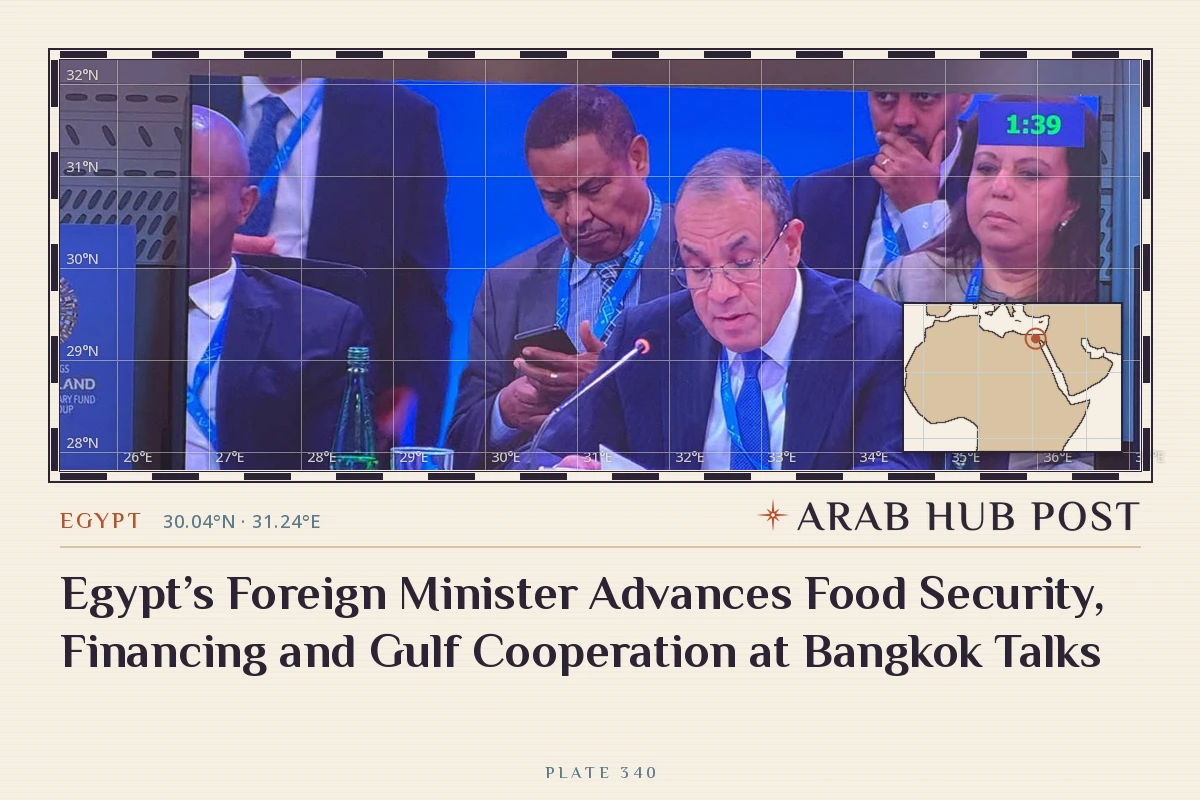
Food Security and Maritime Issues
Egyptian Foreign Minister Badr Abdelatty convened a series of meetings and joined ministerial sessions in Bangkok on Tuesday, on the margins of the annual gatherings of the World Bank Group and the International Monetary Fund. The discussions centred on food security, maritime corridors, development financing, economic reform and cooperation with international and Gulf institutions.
Abdelatty, who also holds the post of Egypt’s governor at the World Bank, took part in a ministerial meeting on food security and critical maritime corridors that included World Bank Group President Ajay Banga, UN Deputy Secretary-General Amina Mohammed and Egyptian Planning and Economic Development Minister Ahmed Rostom. He noted that food security is tightly bound to the stability of global supply chains and strategic shipping lanes, and warned that persistent disruptions are pushing up freight, food and fertiliser prices while adding strain on developing economies.
He outlined Egypt’s steps to reinforce strategic reserves, broaden import sources, boost domestic production and enlarge storage capacity, and affirmed Cairo’s readiness to collaborate with development partners to establish a global hub for grain storage, supply and trade. Abdelatty then set out four priorities for strengthening worldwide resilience to food crises: keep the flow of food, fertiliser and energy trade open; provide insurance and financial guarantees for essential shipments; make rapid, flexible financing available to countries confronting higher import costs; and bolster preparedness through strategic reserves, early-warning mechanisms and closer coordination among exporters, importers and transit states.
Development Finance and Institutional Dialogue
In a separate meeting with World Bank Vice President for the Middle East and North Africa Ousmane Dione, Abdelatty reviewed the completion of the third and final phase of Egypt’s Development Policy Financing framework after the conclusion of the second phase. He also extended an invitation to the World Bank to join the sixth Aswan Forum for Sustainable Peace and Development, which is slated for November.
The dialogue also addressed the reform of the international financial architecture, the enhancement of lending capacity among multilateral development banks and the creation of innovative financing tools to cope with rising sovereign debt burdens in low- and middle-income countries.
Abdelatty raised water cooperation with Dione, reiterating Egypt’s backing for the right of Nile Basin countries to pursue development and construct dams, on condition that such projects comply with international law and its core principles — avoiding harm, prior notification, consultation and consensus. He pointed to a newly launched Egyptian mechanism to finance projects in Nile Basin countries, including dams situated in the southern part of the basin.
Regional Partnerships and Economic Integration
Abdelatty met with Saudi Fund for Development Chief Executive Sultan bin Abdulrahman Al-Marshad to discuss widening development cooperation in Egypt, especially in infrastructure and support for micro, small and medium-sized enterprises. He urged Arab development institutions to assume a larger role in delivering flexible financing to economies hit by regional escalation, higher financing costs and supply-chain disruptions. Al-Marshad replied that the fund remains eager to keep supporting development in Egypt and to explore broader trilateral cooperation in Africa.
In talks with GCC Secretary-General Jasem Mohamed Albudaiwi, Abdelatty stressed that the security of Gulf states forms an integral part of Egyptian national security. The two sides condemned recent attacks targeting Saudi Arabia and reaffirmed their backing for the kingdom’s security, sovereignty and territorial integrity. They also discussed convening a second Egypt-GCC Investment and Trade Forum in New Alamein to promote investment, trade, energy cooperation and supply-chain integration, and underscored the need to continue political consultations under the Egypt-GCC Joint Action Plan for 2024-2028.
Abdelatty separately met with World Bank Chief Economist and Senior Vice President for Development Economics Michael Kremer to present the main components of Egypt’s planned national economic transformation programme. The talks covered the government’s privatisation agenda, the management of state-owned enterprises and efforts to enlarge the private sector’s contribution to economic growth, exports and job creation, as well as food security, agricultural technology and measures to improve soil productivity.
In another meeting, Abdelatty held discussions with Kuwaiti Finance Minister Yaqoub Al-Rifai on increasing Kuwaiti investment in Egypt and identifying sectors and projects that present opportunities for private-sector participation. They also examined ways to strengthen Arab coordination within the World Bank on development financing, fiscal reform and regional priorities, and Abdelatty expressed Egypt’s interest in expanding cooperation with the Kuwait Fund for Arab Economic Development.
Abdelatty later addressed a gathering of ministers and governors of the Group of 24 (G24), calling for reform of international financing mechanisms and the creation of more responsive global financial institutions capable of meeting the needs of developing economies. He said Egypt is expanding investment in the Suez Canal Economic Zone, ports, renewable energy and green hydrogen, while encouraging manufacturing, local value chains and job creation. Abdelatty also urged stronger regional economic integration and the implementation of the African Continental Free Trade Area to foster growth and development across the continent.