Egypt Sets 67% Private Investment Target for 2030, Outlines African Integration Plan
Published By Arab Hub Post Staff
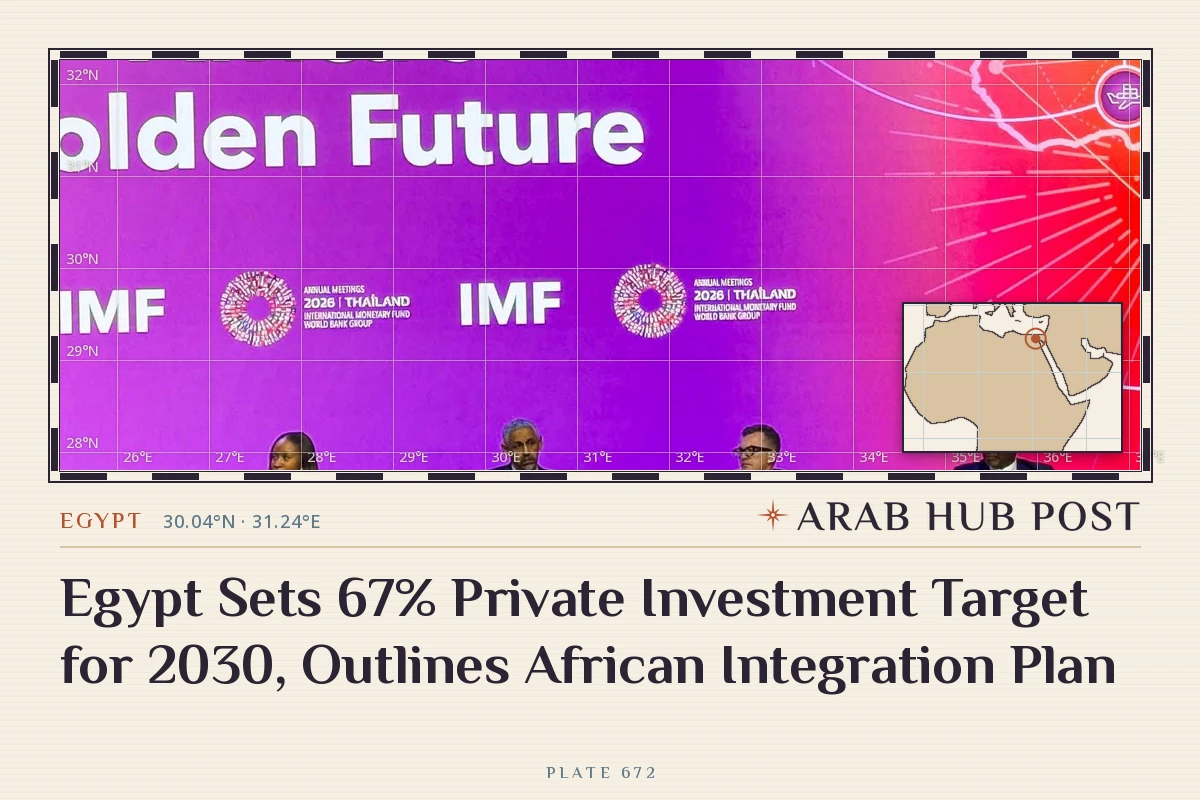
Egypt aims to increase the private sector’s share of total national investments to 67% by 2030, up from 57.7% in the 2025/2026 fiscal year and 43.1% in 2023/2024, Minister of Planning and Economic Development Ahmed Rostom announced. The remarks were delivered at a global forum that brings together finance officials to discuss development priorities.
Investment Target and Policy Measures
Speaking at a panel discussion titled “Africa’s Promising Future: Structural Reforms, Trade Integration, and Private Sector‑Led Growth” during the 81st Annual Meetings of the World Bank Group and International Monetary Fund in Bangkok, Rostom said the government plans to reach this goal by implementing its State Ownership Policy, ensuring competitive neutrality, streamlining administrative procedures, and expanding single‑window services for investors.
Economic Performance and Energy Sector
He noted that the Egyptian economy recorded a real GDP growth rate of 5.1% in the 2025/2026 fiscal year, with total foreign exchange assets reaching $73.1bn and the overall balance of payments posting a surplus of $6.4bn over the same period.
In the energy sector, the minister highlighted that the full settlement of arrears owed to international oil companies in June 2026 helped restore confidence in Egypt’s energy market, and said Egypt is expanding renewable energy projects with private sector participation, aiming for a 42% share of clean energy in its energy mix by 2030.
African Integration and Industrial Deepening
Addressing broader regional issues, Rostom argued that Africa has historically been treated mainly as a source of raw agricultural goods and minerals without sufficient local industrial processing, stressing the need for industrial deepening across the continent to capture higher value‑added, strengthen supply chains and generate local energy and employment.
He said, “For decades, Africa remained treated as a food basket, without achieving sufficient industrial deepening,” and added, “The real challenge for Africa lies in the speed of converting structural reforms into sustainable job opportunities for youth.”
Rostom also highlighted the Infrastructure Financing Guarantee Mechanism as a practical framework for regional cooperation to attract investment into major development projects, citing the full implementation of the African Continental Free Trade Area (AfCFTA), the simplification of customs procedures, cross‑border electrical interconnections and green hydrogen initiatives as critical elements for regional value‑chain integration and energy security.