South Korean Sportswear Plant Secures $30m Investment in Egypt’s West Qantara Zone
Published By Regional Desk
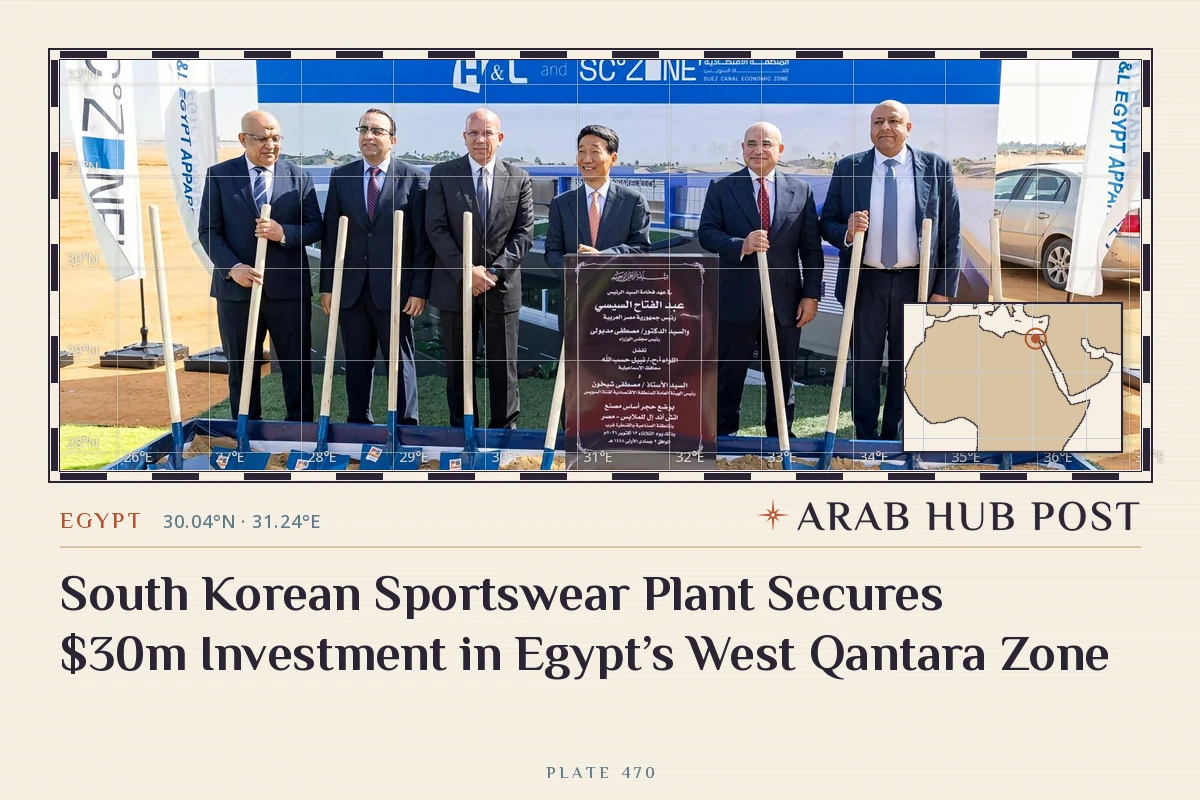
Egypt’s Suez Canal Economic Zone has laid the foundation stone for a South Korean sportswear manufacturing plant in the West Qantara Industrial Zone.
The zone lies along the Suez Canal, a key maritime route connecting the Mediterranean and Red Seas.
Planned investment has doubled to $30 million from an initial $15 million, as Egypt seeks to attract further South Korean investment following President Abdel Fattah Al‑Sisi’s visit to South Korea.
Groundbreaking Ceremony Attended by Officials
Mostafa Shikhon, chairperson of SCZONE, attended the Tuesday groundbreaking ceremony alongside Kim Wan‑jong, South Korea’s ambassador to Egypt; Mohamed Ibrahim, SCZONE vice‑chairperson for the Northern Zone; Ahmed Essam El‑Din, deputy governor of Ismailia; and representatives of the company and local authorities.
Project Details and Expected Impact
The H&L Egypt Apparel project will cover 42 000 square metres and involve the establishment of a smart, environmentally friendly factory equipped with advanced manufacturing technologies.
The facility is expected to create approximately 2 000 direct jobs and expand Egypt’s sportswear manufacturing capacity.
Regional Investment Context
Shikhon said the project marked an important step towards attracting South Korean investment to SCZONE, particularly as relations between Egypt and South Korea have advanced to the level of a comprehensive strategic partnership.
He added that the authority hoped the project would pave the way for a broader wave of South Korean investment across its industrial zones, citing the competitive advantages available to investors.
According to Shikhon, the West Qantara Industrial Zone currently hosts 54 projects representing nine nationalities, with total investments of approximately $1.54 billion.
Textiles and ready‑made garments account for the largest share of industrial activity in the zone, with 43 projects.
He said SCZONE continued to support investors by providing an attractive investment environment and integrated infrastructure, with the aim of enhancing the competitiveness of Egyptian products, boosting exports and creating jobs.
Kim Wan‑jong said the H&L Egypt project would strengthen industrial and investment cooperation between Egypt and South Korea.
He highlighted SCZONE’s strategic location and Egypt’s free trade agreements as advantages for manufacturing and exporting to international markets.
The ambassador expressed hope that the project would serve as a successful model of cooperation between South Korean industrial expertise and Egyptian workers, encouraging further investment from South Korean companies in the economic zone.
Lee Seung‑jun, CEO of H&L Egypt Apparel, said the project marked an important beginning for the company’s operations in Egypt.
He added that the company aimed to establish an advanced industrial base capable of competing in global markets by adopting modern technologies and applying quality and sustainability standards in sportswear manufacturing.
The project is the first investment by a South Korean company to be contracted within SCZONE, with the agreement signed in November 2025.
The increase in planned investment from $15 million to $30 million reflects the company’s confidence in the zone’s investment potential and its prospects as a base for expansion into international markets, according to SCZONE.