
Jordan News explains Snapchat’s Planets feature and how to find your rank among friends
Published By Arab Hub Post Staff
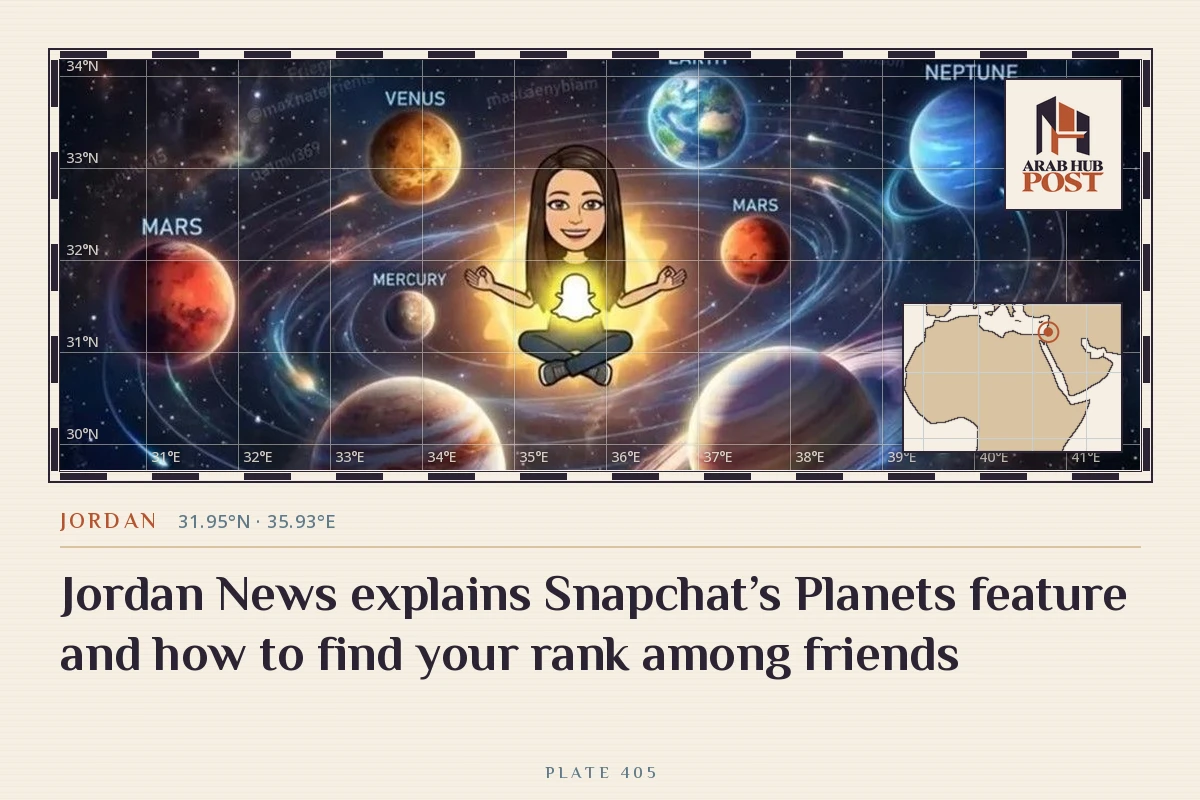
Jordan News, citing Al-Ghad, explains that Snapchat’s Planets feature displays a user’s position on another person’s Best Friends list using a visual model of the solar system.
How the Friend Solar System Works
The feature is part of the Friend Solar System, which is available only to Snapchat+ subscribers. It converts the list of a user’s top eight friends into a set of planets, with each planet showing where the user stands in that friend’s ranking. The system uses the eight planets from Mercury to Neptune, leaving out Pluto. Mercury stands for first place and appears in red, surrounded by red hearts. Venus represents second place, shown in a light colour with multicoloured hearts. Earth is third place, depicted in blue and green and accompanied by the Moon and decorative touches. Mars comes fourth, distinguished by its reddish hue and multicoloured hearts. Jupiter is fifth, a large orange planet with prominent stripes. Saturn is sixth, recognisable by its rings and a pale‑yellow shade. Uranus indicates seventh place, appearing in light blue or cyan. Neptune marks eighth and last place, shown in dark blue.
These planets do not describe different kinds of friendship; they simply reflect the ranking derived from a user’s activity and interaction within the app. Being placed as Mercury does not automatically mean the person is the closest friend in real life.
The Friend Solar System turns the numerical ranking of a person’s top eight friends into a visual representation rather than showing plain numbers. The planetary positions shift over time as users exchange Snaps, chat, or engage in other activities on the app. Snapchat has not revealed the exact formula it uses to calculate these rankings, so there is no guaranteed method to move a particular friend higher except by generally increasing interaction. Consequently, a friend can move from Mercury to Venus or Mars, or in the opposite direction, depending on how communication patterns change.
Finding and Enabling Your Planet
Some profiles display two different badges: “Best Friends” and “Friends”. The “Best Friends” badge means that both users appear on each other’s close‑friends lists, while the “Friends” badge signals an active friendship on the app without guaranteeing that the rankings are mutual. Because of this, a user may rank as Mercury on one friend’s list while that friend occupies a completely different position on the user’s own list.
To see the planet that represents your ranking with a friend, first open Snapchat, navigate to that friend’s profile and open their Friendship Profile. Then look for the “Best Friends” or “Friends” badge that is surrounded by a gold border. Tapping the badge reveals the planet that corresponds to your position in that person’s solar system.
The feature requires a Snapchat+ subscription, and the Friend Solar System must be turned on in the settings. If the badge does not appear, users should verify that the feature is enabled within their subscription settings.
To enable the Friend Solar System, open Snapchat, tap the profile icon in the upper‑left corner, and open the Snapchat+ membership card. From the list of features, locate the “Solar System” option and switch it on. After that, the planets will become visible when you visit friends’ profiles and tap the gold badge linked to their friendship ranking.
What the Rankings Mean
The planetary ranking is not fixed; it can change as a user’s position on another person’s Best Friends list changes. For example, a user might be Mercury during one period and later move to Mars if the level of interaction with that friend fluctuates. Snapchat does not publicly disclose the exact calculation behind these rankings, so they serve as an indicator of app activity rather than a definitive measure of the strength of a personal relationship.
The feature does not necessarily reveal a mutual ranking. The planet shown indicates your place on the other person’s Best Friends list, not that person’s place on yours. Therefore, you could rank first on a friend’s list while they rank third or fourth on yours.
Mercury represents the highest ranking in Snapchat’s planetary system because it denotes first place on a particular friend’s Best Friends list. However, this ranking should not be taken as conclusive proof of a strong relationship outside the app; it is based solely on digital interaction patterns.
Regarding accuracy, the planets accurately reflect a user’s ranking on the Best Friends list according to Snapchat’s internal system, but the company does not publish all the factors that influence these rankings. Since the rankings can shift as activity levels vary, they should not be used alone to judge how close two friends are.
A planet may fail to appear for several reasons: the user lacks a Snapchat+ subscription, the Friend Solar System feature is disabled, the “Best Friends” or “Friends” badge is not shown on the other person’s profile, or the user is simply not included in the ranking displayed for that friend.
Overall, Snapchat Planets offers a visual way to see friends’ rankings based on interactions within the app, but it does not provide a definitive judgment about the strength of a friendship or the nature of personal relationships.




Reader comments
No comments on this report yet.