
Kuwait’s Nazaha Secures Leadership of UN Anti‑Corruption Working Group with 91% Support
Published By Arab Hub Post Staff
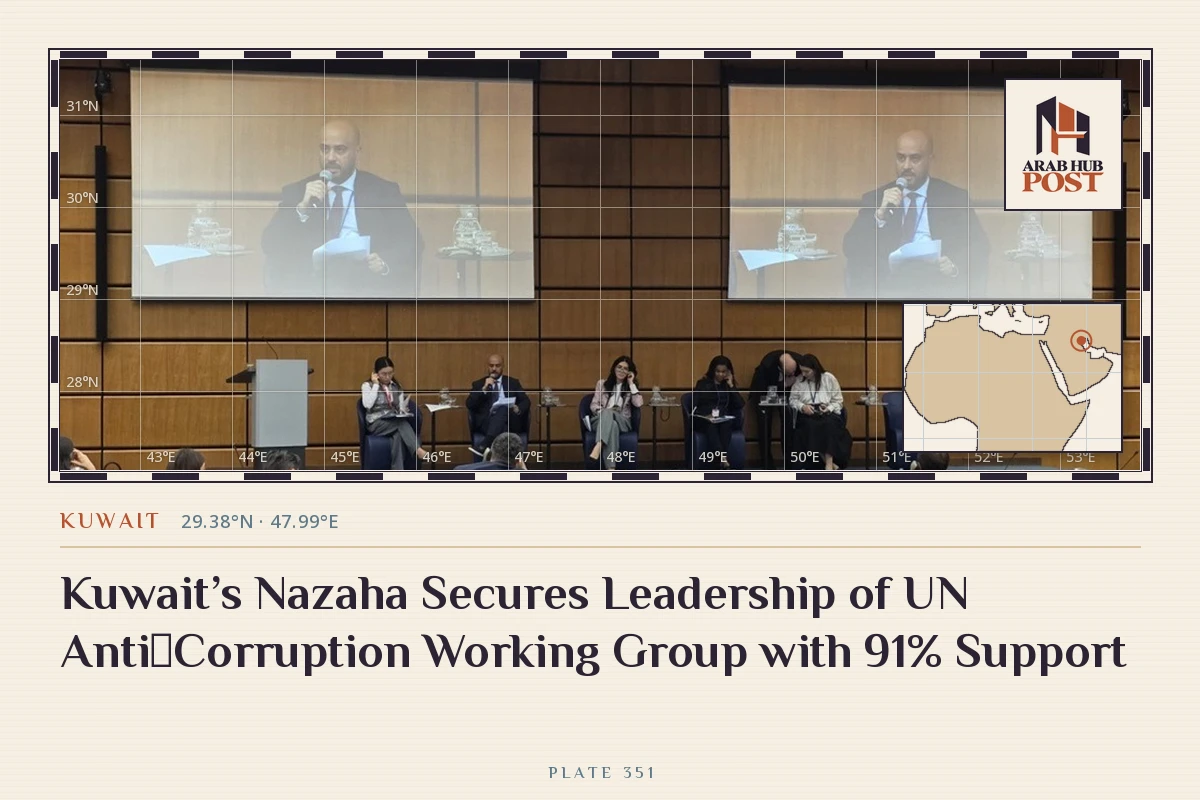
Kuwait’s Anti-Corruption Authority, known as Nazaha, has secured the chairmanship of the third thematic working group on knowledge and peer learning within the United Nations Office on Drugs and Crime’s Globe Network after obtaining 91 percent of the votes.
The outcome highlights Kuwait’s increasing role in regional anti‑corruption cooperation.
Leadership Role in UN Anti‑Corruption Network
The election took place during a video‑conference meeting on Wednesday, 14 October 2026, reflecting international confidence in Kuwait’s capabilities and its contribution to global efforts to combat corruption.
With this mandate, Nazaha will chair the group and align its work with other groups, the General Secretariat and the Steering Committee of the network.
The team’s work will focus on strengthening knowledge‑sharing, exchanging practical experience and enhancing cooperation among law‑enforcement authorities tasked with tackling corruption worldwide.
According to Anwar Al‑Qudairi, Director of the International Cooperation Department at Nazaha, the election marks an achievement for Kuwait, and he noted that “the 91 percent vote was not merely support for the authority’s leadership of an international working group, but also a vote of confidence in the country and its national expertise.”
He added that the result carries a responsibility to intensify efforts and deliver tangible achievements, and that the election reflects Nazaha’s ambition to move beyond participation in international forums and the exchange of experience towards directly leading initiatives and helping shape joint international efforts against corruption.
Al‑Qudairi stressed that the significance of the appointment lies in the working group’s practical responsibilities, particularly its role in turning international knowledge and experience into tools that authorities can use to tackle increasingly complex corruption offences, especially those involving cross‑border activity.
She noted that effective anti‑corruption efforts require more than legislation and legal powers; they also depend on access to specialised knowledge, learning from other countries’ experiences and developing the skills of professionals working in the field.
Nazaha will therefore measure its success not simply by holding a leadership position, but by the practical initiatives and results delivered for members of the network.
Responsibilities and Goals of the Working Group
Dhari Buayabs, Nazaha’s observer of international organizations and conferences, stated that “the third working group played an important role in developing guidance and knowledge materials, sharing best practices among law‑enforcement agencies and monitoring emerging challenges and patterns in corruption offences.”
He added that these included crimes linked to modern technologies, virtual assets and artificial intelligence.
He also said the group would propose initiatives aimed at improving the effectiveness of the authorities responsible for detecting and investigating corruption.
Buayabs explained that Nazaha would use its leadership to strengthen coordination among member entities, promote the exchange of successful experiences and develop knowledge and training initiatives, adding that the objective was to help authorities uncover corruption offences, prosecute those responsible, trace illicit proceeds and recover funds obtained through corruption.
He emphasised that knowledge‑sharing should lead to practical tools and applicable initiatives that strengthen anti‑corruption agencies and improve international cooperation in pursuing cross‑border crimes.
The GlobE Network comprises 256 anti‑corruption bodies from 137 countries and provides a platform for direct and secure communication among law‑enforcement authorities, helping accelerate information exchange and cooperation on cross‑border cases.
Broader Engagement and Future Plans
Nazaha’s election followed its participation in the network’s seventh General Assembly meeting in Vienna, Austria, from 25 to 28 August 2026.
At the gathering, Kuwait shared its expertise in international cooperation and the fight against transnational corruption, highlighted its work to boost transparency on beneficial ownership, and noted the use of the Sahl application for receiving reports electronically.
In addition, the Kuwaiti team conducted bilateral talks with anti‑corruption officials from various nations to seek stronger collaboration and share information and expertise.
Reader comments
No comments on this report yet.