
Qatar Museums unveils exhibition on ancient Chinese maritime ceramic trade
Published By Arab Hub Post Staff
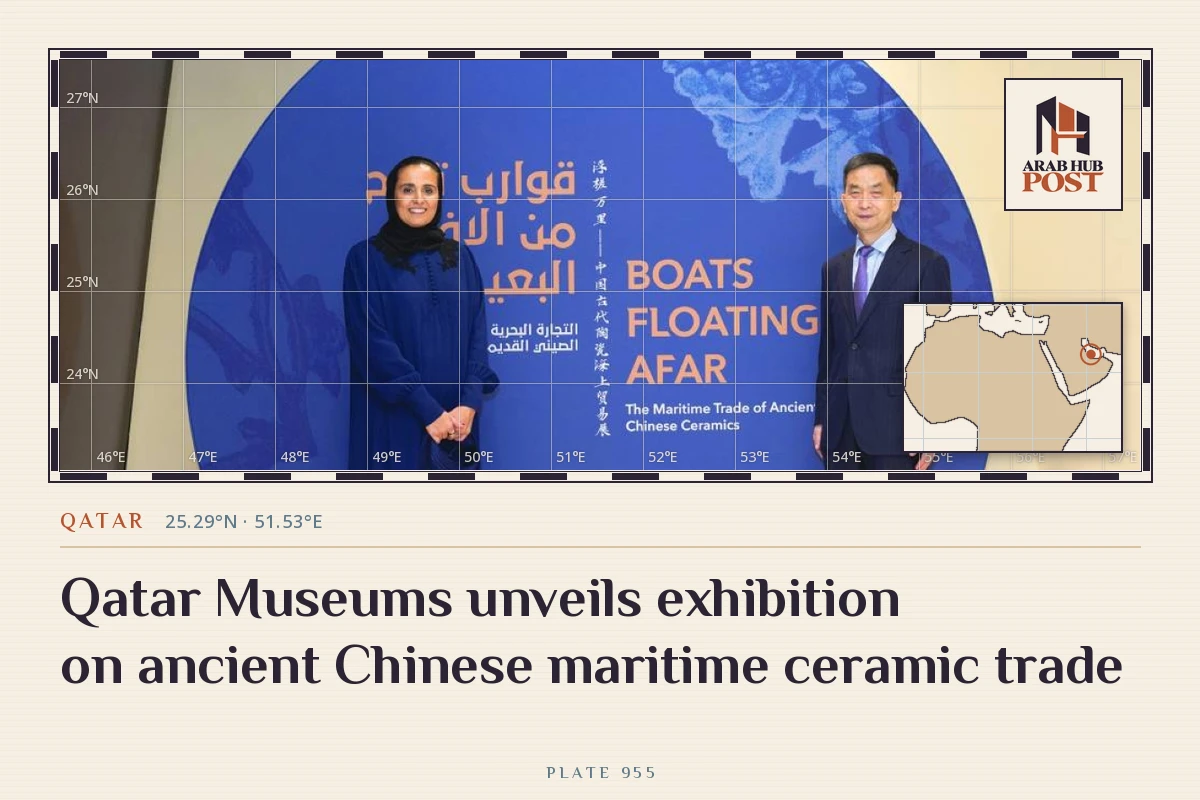
Qatar Museums (QM) Chairperson Sheikha Al Mayassa bint Hamad bin Khalifa al-Thani inaugurated on Monday the exhibition ‘Boats Floating Afar: The Maritime Trade of Ancient Chinese Ceramics’ at the National Museum of Qatar (NMoQ). The display examines how Chinese ceramics travelled vast distances by sea, influencing artistic traditions, commerce and daily life in regions far from their places of origin.
Exhibition details and collaboration
Organised in partnership with the National Museum of China and housed in Temporary Gallery 13, the exhibition spans more than 1,000 years of ceramic production and maritime exchange, from the Tang to the Qing dynasties (618-907 CE to around 1900 CE). It features over 100 objects from the National Museum of China alongside selected items from Qatar Museums’ collections. The exhibition places Qatar within broader historical networks of exchange that connected the Gulf with communities and trading hubs across Asia long before modern global systems emerged. It will remain open until 15 February 2027.
In a press statement, NMoQ Director Sheikh Abdulaziz bin Hamad al-Thani said: “The sea has shaped Qatar’s history for generations, sustaining communities through pearling, fishing and trade and connecting the country with ports and cultures across the region and beyond. Boats Floating Afar: The Maritime Trade of Ancient Chinese Ceramics places Qatar’s history within a far wider narrative of maritime exchange, revealing how objects, skills and ideas travelled across great distances. The objects on view offer tangible evidence of the networks that linked the Gulf with China and Asia centuries ago.”
Luo Wenli, Director of the National Museum of China, stated: “Through Boats Floating Afar: The Maritime Trade of Ancient Chinese Ceramics exhibition, we hope to further advance exchanges and co-operation between the National Museum of China and the National Museum of Qatar. By reflecting together on the history of the Maritime Silk Road and appreciating the beauty of our respective cultures, we hope to deepen mutual understanding, enhance our friendship, and continuously consolidate and strengthen the friendly relations between our two peoples.”
Ceramic highlights and thematic chapters
Visitors can view ceramics produced at some of China’s most renowned kiln centres, including Jingdezhen, Longquan, Dehua, Changsha and Yue. Celadon, bluish-white wares, Ming blue-and-white porcelain and richly decorated Qing pieces illustrate evolving techniques and tastes across successive dynasties. Several objects demonstrate how Chinese makers adapted to overseas markets, modifying forms and decorative styles for customers far from China.
The exhibition is arranged in four thematic chapters, tracing the development of Chinese ceramic trade from the Tang Dynasty (618–907 CE) to the Qing Dynasty (1644–1911 CE). The first chapter, ‘Endless Shores’, introduces the beginnings of maritime trade and the influence of Chinese kilns beyond China. ‘Sea of Sails’ follows the expansion of maritime networks during the Song and Yuan dynasties (960–1368 CE), when rising overseas demand spurred new ceramic wares and trade systems. The third chapter, ‘Expanding Waves’, charts the rise of Chinese porcelain in global markets during the Ming and Qing dynasties (1368–1911 CE).
The final chapter, ‘Across the Seas’, examines the influence of Chinese ceramics on pottery traditions worldwide, with particular focus on Qatar.
Notable artefacts and cultural context
Among the highlights are objects linked to the wreck of the Cirebon, a 10th-century ship discovered off the coast of Java, Indonesia, which illustrate the scale of ceramics transported along maritime trade routes. Chinese pottery fragments excavated in Qatar provide further evidence of these connections to the Gulf.
Complementing the objects are films documenting the history and production of Chinese ceramics, along with footage of Chinese pottery being excavated at archaeological sites in Qatar. Both are subtitled in Arabic and English. Visitors can also see maps illustrating major Chinese kiln centres, cities and ports, as well as maritime trade routes extending as far west as the Red Sea. Accessibility features include Braille information, tactile ceramic models and a hands-on activity.
‘Boats Floating Afar’ builds on the legacy of the Qatar–China 2016 Year of Culture and is part of an ongoing exchange between NMoQ and the National Museum of China. Earlier this year, NMoQ’s exhibition ‘On the Move’ opened in Beijing, tracing the creativity and lifestyles of Qatar’s nomadic and semi-nomadic communities. Together, the two projects deepen the relationship between the two institutions, strengthened through the exchange of collections, research and scholarship.
The exhibition opened as part of the Qatar Creates Fall/Winter 2026–27 season, a programme of exhibitions, public art, performances and cultural events across Qatar.
Reader comments
No comments on this report yet.