
Qatar Cabinet Uses Amir’s Address to Guide Work, Approves Child Rights and Digital Protection Laws
Published By Arab Hub Post Staff
Domestic Priorities and Legislative Framework
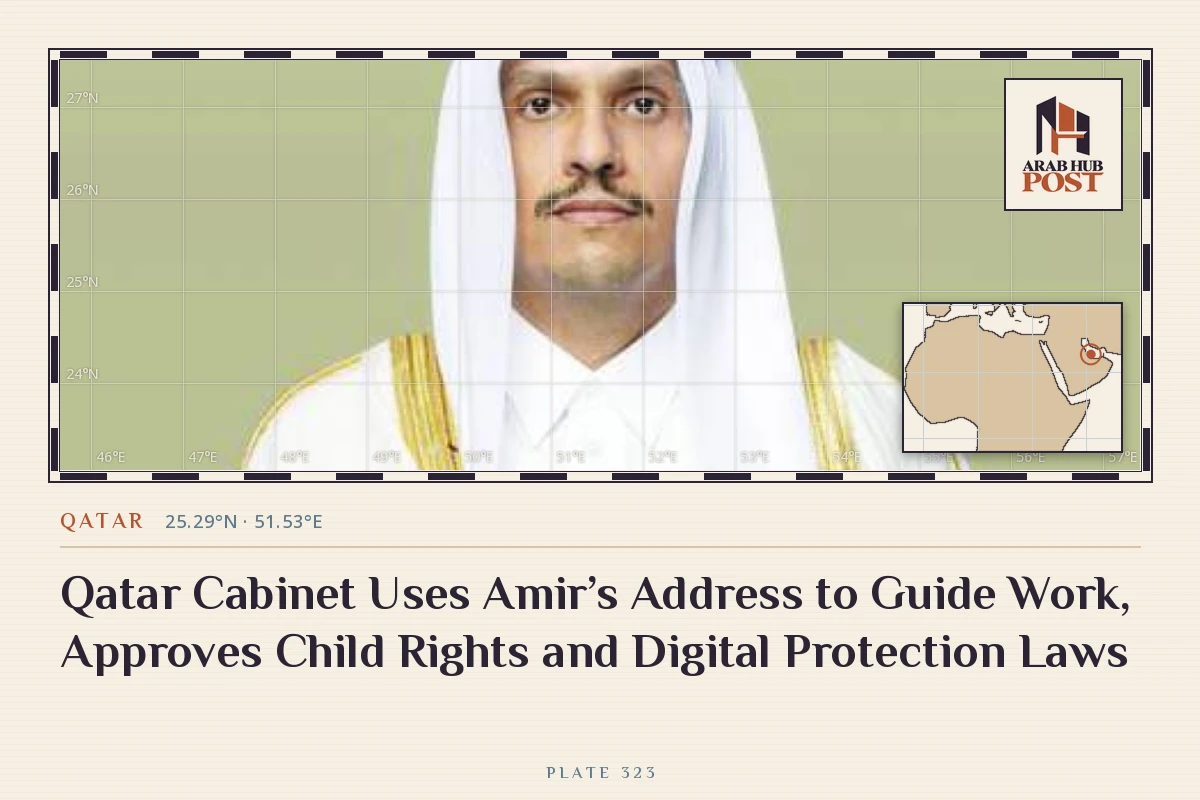
Qatar’s Cabinet convened its regular meeting in Doha on Wednesday, chaired by Prime Minister and Minister of Foreign Affairs Sheikh Mohammed bin Abdulrahman bin Jassim al-Thani, a day after Amir Sheikh Tamim bin Hamad al-Thani outlined national priorities at the opening of the Shura Council’s new legislative session.
The Cabinet called on government ministries and institutions to use the Amir’s address as a guiding framework for their work in the coming period, praising the speech for reviewing the challenges Qatar had faced in recent months and highlighting the country’s resilience, institutional preparedness and priorities for the next phase of national development.
The address emphasised economic diversification, efficient government institutions and social solidarity, while calling for greater commitment to public service, the protection of public funds and the national interest.
The Prime Minister expressed his appreciation for the Amir’s prudent policies on the regional and global levels and instructed ministers to develop plans and programmes to implement the address’s objectives.
The Cabinet reaffirmed Qatar’s foreign policy priorities, including cooperation with Gulf states, support for the Palestinian cause and the pursuit of dialogue and peaceful solutions to regional crises.
It also praised cooperation between the Shura Council and the executive branch, underlining the importance of legislation that supports the private sector and strengthens Qatar’s investment environment.
Regional Security Position
Turning to regional developments, the Cabinet strongly condemned repeated Houthi attacks on King Khalid International Airport in Riyadh, describing them as a serious violation of Saudi Arabia’s sovereignty and a direct threat to regional security, civilians and civil aviation.
It reaffirmed Qatar’s full solidarity with Saudi Arabia and its support for measures taken by the kingdom to protect its sovereignty, security and territorial integrity.
The Cabinet stated that Saudi Arabia’s security is inseparable from Qatar’s security and the collective security of the Gulf Cooperation Council.
Approved Draft Laws and Agreements
On the agenda, the Cabinet approved draft legislation on children’s rights and digital protection, alongside measures to strengthen safeguards for children and regulate radiation-related activities.
The proposed child rights law, prepared by the Ministry of Social Development and Family as part of its 2025‑30 strategy, aims to establish a comprehensive legal framework for children’s care and protection, ensuring they grow up in a safe and stable environment.
The Cabinet said the draft law would be published for ten days on Qatar’s Al Meezan legal portal and the Sharek platform to gather public feedback before undergoing legislative review.
The Cabinet also approved a draft law on the digital protection of children, following a study coordinated by the Cabinet’s General Secretariat in consultation with relevant authorities, and tasked the Ministry of Social Development and Family with taking further measures based on a separate study into digital safety among children and young people in Qatar.
Furthermore, the Cabinet approved a draft decision by the Minister of Environment and Climate Change to introduce a radiation practice code covering nuclear gauges and well logging.
Prepared in cooperation with QatarEnergy, the proposed rules aim to establish safety requirements for the possession, use, transport and storage of radioactive sources, in line with standards issued by the International Atomic Energy Agency.
The measures are intended to strengthen oversight and protect workers, the public and the environment from radiation exposure.
The draft will be published for seven days of public consultation before legislative review.
The meeting concluded with the Cabinet approving draft memorandums of understanding on cooperation between the Qatari and Armenian justice ministries, and on transport and supporting logistics services between Qatar and Bahrain.
Other matters reviewed included reports on government service fees, civil aviation security, labour cooperation with the Republic of North Macedonia and agricultural cooperation and food security among GCC states.


Reader comments
No comments on this report yet.