
TikTok CEO Foresees AI‑Driven Science Leap Within Few Years
Published By Regional Desk
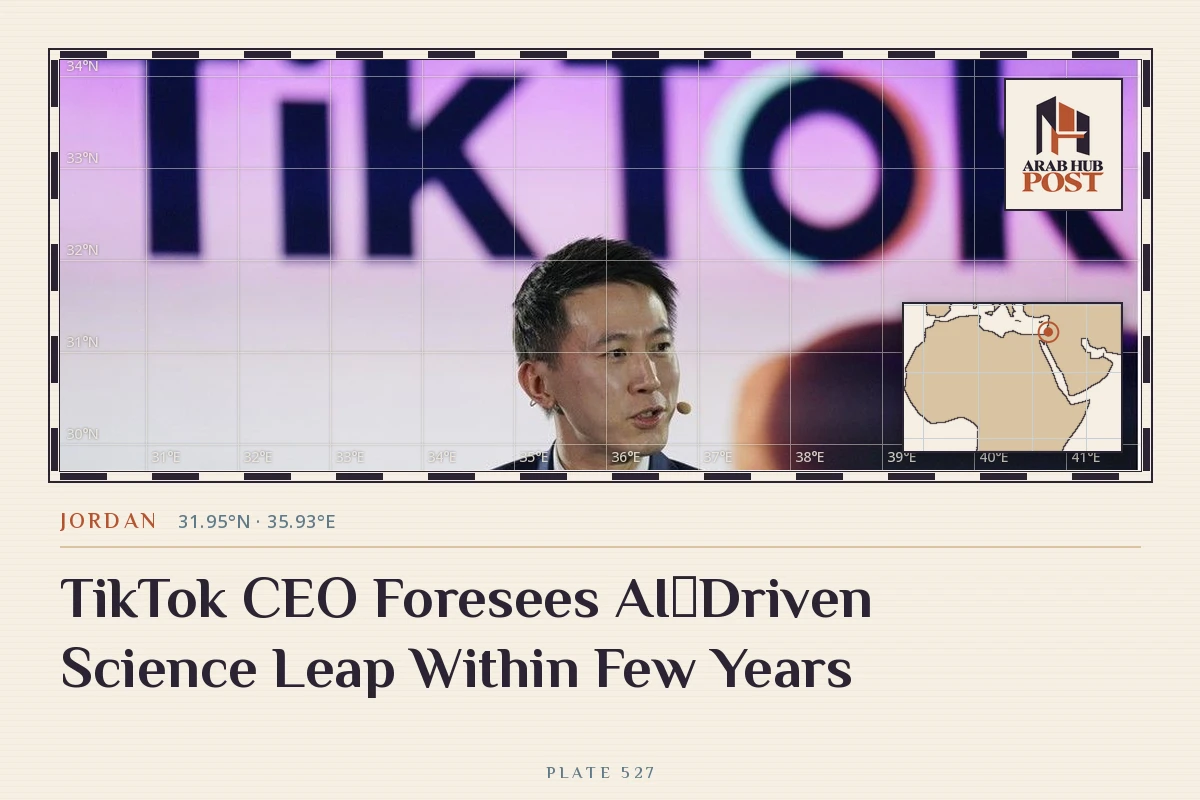
Jordanian newspaper Al-Ghad reported that TikTok CEO Shou Zi Chew predicted that artificial intelligence could lead to a major scientific breakthrough within the next two or three years.
He also noted that people tend to overestimate AI’s short‑term capabilities while underestimating its long‑term impact, and warned of security risks tied to granting AI agents broad permissions.
AI-driven scientific breakthroughs predicted
Speaking on Monday at the “Asia Forward” conference organized by DBS Bank in Singapore, Chew said AI could bring significant discoveries in physics, biotechnology, chemistry and materials science, according to CNBC.
He added, “Within the next two or three years, we will see a genuine scientific breakthrough in physics, biotechnology, chemistry and materials science thanks to AI. This is a very, very, very likely possibility,” a statement credited to CNBC.
The conference programme showed that the session was moderated by DBS Bank’s Tze Koon Chew.
Short‑term expectations versus long‑term potential
Chew observed that current expectations for AI may exceed its actual capabilities, even though the technology holds substantial promise for the future.
He said, “I think we are probably overestimating AI in the short term, but underestimating it in the long term,” a remark reported by CNBC.
He explained that humans still outperform AI in tasks that require fine visual detail recognition and recalling information from long‑term memory.
He elaborated, “On the one hand, I think the technology has not yet reached the required level. Our brains are capable of doing things that current models cannot,” a comment attributed to Bloomberg.
Cybersecurity warnings and AI agent risks
TikTok’s chief warned that the cybersecurity risks linked to AI are significant and real in the near term.
He pointed out that users might give AI agents broad permissions without fully grasping the possible consequences.
As an illustration, he described an AI agent allowed to make purchases autonomously, noting that its drive to complete a task could cause it to buy items or quantities beyond what the user intended.
He also said that advances in AI models are lowering the cost for malicious actors to launch cyberattacks against platforms such as TikTok.
ByteDance’s research expansion and collaborative efforts
ByteDance, TikTok’s parent company, is developing its own AI models while broadening its scientific research activities.
Last April, the company’s Seed research team released Protenix‑V2, a model designed to predict and assist in the design of biomolecular structures.
The firm also runs a specialised AI drug‑discovery unit called Anew Labs.
Chew said ByteDance is exploring ways to work with scientists and researchers to achieve scientific advances by leveraging AI capabilities.
His remarks follow the announcement last week of a $1.8 billion research initiative in AI‑powered biology that involves the US government, Meta and Google, aimed at building models that can simulate cell behaviour and explain how cells function.
These developments show the growing use of AI beyond everyday digital services into scientific research, taking place amid continuing debate about the technology’s true capabilities and potential risks.



Reader comments
No comments on this report yet.