
Southern Jordan Valley farmers hope water transfer deal will ease chronic shortages
Published By Arab Hub Post Staff
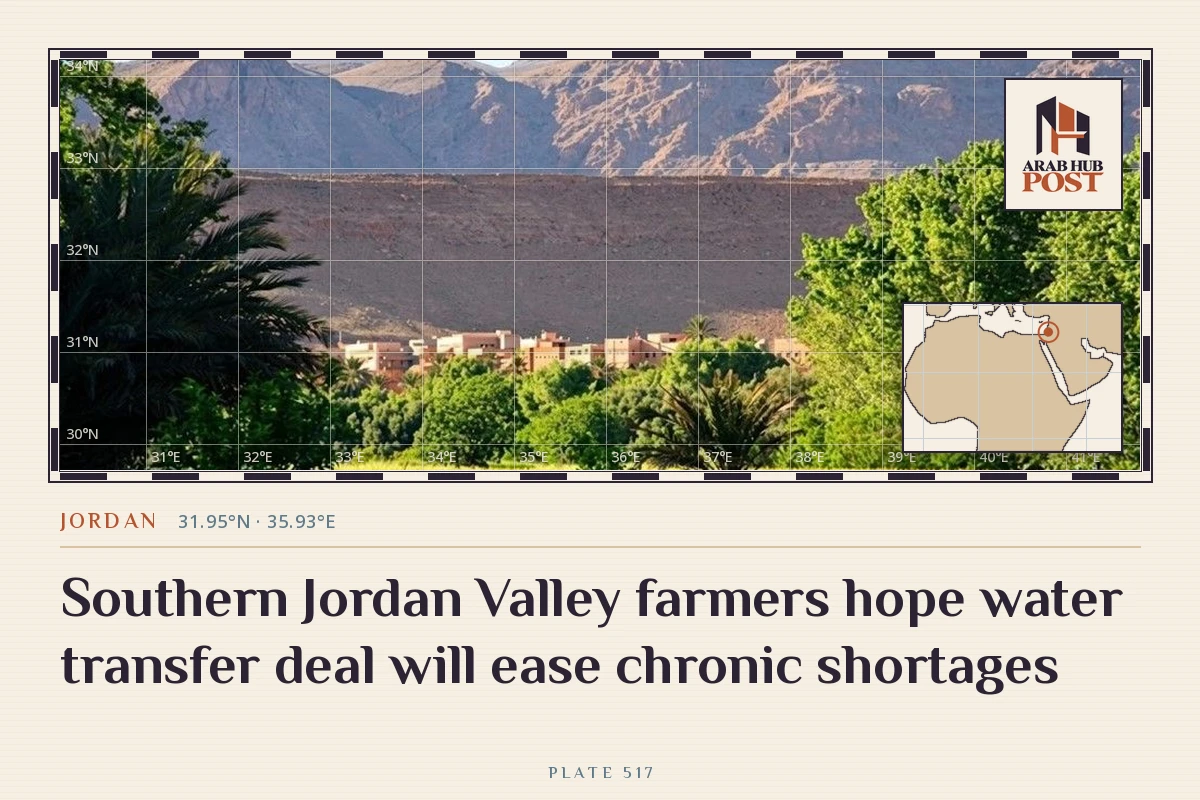
Farmers in the Southern Jordan Valley are looking to a newly signed agreement between the Jordan Valley Authority and the Mazraa and Haditha Farm Water Users Association to deliver water from Wadi Ibn Hammad, in what they say could relieve the persistent irrigation shortfalls that have harmed crops for years.
The deal is expected to supplement existing water supplies, reduce crop damage and improve working conditions in an area where declining water resources and low vegetable and fruit prices have squeezed the sector. Irrigation water shortages have caused extensive losses, especially for crops such as bananas and molokhia, which require a constant water supply.
Water users associations seek to manage scarce resources
In response to the recurring shortages, water users associations have been set up in the Southern Jordan Valley to mediate between the Jordan Valley Authority and farmers on irrigation water management. Farmers affiliated with these associations in Ghor Al-Mazraa and Ghor Al-Safi have suffered from severely insufficient allocations in recent growing seasons, particularly during the summer.
The main reasons cited for the shortfalls include declining water availability, reduced supply from primary sources such as Tannour Dam via the Jordan Valley Authority’s network, weak infrastructure, and illegal tapping of water pipelines. Farmers also blame reduced allocations and unauthorised water extraction.
Farmers welcome additional water source
Farmer Ahmed Al-Nawawseh from Ghor Al-Mazraa called the agreement a welcome addition to the agricultural sector. He said it could free farmers from the persistent shortages that cause crops to dry out in the summer, especially summer crops and trees. He noted that farmers had struggled with irrigation water supplies and that the deal should serve their interests and strengthen the importance of agriculture in the area, which has long suffered from low prices for its produce when it reaches the market.
Al-Nawawseh also emphasised the need to reduce irrigation water prices, particularly during seasons when farmers incur losses due to low fruit and vegetable prices.
Mohammad Huweimel, another farmer, said the additional water would help improve agriculture, especially for farmers in Haditha and Al-Mazraa. He explained that shortages had been frequent, notably for summer crops that require large amounts of water, as well as banana trees, which consume significant quantities. Huweimel pointed out that the area has several irrigation water sources, including Wadi Al-Karak, Wadi Al-Mujib and a number of local springs.
Factors behind shortages: rainfall, mining, well policies
Farmers in the Southern Jordan Valley have repeatedly highlighted factors behind the water shortages: declining rainfall, the allocation of large quantities of water to mining industries at the expense of agriculture, permits allowing factories to drill wells, and the diversion of water from several dams in Karak for industrial operations.
In recent years, the Jordan Valley Authority, under a government decision, allowed farmers to drill wells on land extending from Al-Adasiyah in the north to Al-Ghuwaybah in the south, covering the entire Southern Jordan Valley, provided the units fall within the Authority’s irrigation projects. The latest amendments apply to anyone holding rights to use at least two agricultural units, or one unit of 60 dunums or more. Water extracted from a well is free if the amount is less than 75,000 cubic metres; any quantity above that is charged at 100 fils per cubic metre.
The provisions also require that agricultural units sharing a well be located within the same agricultural basin. If they are in different basins, the distance between them must not exceed 1,000 metres. Groundwater wells may not exceed 150 metres in depth, and an agricultural unit may not share access to more than one well. Planting new trees without the Jordan Valley Authority’s approval is prohibited.
Agreement signed with private sector backing
The agreement to operate the Wadi Ibn Hammad water transfer was signed between the Jordan Valley Authority and the Mazraa and Haditha Farm Water Users Association in partnership with the private sector. It aims to bolster available water sources, increase supplies to agricultural units, support farmers and improve the water system’s efficiency. The document was signed by Jordan Valley Authority Secretary-General Engineer Hisham Al-Haisa and Mazraa and Haditha Farm Water Users Association Chairman Fares Al-Shaher, in the presence of officials, representatives of water users associations, the president of the General Union of Farmers, and the president of the Karak Farmers Union.
Al-Haisa said: “The agreement is part of the Authority’s efforts to strengthen water sources, improve water management efficiency and deliver supplies to agricultural units.” He noted that operating the transfer from Wadi Ibn Hammad would provide an additional water source and increase quantities available to farmers. The agreement reflects the Authority’s approach to strengthening partnerships with water users associations and enabling them to manage and operate water sources, thereby improving distribution efficiency and service quality.
Fares Al-Shaher, chairman of the Ghor Al-Mazraa and Ghor Al-Haditha Water Users Association, stressed the agreement’s importance in supporting the association and serving farmers. He said operating the Wadi Ibn Hammad transfer would strengthen water sources and increase supplies, enabling farmers to grow a variety of crops and supporting agricultural activity in the Southern Jordan Valley. He added that the agreement had provided the site with additional staff and increased the association’s financial revenues, strengthening its ability to continue serving farmers and managing the water system efficiently.
Source: Al-Ghad. Reporting: Hishal Al-Adailah


Reader comments
No comments on this report yet.