
Oman’s Foreign Minister Reaffirms Diplomatic Push for Gulf Security at Cambridge Lecture
Published By Regional Desk
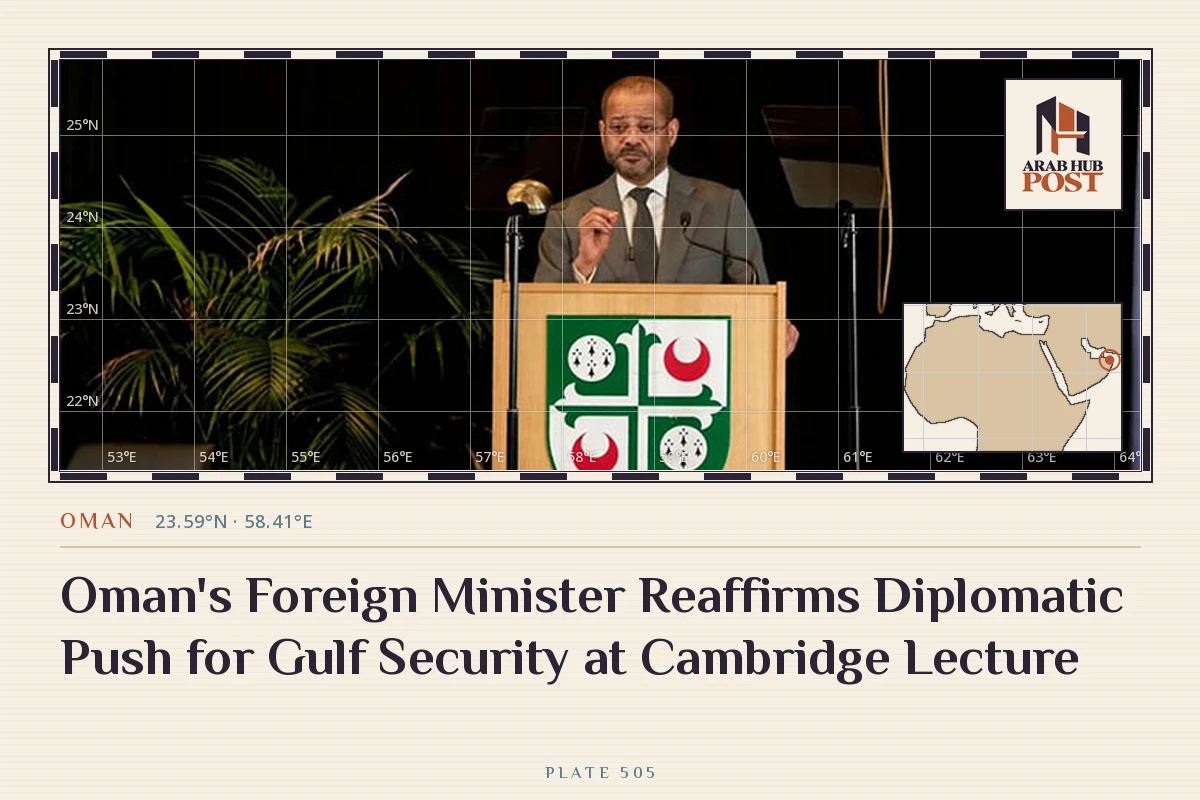
Oman’s Foreign Minister Sayyid Badr bin Hamad Al Busaidi has affirmed that the sultanate continues its diplomatic efforts to enhance security and stability in the Gulf region by facilitating dialogue, resolving conflicts, building trust, and advocating for a comprehensive regional security framework involving the eight Gulf littoral states. The minister made the remarks during a lecture titled “Comprehensive Security in the Gulf” at the University of Cambridge on Monday, which was attended by diplomats, experts, and academics specialising in foreign policy. Oman, located on the southeastern coast of the Arabian Peninsula, has historically played a mediating role in regional disputes.
Policy based on regional interdependence
Busaidi explained that Oman’s policy is founded on the understanding that its security depends on the security of its regional environment. This conviction, he said, drives the sultanate to continue outreach efforts with regional countries to settle disputes, preserve peace, and expand the scope of peace. He noted that Oman maintains peaceful relations with all its neighbours.
Facilitating US-Iran talks and Strait of Hormuz navigation
The foreign minister reviewed Oman’s role in facilitating negotiations between the United States and Iran over the past two years, aimed at reaching a settlement regarding the Iranian nuclear programme and ending decades of hostility. He asserted that the talks had made important progress and that an agreement was within reach of both parties. Busadi also referred to high-level talks and technical consultations with Iran concerning temporary arrangements to help ensure freedom of navigation through the Strait of Hormz. He stressed that implementing these arrangements requires a practical understanding between Iran and the United States, as well as a willingness from both sides to make concessions.
Call for new regional dialogue and non-aggression pact
The minister explained that recent negotiating experiences confirm the importance of regional states assuming responsibility for their own security rather than relying excessively on external powers. He called for launching a new regional dialogue encompassing the six Gulf Cooperation Council states, Iraq, and Iran to build a security system based on cooperation and mutual trust. Busadi recalled a 1976 initiative in Muscat when the foreign ministers of the eight Gulf littoral states met to discuss collective security arrangements, suggesting that reviving that ambition could open a more comprehensive regional track to address current challenges. He affirmed that Oman calls for a non-aggression pact among the eight states as a fundamental step toward sustainable regional security. External partnerships, he said, should transform into major economic investments with the eight states and play a supportive role, while giving priority to the collective responsibility of the region’s states in designing, developing, and implementing their security arrangements.

Reader comments
No comments on this report yet.