
Oman Hosts Conference on Language and Literature in Interdisciplinary Context
Published By Regional Desk
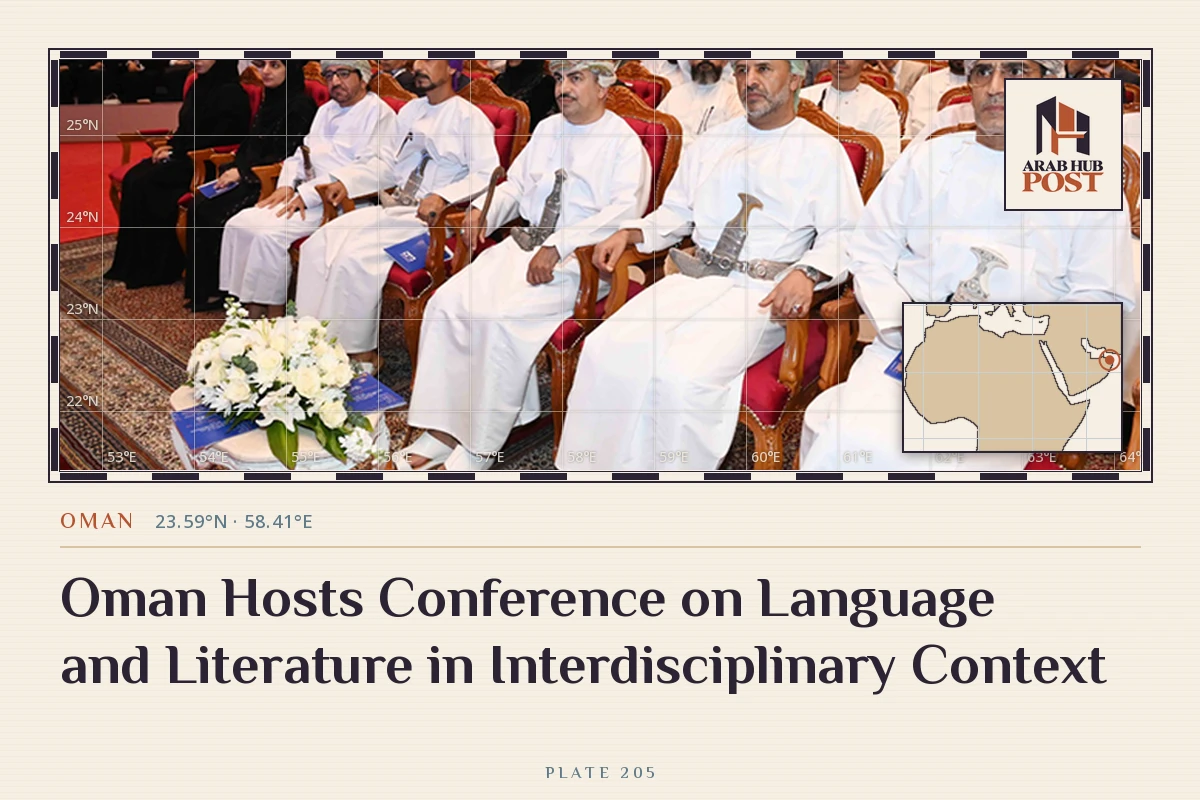
The sixth international scientific conference of the Department of Arabic Language and Literature at Sultan Qaboos University (SQU) began on Monday in Muscat. The three-day event, titled “Language and Literature in Light of Interdisciplinary Studies,” was opened under the patronage of Abdullah Nasser Al Harrasi, Minister of Information.
Conference Aims and Themes
Organised by SQU’s College of Arts and Social Sciences, the conference explores how language and literature can integrate with other scientific and humanities disciplines. Participants are discussing ways to develop curricula and research tools in Arabic studies by combining linguistic and literary heritage with modern knowledge, aiming to keep pace with scientific and technological changes while preserving the distinctiveness of Arabic sciences.
Speaking on behalf of the organising committee, Mohammed Sulaiman Al Omeiri said that interdisciplinary studies rely on building cognitive and methodological links between different scientific fields. This allows phenomena to be examined from multiple, integrated perspectives, leading to the creation of new knowledge that goes beyond the traditional boundaries of individual disciplines.
Al Omeiri stressed that the complexity and multi-layered nature of human phenomena require integrating different viewpoints while maintaining disciplinary precision and the uniqueness of each field’s tools. He described interdisciplinarity as an extension of specialised knowledge maturity and a response to questions that demand contributions from more than one scientific domain.
He noted that language and literature hold a central role in this cognitive interaction because language shapes concepts and organises human experience, while literature connects to imagination, memory, culture, history, cognition, and emotion. The conference, he said, calls for formulating joint research questions where evidence and methodologies combine to reach a more comprehensive interpretation of linguistic and literary phenomena.
The conference’s topics enable the convergence of linguistics, semiotics, pragmatics, and fresh perspectives on grammar, morphology, rhetoric, and criticism, Al Omeiri added. They also encourage openness to cognitive, neurological, psychological, and sociological knowledge, as well as computing and artificial intelligence. He underlined the need to distinguish between the general principles of reasoning and the specific procedures of each science.
Participants’ Perspectives
During the opening ceremony, a visual presentation was followed by a speech from participant Yahya Bahoun of the University of Ghardaïa in Algeria. He expressed the attendees’ gratitude to Sultan Qaboos University and the organising, scientific and administrative committees, praising the conference for providing opportunities for meeting, dialogue, and exchange of ideas and expertise.
Bahoun said the conference reflects a renewed awareness of the importance of openness among disciplines, and that the Arabic language serves as a space where the sciences of language, literature, history, philosophy, media and technology intersect. The conference’s themes, he added, combine heritage and contemporary studies, opening research paths that keep pace with scientific and technological developments while preserving the authenticity of Arabic and its civilisational standing.
He expressed hope that the proceedings would yield beneficial scientific results and contribute to ongoing communication and cooperation among researchers, as well as the development of curricula and disciplines, in service of science, knowledge and the Arabic language. The ceremony also included a poetry recitation.
Research Topics and Papers
The conference addresses nine themes examining the relationship of interdisciplinary studies with linguistics, pragmatics, semiotics, applied linguistics, grammar, morphology, rhetoric, criticism and acculturation, in addition to the theme of language, literature and artificial intelligence.
Research papers cover subjects linking linguistic and literary studies with various cognitive and applied fields. These include linguistic economy in leadership discourse and its impact on fulfilling responsibilities, features of cognitive imagery in the thought of Abdulqaher Al Jurjani, the conceptual structure among depression patients, and the pragmatics of functional discourse in ancient Arabic heritage.
In the field of artificial intelligence, papers address the transformations of literary and linguistic discourse and the limits of interaction between human creativity and automated text production. They also cover the use of smart technologies in evaluating Arabic writing, building treebanks for texts from eras of linguistic citation to support computational processing of Arabic, and studying the artistic and narrative characteristics of AI-generated stories.
The conference aims to enhance scientific dialogue among researchers, explore areas of mutual influence between Arabic and other sciences, and develop research tools in language and literature. It also seeks to discuss the potential for transitioning from individual studies to institutional partnerships and sustainable interdisciplinary research projects.
Additionally, the conference raises issues related to the controls for employing theories and concepts from various disciplines in the study of Arabic, the extent to which interdisciplinary studies affect the content and methodologies of disciplines, and ways to achieve cognitive integration while considering the civilisational context and characteristics of the Arabic language.
Reader comments
No comments on this report yet.